Monday, November 10, 2014

Book "The Adventure of the Three Students" by Sir Arthur Conan Doyle

About the Book: "The Adventure of the Three Students", one of the 56 Sherlock Holmes short stories written by the British author Sir Arthur Conan Doyle, is one of 13 stories in the cycle collected as The Return of Sherlock Holmes.
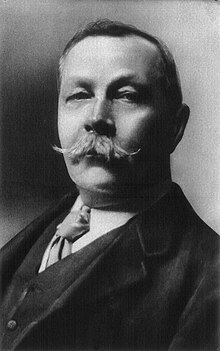
About the Author: Arthur Ignatius Conan Doyle was born on 22 May 1859 at 11 Picardy Place, Edinburgh, Scotland. From 1876 to 1881, he studied medicine at the University of Edinburgh, including a period working in the town of Aston (now a district of Birmingham) and in Sheffield, as well as in Shropshire at Ruyton-XI-Towns. While studying, Doyle began writing short stories. His earliest extant fiction, "The Haunted Grange of Goresthorpe", was unsuccessfully submitted to Blackwood's Magazine. His first published piece "The Mystery of Sasassa Valley", a story set in South Africa, was printed in Chambers's Edinburgh Journal on 6 September 1879. On 20 September 1879, he published his first non-fiction article, "Gelsemium as a Poison" in the British Medical Journal. In 1882 he joined former classmate George Turnavine Budd as his partner at a medical practice in Plymouth, but their relationship proved difficult, and Doyle soon left to set up an independent practice. Arriving in Portsmouth in June of that year with less than £10 (£900 today) to his name, he set up a medical practice at 1 Bush Villas in Elm Grove, Southsea. The practice was initially not very successful. While waiting for patients, Doyle again began writing stories and composed his first novels, The Mystery of Cloomber, not published until 1888, and the unfinished Narrative of John Smith, which would go unpublished until 2011. He amassed a portfolio of short stories including "The Captain of the Pole-Star" and "J. Habakuk Jephson's Statement", both inspired by Doyle's time at sea, the latter of which popularized the mystery of the Mary Celeste and added fictional details such as the perfect condition of the ship (which had actually taken on water by the time it was discovered) and its boats remaining on board (the one boat was in fact missing) that have come to dominate popular accounts of the incident. Doyle struggled to find a publisher for his work. His first significant piece, A Study in Scarlet, was taken by Ward Lock Co. on 20 November 1886, giving Doyle £25 for all rights to the story. The piece appeared later that year in the Beeton's Christmas Annual and received good reviews in The Scotsman and the Glasgow Herald. The story featured the first appearance of Watson and Sherlock Holmes, partially modeled after his former university teacher Joseph Bell. Doyle wrote to him, "It is most certainly to you that I owe Sherlock Holmes ... Round the center of deduction and inference and observation which I have heard you inculcate I have tried to build up a man." Robert Louis Stevenson was able, even in faraway Samoa, to recognize the strong similarity between Joseph Bell and Sherlock Holmes: "My compliments on your very ingenious and very interesting adventures of Sherlock Holmes. ... Can this be my old friend Joe Bell?" Other authors sometimes suggest additional influences—for instance, the famous Edgar Allan Poe character C. Auguste Dupin. A sequel to A Study in Scarlet was commissioned and The Sign of the Four appeared in Lippincott's Magazine in February 1890, under agreement with the Ward Lock company. Doyle felt grievously exploited by Ward Lock as an author new to the publishing world and he left them. Short stories featuring Sherlock Holmes were published in the Strand Magazine. Doyle first began to write for the 'Strand' from his home at 2 Upper Wimpole Street, now marked by a memorial plaque. In this period, however, Holmes was not his sole subject and in 1893, he collaborated with J.M. Barrie on the libretto of Jane Annie. Doyle was found clutching his chest in the hall of Windlesham Manor, his house in Crowborough, East Sussex, on 7 July 1930. He died of a heart attack at the age of 71. His last words were directed toward his wife: "You are wonderful." At the time of his death, there was some controversy concerning his burial place, as he was avowedly not a Christian, considering himself a Spiritualist. He was first buried on 11 July 1930 in Windlesham rose garden. He was later re-interred together with his wife in Minstead churchyard in the New Forest, Hampshire. Carved wooden tablets to his memory and to the memory of his wife are held privately and are inaccessible to the public. That inscription reads, "Blade straight / Steel true / Arthur Conan Doyle / Born May 22nd 1859 / Passed On 7th July 1930." The epitaph on his gravestone in the churchyard reads, in part: "Steel true/Blade straight/Arthur Conan Doyle/Knight/Patriot, Physician, and man of letters". Undershaw, the home near Hindhead, Haslemere, south of London, that Doyle had built and lived in between October 1897 and September 1907, was a hotel and restaurant from 1924 until 2004. It was then bought by a developer and stood empty while conservationists and Doyle fans fought to preserve it. In 2012 the High Court ruled that the redevelopment permission be quashed because proper procedure had not been followed. A statue honors Doyle at Crowborough Cross in Crowborough, where he lived for 23 years. There is also a statue of Sherlock Holmes in Picardy Place, Edinburgh, close to the house where Doyle was born.

My Review: In this story, Sherlock Holmes finds himself in a famous university town (probably either Oxford or Cambridge) when a tutor and lecturer of St Luke's College, Mr. Hilton Soames, brings him an interesting problem. Someone had been into Soames’s office and looked at the galley proofs of an exam he was going to give. Soames had gone to a friend’s for tea and locked his office. When he came back an hour later, he found a key in the lock. His servant, Bannister, forgot his key after he found Soames was gone for tea. Nevertheless, the proofs were found out of place, with one near the window, another on the floor, and the last still on the desk. Bannister swears that he did not touch the papers. Interestingly, Holmes can tell Soames which of the papers was in which place.
Soames’s desire is to uncover the cheater and prevent him from taking the exam, since it is for a sizeable scholarship. Fortunately there are only three students who will take the exam, all of which live above him in the same building.
Soames found other clues in his office: pencil shavings, a broken pencil lead, a clean, new cut in his new desk surface about three inches (7.5 cm) long, and a small hollow pyramidal blob of black clay speckled with sawdust. He could find no footmarks or other physical evidence.
Daulat Ras, one of the three students, had been to see Soames while the proofs were on his desk, but as far as Soames can recall, they were rolled up and likely would not have been recognizable as such. At Holmes' request,. Soames gives a brief outline of each of the three students. The first, Giles Gilchrist, is an athletic industrious scholar (in contrast to his father who squandered his fortune in horse racing); the second, Ras, is described as quiet and methodical; the third is Miles McLaren, a gifted man but thoroughly dissolute and given to gambling.
Holmes examines the office window from outside, standing on tiptoes to look in. Inside, there are no clues in the carpet. The cheater obviously took the papers over to the window one by one so that he could see Soames returning, but as it happens, he did not come back the usual way. When Soames came in, he was not aware of any hurried footsteps.
Holmes examines the blob of clay, and pays particular attention to the cut in the desk. This then leads him to ask where a nearby door leads. It is Soames’s bedroom. Upon examining that, Holmes finds another, similar, sawdust-speckled blob of clay. Then, he stuns Soames by telling him that the cheater, upon hearing his approach, hid in Soames’s bedroom. He was there, hiding behind a curtain, all the time that Soames was questioning Bannister.
Holmes questions Bannister and is apparently interested in the fact that anyone in the room could have got out after having entered with the key. He also asks Bannister why he sat several chairs away when he suddenly felt unwell at what had happened. Bannister will not venture a hypothesis as to a suspect.
Holmes decides to call on all three students. In Gilchrist’s room on the first floor, and Ras’s room on the second, Holmes cleverly contrives a ruse which will make it necessary for him to borrow a pencil, and a knife to sharpen his own. In neither case was there a promising clue to match evidence found in Soames’s room.
On the third floor, Miles McLaren is rude and will not let anyone in. Curiously, Holmes then asks Soames how tall McLaren is. Soames reckons McLaren’s height is about five foot six (165 cm), making him taller than Ras but much shorter than Gilchrist, who is quite tall, being a hurdler and a long-jumper.
Holmes has now deduced almost everything — all but Bannister’s rĂ´le in this business.
The next morning, the day of the exam, Holmes surprises Dr. Watson by showing him a third, identical, blob of clay. Holmes now knows everything. He confronts Bannister with the evidence. Bannister will not own up to anything, and insists that there was no-one in Soames’s office while he was there. Holmes, however, sends for Gilchrist, and proceeds to lay out his results.
The cheater was someone who knew the exam proofs were there. This could only be Gilchrist because the proofs’ whereabouts had been kept secret, and Gilchrist was the only one tall enough to have been able to look in through Soames’s window to see them there. Holmes has also identified the blobs as the special clay found in the long-jump pit, which is where the third one came from, further implicating Gilchrist. Gilchrist does not help his own position very much by reproaching Bannister for his apparent treachery. Bannister was indeed the one who covered for Gilchrist. He felt that he had to, for old times’ sake: Bannister was once Gilchrist’s father’s butler.
Other clues point to the solution:
The scratch on the desk was caused by Gilchrist’s spiked jumping shoes as he grabbed them in his haste; the scratch naturally pointed towards the bedroom, where he ran and hid;
Bannister had sat several chairs away to hide Gilchrist’s gloves, left on that chair;
Bannister was the one who let Gilchrist out of the now-locked room once Soames had left.
For his part, Gilchrist credits Bannister with convincing him not to profit from his misdeed, and presents Soames with a letter stating his wish not to sit the exam, but accept an offer in South Africa for the Rhodesian Police.
Excellent plot, I recommend this book to all readers that appreciate a very well written mystery.

Friday, November 7, 2014

Book "The Adventure of the Six Napoleons" by Sir Arthur Conan Doyle


http://bookscrier.com/the-adventure-of-the-six-napoleons


About the Book: "The Adventure of the Six Napoleons", one of the 56 Sherlock Holmes short stories written by British author Sir Arthur Conan Doyle, is one of 13 stories in the cycle collected as The Return of Sherlock Holmes.

About the Author: Arthur Ignatius Conan Doyle was born on 22 May 1859 at 11 Picardy Place, Edinburgh, Scotland. From 1876 to 1881, he studied medicine at the University of Edinburgh, including a period working in the town of Aston (now a district of Birmingham) and in Sheffield, as well as in Shropshire at Ruyton-XI-Towns. While studying, Doyle began writing short stories. His earliest extant fiction, "The Haunted Grange of Goresthorpe", was unsuccessfully submitted to Blackwood's Magazine. His first published piece "The Mystery of Sasassa Valley", a story set in South Africa, was printed in Chambers's Edinburgh Journal on 6 September 1879. On 20 September 1879, he published his first non-fiction article, "Gelsemium as a Poison" in the British Medical Journal. In 1882 he joined former classmate George Turnavine Budd as his partner at a medical practice in Plymouth, but their relationship proved difficult, and Doyle soon left to set up an independent practice. Arriving in Portsmouth in June of that year with less than £10 (£900 today) to his name, he set up a medical practice at 1 Bush Villas in Elm Grove, Southsea. The practice was initially not very successful. While waiting for patients, Doyle again began writing stories and composed his first novels, The Mystery of Cloomber, not published until 1888, and the unfinished Narrative of John Smith, which would go unpublished until 2011. He amassed a portfolio of short stories including "The Captain of the Pole-Star" and "J. Habakuk Jephson's Statement", both inspired by Doyle's time at sea, the latter of which popularized the mystery of the Mary Celeste and added fictional details such as the perfect condition of the ship (which had actually taken on water by the time it was discovered) and its boats remaining on board (the one boat was in fact missing) that have come to dominate popular accounts of the incident. Doyle struggled to find a publisher for his work. His first significant piece, A Study in Scarlet, was taken by Ward Lock Co. on 20 November 1886, giving Doyle £25 for all rights to the story. The piece appeared later that year in the Beeton's Christmas Annual and received good reviews in The Scotsman and the Glasgow Herald. The story featured the first appearance of Watson and Sherlock Holmes, partially modeled after his former university teacher Joseph Bell. Doyle wrote to him, "It is most certainly to you that I owe Sherlock Holmes ... Round the center of deduction and inference and observation which I have heard you inculcate I have tried to build up a man." Robert Louis Stevenson was able, even in faraway Samoa, to recognize the strong similarity between Joseph Bell and Sherlock Holmes: "My compliments on your very ingenious and very interesting adventures of Sherlock Holmes. ... Can this be my old friend Joe Bell?" Other authors sometimes suggest additional influences—for instance, the famous Edgar Allan Poe character C. Auguste Dupin. A sequel to A Study in Scarlet was commissioned and The Sign of the Four appeared in Lippincott's Magazine in February 1890, under agreement with the Ward Lock company. Doyle felt grievously exploited by Ward Lock as an author new to the publishing world and he left them. Short stories featuring Sherlock Holmes were published in the Strand Magazine. Doyle first began to write for the 'Strand' from his home at 2 Upper Wimpole Street, now marked by a memorial plaque. In this period, however, Holmes was not his sole subject and in 1893, he collaborated with J.M. Barrie on the libretto of Jane Annie. Doyle was found clutching his chest in the hall of Windlesham Manor, his house in Crowborough, East Sussex, on 7 July 1930. He died of a heart attack at the age of 71. His last words were directed toward his wife: "You are wonderful." At the time of his death, there was some controversy concerning his burial place, as he was avowedly not a Christian, considering himself a Spiritualist. He was first buried on 11 July 1930 in Windlesham rose garden. He was later re-interred together with his wife in Minstead churchyard in the New Forest, Hampshire. Carved wooden tablets to his memory and to the memory of his wife are held privately and are inaccessible to the public. That inscription reads, "Blade straight / Steel true / Arthur Conan Doyle / Born May 22nd 1859 / Passed On 7th July 1930." The epitaph on his gravestone in the churchyard reads, in part: "Steel true/Blade straight/Arthur Conan Doyle/Knight/Patriot, Physician, and man of letters". Undershaw, the home near Hindhead, Haslemere, south of London, that Doyle had built and lived in between October 1897 and September 1907, was a hotel and restaurant from 1924 until 2004. It was then bought by a developer and stood empty while conservationists and Doyle fans fought to preserve it. In 2012 the High Court ruled that the redevelopment permission be quashed because proper procedure had not been followed. A statue honors Doyle at Crowborough Cross in Crowborough, where he lived for 23 years. There is also a statue of Sherlock Holmes in Picardy Place, Edinburgh, close to the house where Doyle was born.

My Review: In this story, Inspector Lestrade of Scotland Yard brings Holmes a seemingly trivial problem about a man who shatters plaster busts of Napoleon. One was shattered in Morse Hudson’s shop, and two others, sold by Hudson to a Dr. Barnicot, were smashed after the doctor’s house and branch office had been burgled. Nothing else was taken. In the former case, the bust was taken outside before being broken.
Holmes knows that Lestrade’s theory about a Napoleon-hating lunatic must be wrong. The busts in question all came from the same mould. Why is he breaking them?
The next day, Lestrade calls Holmes to a house where there has been yet another bust-shattering, but there has also been a murder. Mr. Horace Harker found the dead man on his doorstep after investigating a noise. His Napoleon bust was also taken by a burglar entering through a window. It, too, was from the same mould. Also, a photograph of a rather apish-looking man is found in the dead man’s pocket.
The fragments of Harker's bust are in the front garden of an empty house up the street. Obviously the burglar wanted to see what he was doing, for there is a streetlamp here, whereas the bust could have been broken at another empty house nearer Harker’s, but it had been dark there.
Holmes tells Lestrade to tell Harker, a journalist for the Central Press Syndicate, that he is convinced that the culprit is a lunatic. Holmes knows that this is not true, but it is expedient to use the press to convince the culprit that this is what the investigators believe.
Holmes interviews the two shopkeepers who sold the busts and finds out whom they were sold to, and where they were made, Gelder & Co. A couple of his informants also recognize the apish man in the picture. They know him as Beppo, an Italian immigrant. He even worked in the shop where the first bust was broken, having left his job there only two days earlier.
Holmes goes to Gelder & Co. and finds out that the busts were part of a batch of six, but other than that, the manager can think of no reason why they should be special, or why anyone would want to destroy them. He recognizes Beppo’s picture, and describes him as a rascal. He was imprisoned for a street-fight stabbing a year earlier, but has likely been released now. He once worked at Gelder & Co., but has not been back. His cousin still works there. Holmes begs the manager not to talk to the cousin about Beppo.
That evening, Lestrade brings news that the dead man has been identified as Pietro Venucci, a Mafioso. Lestrade believes that Venucci was sent to kill Beppo, but wound up dead himself. Why is the Mafia after Beppo?
After sending an express message, Holmes invites Dr. Watson and Lestrade to join him outside a house in Chiswick where apparently Holmes is expecting another bust-breaking. Lestrade by now is exasperated with Holmes’s preoccupation with the busts, but comes. They are not disappointed. Beppo shows up, enters the house, and comes back out of the window minutes later with a Napoleon bust, which he proceeds to shatter. He then examines the pieces, quite unaware that Holmes and Lestrade are sneaking up behind him. They pounce, and Beppo is arrested. He will not talk, however.
The mystery is at last laid bare after Holmes offers £10 to the owner of the last existing bust, making him sign a document transferring all rights and ownership of the bust to Holmes. After the seller has left, Holmes smashes the bust and among the plaster shards is a gem, the black pearl of the Borgias. Holmes was aware of the case of its disappearance from the beginning. Suspicion had fallen on the owner’s maid, whose name was Lucretia Venucci – the dead man’s sister. Beppo somehow got the pearl from Pietro Venucci, and hid it inside a still-soft plaster bust at the factory where he worked, moments before his arrest for the street-fight stabbing.
After serving his one-year sentence, he sought to retrieve the hidden pearl. He found out from his cousin who bought the busts, and through his own efforts and confederates’, even found out who the end buyers were. He then proceeded to seek the busts out, smashing them one by one to find the pearl.
Although he appears in later published works, this is one of Lestrade's last appearances within the canon. After this he is only mentioned by Holmes or Watson, in "The Disappearance of Lady Frances Carfax" and "The Adventure of the Three Garridebs" as a working member of the Yard.
I recommend this book to all readers who appreciate a well written mystery story, mainly for those who love Sherlock Holmes.

Thursday, November 6, 2014

Book "The Adventure of Charles Augustus Milverton" by Sir Arthur Conan Doyle

About the Book: "The Adventure of Charles Augustus Milverton" is one of the 56 Sherlock Holmes short stories written by British author Sir Arthur Conan Doyle. It is one of 13 stories in the cycle collected as The Return of Sherlock Holmes and was published in 1904.


About the Author: Arthur Ignatius Conan Doyle was born on 22 May 1859 at 11 Picardy Place, Edinburgh, Scotland. From 1876 to 1881, he studied medicine at the University of Edinburgh, including a period working in the town of Aston (now a district of Birmingham) and in Sheffield, as well as in Shropshire at Ruyton-XI-Towns. While studying, Doyle began writing short stories. His earliest extant fiction, "The Haunted Grange of Goresthorpe", was unsuccessfully submitted to Blackwood's Magazine. His first published piece "The Mystery of Sasassa Valley", a story set in South Africa, was printed in Chambers's Edinburgh Journal on 6 September 1879. On 20 September 1879, he published his first non-fiction article, "Gelsemium as a Poison" in the British Medical Journal. In 1882 he joined former classmate George Turnavine Budd as his partner at a medical practice in Plymouth, but their relationship proved difficult, and Doyle soon left to set up an independent practice. Arriving in Portsmouth in June of that year with less than £10 (£900 today) to his name, he set up a medical practice at 1 Bush Villas in Elm Grove, Southsea. The practice was initially not very successful. While waiting for patients, Doyle again began writing stories and composed his first novels, The Mystery of Cloomber, not published until 1888, and the unfinished Narrative of John Smith, which would go unpublished until 2011. He amassed a portfolio of short stories including "The Captain of the Pole-Star" and "J. Habakuk Jephson's Statement", both inspired by Doyle's time at sea, the latter of which popularized the mystery of the Mary Celeste and added fictional details such as the perfect condition of the ship (which had actually taken on water by the time it was discovered) and its boats remaining on board (the one boat was in fact missing) that have come to dominate popular accounts of the incident. Doyle struggled to find a publisher for his work. His first significant piece, A Study in Scarlet, was taken by Ward Lock Co. on 20 November 1886, giving Doyle £25 for all rights to the story. The piece appeared later that year in the Beeton's Christmas Annual and received good reviews in The Scotsman and the Glasgow Herald. The story featured the first appearance of Watson and Sherlock Holmes, partially modeled after his former university teacher Joseph Bell. Doyle wrote to him, "It is most certainly to you that I owe Sherlock Holmes ... Round the center of deduction and inference and observation which I have heard you inculcate I have tried to build up a man." Robert Louis Stevenson was able, even in faraway Samoa, to recognize the strong similarity between Joseph Bell and Sherlock Holmes: "My compliments on your very ingenious and very interesting adventures of Sherlock Holmes. ... Can this be my old friend Joe Bell?" Other authors sometimes suggest additional influences—for instance, the famous Edgar Allan Poe character C. Auguste Dupin. A sequel to A Study in Scarlet was commissioned and The Sign of the Four appeared in Lippincott's Magazine in February 1890, under agreement with the Ward Lock company. Doyle felt grievously exploited by Ward Lock as an author new to the publishing world and he left them. Short stories featuring Sherlock Holmes were published in the Strand Magazine. Doyle first began to write for the 'Strand' from his home at 2 Upper Wimpole Street, now marked by a memorial plaque. In this period, however, Holmes was not his sole subject and in 1893, he collaborated with J.M. Barrie on the libretto of Jane Annie. Doyle was found clutching his chest in the hall of Windlesham Manor, his house in Crowborough, East Sussex, on 7 July 1930. He died of a heart attack at the age of 71. His last words were directed toward his wife: "You are wonderful." At the time of his death, there was some controversy concerning his burial place, as he was avowedly not a Christian, considering himself a Spiritualist. He was first buried on 11 July 1930 in Windlesham rose garden. He was later re-interred together with his wife in Minstead churchyard in the New Forest, Hampshire. Carved wooden tablets to his memory and to the memory of his wife are held privately and are inaccessible to the public. That inscription reads, "Blade straight / Steel true / Arthur Conan Doyle / Born May 22nd 1859 / Passed On 7th July 1930." The epitaph on his gravestone in the churchyard reads, in part: "Steel true/Blade straight/Arthur Conan Doyle/Knight/Patriot, Physician, and man of letters". Undershaw, the home near Hindhead, Haslemere, south of London, that Doyle had built and lived in between October 1897 and September 1907, was a hotel and restaurant from 1924 until 2004. It was then bought by a developer and stood empty while conservationists and Doyle fans fought to preserve it. In 2012 the High Court ruled that the redevelopment permission be quashed because proper procedure had not been followed. A statue honors Doyle at Crowborough Cross in Crowborough, where he lived for 23 years. There is also a statue of Sherlock Holmes in Picardy Place, Edinburgh, close to the house where Doyle was born.

My Review: I consider this one of the best short stories featuring Sherlock Holmes. In this story, Holmes is hired by the dĂ©butante Lady Eva Blackwell to retrieve compromising letters from a blackmailer: Milverton, who causes Holmes more revulsion than any of the 50-odd murderers in his career. Milverton is "the king of blackmailers" and he makes his living out of blackmail. He demands £7,000 (about £700,000 in 2010) for the letters, which would cause a scandal that would end Lady Eva's marriage engagement. Holmes offers £2,000, all Lady Eva can pay, but Milverton insists on £7,000. It is worth £2,000 to him to make an example of Lady Eva. Holmes resolves to recover the letters by whatever means necessary, as Milverton has placed himself outside the bounds of morality.
Holmes visits Milverton's Hampstead house, disguised as a plumber, in order to learn the plan of the house and Milverton's daily routine. He cultivates the acquaintance of Milverton's housemaid and even becomes engaged to marry her. This rather shocks Watson, but Holmes assures him that he has a hated rival who will step in when the plumber disappears. Holmes has learned where Milverton keeps his blackmail papers (a safe in his study), and plans to burgle Milverton's house that night. Watson comes along.
They break into the study, and Holmes opens the safe. But just then Milverton, who should be in bed asleep, enters the study. Holmes and Watson hide behind a curtain, while Milverton has a midnight meeting with a supposed maidservant offering to sell letters that would compromise her mistress.
The woman is actually one of Milverton's former victims, whose broken-hearted husband died when she wouldn't pay Milverton and he revealed her secret. Now she avenges her husband by shooting Milverton to death, then stamps on his face.
Watson instinctively begins to rush out and stop the shooting, but Holmes restrains him. Holmes understands, and Watson instantly realises, "that it was no affair of ours; that justice had overtaken a villain..." The woman runs away, and Milverton's household is roused by the shots. But Holmes takes the time to dump all of Milverton's blackmail papers on the fire in the fireplace, despite the risk of being discovered and caught.
Then Holmes and Watson escape through the garden and over the wall. Watson has to kick himself free from a pursuer who has grabbed his leg.
The next morning, Inspector Lestrade calls at Baker Street to ask for Holmes' help in investigating Milverton's murder, which he ascribes to the two burglars seen escaping over the garden wall. He has a description of one of them: "a middle-aged, strongly built man-square jaw, thick neck, moustache..." Holmes calls that vague. "Why, it might be a description of Watson!" he says, which amuses Lestrade. But Holmes refuses Lestrade's request: "my sympathies are with the criminals, and I will not handle the case."
Later, Holmes recognises the face of the woman who killed Milverton. He shows Watson her photograph displayed in a shop-window among those of other celebrities. Watson recognizes the name of her famous husband, but Holmes signals silence with a finger to his lips.
I recommend this book to all readers who appreciate a well written mystery story, mainly for those who love Sherlock Holmes.

Wednesday, November 5, 2014

Book "Time Before Time" by K.A.Manji

About the Book: Kronos wants what no one else has: a dinosaur. Unfortunately, the Podship he sends back in time to capture a dinosaur comes back empty, and the monkey-pilot dead. Another attempt will have to be made. But when evidence reveals his son, Jupiter, aiding and encouraging the striking miners on his moon colony, Kronos determines to separate Jupiter from the negotiations by sending him in the next Podship. Except Jupiter has his own intentions. His mother was killed thirty years ago. By using time travel he could save her. It would take only a moment. A blip in time. What’s done can be undone...right?

My Review: If you love time traveling stories, you will not be disappointed with this one.
The author develops a story in a future when time traveling is at its beginning and a man (Kronos) wants to use the new technology to bring back a dinosaur to his time, in order to exhibit it and become famous. His first trial fails, as he sends the time travel capsule with a monkey pilot, which returns dead...
Kronos owns a mining colony on the moon, which currently is on strike. When his son (Jupiter) fails to negotiate with the workers and starts sympathizing with them, he decides to send his son in the time travel adventure, together with his mistress (Anya) who is now pregnant, to hunt for the dinosaur. His plan is to get rid of both of them and he asks his chief scientist (Laszlo) to program the capsule for not returning. But his chief astrophysicist has plans of his own, including changing the past, preventing a murder to happen and even investing in the stock market, buying shares of his company for pennies before it becomes expensive. And he counts with the help of Jupiter to achieve his plan! But the end of the story is completely unpredictable. It is worth reading.
Very original story in a theme that is usually overloaded with poor new ideas, very well written, it will keep you entertained for hours.
I received this book from Inkspan for reviewing and I was not requested to provide a positive review. Opinion expressed here is my own.

Tuesday, November 4, 2014

Book "The Adventure of the Black Peter" by Sir Arthur Conan Doyle

About the Book: "The Adventure of Black Peter" is a Sherlock Holmes story by Arthur Conan Doyle. This tale is in the collection The Return of Sherlock Holmes, but was published originally in 1904 in the Strand Magazine and Collier's.

About the Author: Arthur Ignatius Conan Doyle was born on 22 May 1859 at 11 Picardy Place, Edinburgh, Scotland. From 1876 to 1881, he studied medicine at the University of Edinburgh, including a period working in the town of Aston (now a district of Birmingham) and in Sheffield, as well as in Shropshire at Ruyton-XI-Towns. While studying, Doyle began writing short stories. His earliest extant fiction, "The Haunted Grange of Goresthorpe", was unsuccessfully submitted to Blackwood's Magazine. His first published piece "The Mystery of Sasassa Valley", a story set in South Africa, was printed in Chambers's Edinburgh Journal on 6 September 1879. On 20 September 1879, he published his first non-fiction article, "Gelsemium as a Poison" in the British Medical Journal. In 1882 he joined former classmate George Turnavine Budd as his partner at a medical practice in Plymouth, but their relationship proved difficult, and Doyle soon left to set up an independent practice. Arriving in Portsmouth in June of that year with less than £10 (£900 today) to his name, he set up a medical practice at 1 Bush Villas in Elm Grove, Southsea. The practice was initially not very successful. While waiting for patients, Doyle again began writing stories and composed his first novels, The Mystery of Cloomber, not published until 1888, and the unfinished Narrative of John Smith, which would go unpublished until 2011. He amassed a portfolio of short stories including "The Captain of the Pole-Star" and "J. Habakuk Jephson's Statement", both inspired by Doyle's time at sea, the latter of which popularized the mystery of the Mary Celeste and added fictional details such as the perfect condition of the ship (which had actually taken on water by the time it was discovered) and its boats remaining on board (the one boat was in fact missing) that have come to dominate popular accounts of the incident. Doyle struggled to find a publisher for his work. His first significant piece, A Study in Scarlet, was taken by Ward Lock Co. on 20 November 1886, giving Doyle £25 for all rights to the story. The piece appeared later that year in the Beeton's Christmas Annual and received good reviews in The Scotsman and the Glasgow Herald. The story featured the first appearance of Watson and Sherlock Holmes, partially modeled after his former university teacher Joseph Bell. Doyle wrote to him, "It is most certainly to you that I owe Sherlock Holmes ... Round the center of deduction and inference and observation which I have heard you inculcate I have tried to build up a man." Robert Louis Stevenson was able, even in faraway Samoa, to recognize the strong similarity between Joseph Bell and Sherlock Holmes: "My compliments on your very ingenious and very interesting adventures of Sherlock Holmes. ... Can this be my old friend Joe Bell?" Other authors sometimes suggest additional influences—for instance, the famous Edgar Allan Poe character C. Auguste Dupin. A sequel to A Study in Scarlet was commissioned and The Sign of the Four appeared in Lippincott's Magazine in February 1890, under agreement with the Ward Lock company. Doyle felt grievously exploited by Ward Lock as an author new to the publishing world and he left them. Short stories featuring Sherlock Holmes were published in the Strand Magazine. Doyle first began to write for the 'Strand' from his home at 2 Upper Wimpole Street, now marked by a memorial plaque. In this period, however, Holmes was not his sole subject and in 1893, he collaborated with J.M. Barrie on the libretto of Jane Annie. Doyle was found clutching his chest in the hall of Windlesham Manor, his house in Crowborough, East Sussex, on 7 July 1930. He died of a heart attack at the age of 71. His last words were directed toward his wife: "You are wonderful." At the time of his death, there was some controversy concerning his burial place, as he was avowedly not a Christian, considering himself a Spiritualist. He was first buried on 11 July 1930 in Windlesham rose garden. He was later re-interred together with his wife in Minstead churchyard in the New Forest, Hampshire. Carved wooden tablets to his memory and to the memory of his wife are held privately and are inaccessible to the public. That inscription reads, "Blade straight / Steel true / Arthur Conan Doyle / Born May 22nd 1859 / Passed On 7th July 1930." The epitaph on his gravestone in the churchyard reads, in part: "Steel true/Blade straight/Arthur Conan Doyle/Knight/Patriot, Physician, and man of letters". Undershaw, the home near Hindhead, Haslemere, south of London, that Doyle had built and lived in between October 1897 and September 1907, was a hotel and restaurant from 1924 until 2004. It was then bought by a developer and stood empty while conservationists and Doyle fans fought to preserve it. In 2012 the High Court ruled that the redevelopment permission be quashed because proper procedure had not been followed. A statue honors Doyle at Crowborough Cross in Crowborough, where he lived for 23 years. There is also a statue of Sherlock Holmes in Picardy Place, Edinburgh, close to the house where Doyle was born.

My Review: This is a good story with a nice plot: Forest Row in the Weald is the scene of a gruesome harpoon murder, and a young police inspector, Stanley Hopkins, asks Holmes, whom he admires, for help. Holmes has already determined that it would take a great deal of strength and skill to run a man through with a harpoon and embed it in the wall behind him.
Peter Carey, the 50-year-old victim and former master of the Sea Unicorn of Dundee, was a most unpleasant man, especially when he was drunk. He had a reputation for being violent, even having been prosecuted once for assaulting the local vicar. His daughter is actually glad that he is dead. She and her mother have endured years of abuse from the old whaler and sealer, who moreover had some remarkably peculiar habits. He did not sleep in the family house, but in an outhouse that he built some distance from the house, and which he decorated to look like a sailor’s cabin on a ship. This is where he was found harpooned. Hopkins could find no footprints or other physical evidence.
A tobacco pouch was, however, found at the scene, made of sealskin and with the initials “P. C.”, and also full of strong ship’s tobacco. This is curious, as Peter Carey — Black Peter as people called him — seldom smoked. Indeed, Hopkins found no pipe in the cabin.
The only clue from an eyewitness comes from a stonemason named Slater, who says that he saw the shadow of a head on the blind in one of Carey’s cabin windows, and he is sure that it was not Carey. The next day, Carey was in his foulest mood, and then early the next morning, at about two o’clock, his daughter heard a scream from the direction of the cabin, but took no notice. Carey often screamed when he was drunk. The murder was not discovered until about midday, when the ladies summoned enough courage to look in on him. Hopkins was soon on the scene.
Carey was fully dressed, suggesting that he was expecting a visit, and there was some rum laid out along with two dirty glasses. There were brandy and whisky, too, but neither had been touched. There was also a knife in its sheath at the dead man’s feet. Mrs. Carey has identified it as her husband’s.
A little notebook was found at the scene. It contains the initials J. H. N. and the year 1883. It also says C. P. R. on the second page, which Holmes reckons stands for Canadian Pacific Railway. The first set of initials is likely a stockbroker’s, as the little book is full of what appears to be stock exchange information.
Holmes decides to accompany Hopkins to Forest Row, and upon arrival, Hopkins observes that someone has tried to break into Carey’s cabin, but failed. Holmes believes that the burglar will likely try again, this time bringing a more useful tool for the job.
After examining the inside of the cabin, Holmes observes from the lack of dust that something has been taken from a shelf, even though the burglar did not get in. It was a book, or possibly a box.
Holmes, Dr. Watson, and Hopkins all lie in wait for the burglar that night, and they are not disappointed. Along he comes, he breaks into the cabin, and goes through one of Carey’s old logbooks, cursing when he finds that the information that he wants is missing, having been torn out of the book. As he is leaving the cabin, Hopkins moves in and arrests him.
He is John Hopley Neligan — which matches the initials in the notebook — the son of a long-vanished, failed banker. He claims he was looking at Carey’s logs to test a theory of his. His father disappeared with a box full of securities after his bank failed. He took them on a yacht bound for Norway. He believes that his father’s boat may have been driven north on the North Sea by bad weather, and met the Sea Unicorn, captained by Carey. He believes that Carey knew something about his father’s disappearance, and that possibly his father was murdered by the man who has now himself become a murder victim as he has traced some of his father's long lost securities back to Carey.
Hopkins takes Neligan off to the station, even though Neligan swears that he has nothing to do with the murder. Holmes believes this to be true. Neligan is, after all, a slight, thin man, hardly capable of running a man through with a harpoon. Furthermore, that kind of attack requires a practiced wielder such as a professional harpooner.
Holmes saves Neligan from the noose by finding the true killer in a most unusual way. He advertises for a harpooner, posing as a sea captain named Basil. He gets three applicants at 221B Baker Street for the job, and one of them is indeed Peter Carey’s killer, as confirmed by his name, Patrick Cairns (the tobacco pouch was his, not Carey’s), and the fact that Holmes had established that he was once Carey’s shipmate. Holmes also felt sure that a murderer would want to leave the country for a while.
Holmes handcuffs Cairns unawares, but the latter furiously denies that he murdered Carey, claiming self-defence, as Carey was reaching for his knife. He was actually at Carey’s cabin to extort hush money from him. Neligan’s father had indeed come aboard the Sea Unicorn with his tin box of securities, and Carey had murdered him by throwing him overboard while no-one was looking (but actually, Cairns had seen). Carey did not take kindly to being forced in this way by his old subordinate, prompting Cairns to take the action that he did after Carey draws a knife on Cairns..
The rum was another clue. Holmes was sure that it, and the fact that the brandy and whiskey had been left alone, were sure signs that the murderer was a seaman.
Neligan is released and the securities returned to him-although those Carey had sold cannot be recovered.
I recommend this book to all readers who appreciate a well written mystery story, mainly for those who love Sherlock Holmes.

Monday, November 3, 2014

Book "The Book of Zev" by Marilyn Ida Horowitz

About the Book: The Book of Zev is a black-comedy thriller that tells the story of two gentle people who change the course of history. Zev Bronfman, a strapping 32-year old-virgin, angry atheist, refugee from a religious Jewish life, and former engineer for the U.S. Patent Office in Alexandria, Virginia, drives a cab and sleeps around in New York City. After a bitter divorce, Sarah Hirshbaum, a beautiful, redheaded, depressed, God-hating kosher chef, seesaws between yoga and too much red wine. Independently, the two consult the same psychic who inadvertently sends Sarah Zev’s session tape. When Sarah contacts Zev to pick up the recording, a series of events forces them to connect with a powerful terrorist in order to thwart his plans to destroy the UN and Israel.

About the Author: Marilyn Horowitz is a Manhattan based writing teacher and award winning professor at New York University, author, and producer, as well as a judge for the prestigious Fulbright Scholarship Program for film and media. Marilyn has also lectured and served on panels at many groups and conferences including: Writers Guild of America East, Philadelphia Writer’s Conference, Great American Pitchfest, Screenwriting Expo and Author101. She is featured in Now Write! Screenwriting anthology published by Tarcher/Penguin edited by Sherry Ellis. She has written several feature-length screenplays. Her production credits include the feature films And Then Came Love (2007), starring Vanessa Williams and distributed by Warner Bros., Caleb’s Door (2009), distributed by Around the Scenes, Found in Time (2011), Nocturnal Agony (2011), and The One (2011).

My Review: This is a very well written book with a very entertaining plot. 
Zev is a 32 year old man still living with his parents and working for U.S.Patent Office. He was raised in the best Jewish tradition and a near death experience makes him rethink his values and his life. Also a psychic experience that makes him act and save the life a child has a deep impact upon him. 
Sarah is a gorgeous kosher chef that is coming from a divorce. She also has Jewish roots and also question God in her own way. 
When Zev moves to NY to drive a cab and to change his life style, going away from his Jewish family, he met Sarah by accident and the story evolves in a high intensity thriller. While they are trying to stay away from God, He has other plans for both of them, like saving the United Nation and Israel from complete destruction. So, nothing happens by accident!
With a superb analysis of the psychological minds of the characters, the author manages to bring to life an incredible thriller that will keep the reader at the edge of his/her seat for most of the book. Be aware that you might loose your whole night for not being able to stop reading this wonderful novel.
Definitely one of the best books I have read this year. Kudos to the author for this magnificent work!
I received this book from the author for reviewing and I was not requested to post a positive review. Opinion expressed here is my own.

If you read this review, feel free to leave a comment.


Friday, October 31, 2014

Balance of October, 2014

During the month of October, I reviewed the following:

Books:
- "The Adventure of the Greek Interpreter" by Sir Arthur Conan Doyle. Read my review.
- "The Naval Treaty" by Sir Arthur Conan Doyle. Read my review.
- "Transoceanic Lights" by Sui Li. Read my review.
- "A Charge of Valor" by Morgan Rice. Read my review.
- "The Final Problem" by Sir Arthur Conan Doyle. Read my review.
- "The Adventure of the Empty House" by Sir Arthur Conan Doyle. Read my review.
- "Gameland - Episode 7 - Tag, You're Dead" by Saul W. Tanpepper. Read my review.
- "The Adventure of the Norwook Builder" by Sir Arthur Conan Doyle. Read my review.
- "Dracengard" by Christopher Vale. Read my review.
- "The Adventure of the Dancing Men" by Sir Arthur Conan Doyle. Read my review.
- "The Adventure of the Solitary Cyclist" by Sir Arthur Conan Doyle. Read my review.
- "Gameland - Episode 8 - Jacker's Code" by Saul W.Tanpepper. Read my review.
- "The Adventure of the Priory School" by Sir Arthur Conan Doyle. Read my review.

Wednesday, October 22, 2014

Book "The Adventure of the Priory School" by Sir Arthur Conan Doyle

About the Book: "The Adventure of the Priory School", one of the 56 Sherlock Holmes short stories written by British author Sir Arthur Conan Doyle, is one of 13 stories in the cycle collected as The Return of Sherlock Holmes. Doyle ranked "The Adventure of the Priory School" tenth in his list of his twelve favorite Holmes stories.

About the Author: Arthur Ignatius Conan Doyle was born on 22 May 1859 at 11 Picardy Place, Edinburgh, Scotland. From 1876 to 1881, he studied medicine at the University of Edinburgh, including a period working in the town of Aston (now a district of Birmingham) and in Sheffield, as well as in Shropshire at Ruyton-XI-Towns. While studying, Doyle began writing short stories. His earliest extant fiction, "The Haunted Grange of Goresthorpe", was unsuccessfully submitted to Blackwood's Magazine. His first published piece "The Mystery of Sasassa Valley", a story set in South Africa, was printed in Chambers's Edinburgh Journal on 6 September 1879. On 20 September 1879, he published his first non-fiction article, "Gelsemium as a Poison" in the British Medical Journal. In 1882 he joined former classmate George Turnavine Budd as his partner at a medical practice in Plymouth, but their relationship proved difficult, and Doyle soon left to set up an independent practice. Arriving in Portsmouth in June of that year with less than £10 (£900 today) to his name, he set up a medical practice at 1 Bush Villas in Elm Grove, Southsea. The practice was initially not very successful. While waiting for patients, Doyle again began writing stories and composed his first novels, The Mystery of Cloomber, not published until 1888, and the unfinished Narrative of John Smith, which would go unpublished until 2011. He amassed a portfolio of short stories including "The Captain of the Pole-Star" and "J. Habakuk Jephson's Statement", both inspired by Doyle's time at sea, the latter of which popularized the mystery of the Mary Celeste and added fictional details such as the perfect condition of the ship (which had actually taken on water by the time it was discovered) and its boats remaining on board (the one boat was in fact missing) that have come to dominate popular accounts of the incident. Doyle struggled to find a publisher for his work. His first significant piece, A Study in Scarlet, was taken by Ward Lock Co. on 20 November 1886, giving Doyle £25 for all rights to the story. The piece appeared later that year in the Beeton's Christmas Annual and received good reviews in The Scotsman and the Glasgow Herald. The story featured the first appearance of Watson and Sherlock Holmes, partially modeled after his former university teacher Joseph Bell. Doyle wrote to him, "It is most certainly to you that I owe Sherlock Holmes ... Round the center of deduction and inference and observation which I have heard you inculcate I have tried to build up a man." Robert Louis Stevenson was able, even in faraway Samoa, to recognize the strong similarity between Joseph Bell and Sherlock Holmes: "My compliments on your very ingenious and very interesting adventures of Sherlock Holmes. ... Can this be my old friend Joe Bell?" Other authors sometimes suggest additional influences—for instance, the famous Edgar Allan Poe character C. Auguste Dupin. A sequel to A Study in Scarlet was commissioned and The Sign of the Four appeared in Lippincott's Magazine in February 1890, under agreement with the Ward Lock company. Doyle felt grievously exploited by Ward Lock as an author new to the publishing world and he left them. Short stories featuring Sherlock Holmes were published in the Strand Magazine. Doyle first began to write for the 'Strand' from his home at 2 Upper Wimpole Street, now marked by a memorial plaque. In this period, however, Holmes was not his sole subject and in 1893, he collaborated with J.M. Barrie on the libretto of Jane Annie. Doyle was found clutching his chest in the hall of Windlesham Manor, his house in Crowborough, East Sussex, on 7 July 1930. He died of a heart attack at the age of 71. His last words were directed toward his wife: "You are wonderful." At the time of his death, there was some controversy concerning his burial place, as he was avowedly not a Christian, considering himself a Spiritualist. He was first buried on 11 July 1930 in Windlesham rose garden. He was later re-interred together with his wife in Minstead churchyard in the New Forest, Hampshire. Carved wooden tablets to his memory and to the memory of his wife are held privately and are inaccessible to the public. That inscription reads, "Blade straight / Steel true / Arthur Conan Doyle / Born May 22nd 1859 / Passed On 7th July 1930." The epitaph on his gravestone in the churchyard reads, in part: "Steel true/Blade straight/Arthur Conan Doyle/Knight/Patriot, Physician, and man of letters". Undershaw, the home near Hindhead, Haslemere, south of London, that Doyle had built and lived in between October 1897 and September 1907, was a hotel and restaurant from 1924 until 2004. It was then bought by a developer and stood empty while conservationists and Doyle fans fought to preserve it. In 2012 the High Court ruled that the redevelopment permission be quashed because proper procedure had not been followed. A statue honors Doyle at Crowborough Cross in Crowborough, where he lived for 23 years. There is also a statue of Sherlock Holmes in Picardy Place, Edinburgh, close to the house where Doyle was born.

My Review: In this story, Holmes receives a visit from Dr. Thorneycroft Huxtable, the founder and principal of a preparatory school called Priory School in Northern England. He beseeches Holmes to come back to Mackleton with him to look into the kidnapping of one of his pupils.
The boy's father, the Duke of Holdernesse, has offered a reward of £5000 to anyone who can tell him where his son, the ten-year-old Lord Saltire, is, and a further £1000 to anyone who can tell him who his kidnappers are.
James Wilder, the Duke's personal secretary, has also been indiscreet enough to mention something to Huxtable about the young Lord's unhappy home life. His parents no longer live together, his mother having moved to Southern France. Wilder has said that Lord Saltire's sympathies were with his mother in these matters. Upon arrival at the school, though, Lord Saltire seemed to be quite happy, and in his element.
Less than a fortnight later, however, he suddenly disappeared from the school. He could only have left by climbing out of his window at night and down the thick ivy to the ground. Curiously, the German master, Heidegger, is also missing, along with his bicycle. Lord Saltire had received a letter that very day from his father, but Huxtable has no idea of the contents. The boy has taken it with him. He was fully dressed, too. However, Heidegger left his shirt and socks behind.
Holmes decides to accompany Huxtable back to Mackleton, even though he is quite busy with business in London. He tells Huxtable first that if he is going to telegraph home, it would be wise to let the rumor of progress in Liverpool persist.
Once in the North, Holmes asks the Duke a few questions. His Grace does not think that his estranged wife has anything to do with his son's disappearance, nor has there been a ransom demand. He can also think of nothing in the letter that he wrote, posted by James Wilder along with dozens of others, that could have upset Lord Saltire.
Holmes establishes that the boy and his kidnappers could not have used the nearby road without being seen, suggesting that they went cross-country. As if to confirm this, the police find the boy's school cap in some gypsies' possession. They swear that they simply found it on the moor, but the police lock them up.
Holmes and Dr. Watson go hunting for clues. They find a bicycle track, but it is not Heidegger's; it does not match his tires. Holmes observes, however, that one tire has a patch on it. Most anything observable has been obliterated by cow tracks, making sleuthing rather difficult. Indeed, the only marks on the ground anywhere nearby are cows' hoof prints.
Eventually, Heidegger's bicycle tracks are found, and they end where he apparently had his head smashed in. There he lies, quite dead.
A number of things may already be deduced:
  • Lord Saltire left the school of his own free will;
  • Heidegger hurriedly went after him, having seen him climb down, which explains his less than complete dress;
  • The boy had a swift means of escape, for Heidegger would not have bothered with his bicycle if the boy had been on foot;
  • The boy had an adult companion, for he himself could not have smashed Heidegger's head in;
  • No other cyclist, nor another man on foot could have anything to do with the murder, for there are no marks on the ground to indicate this;

Something caused the boy to leave school at night, either homesickness (unlikely) or the letter he was mentioned to have received.
Holmes and Watson find themselves at the Fighting Cock Inn, and meet the innkeeper, Reuben Hayes, who seems startled indeed to hear that Holmes wants to go to Holdernesse Hall, the Duke's nearby house, to tell him news of his son. The two men have lunch there, and Holmes suddenly realizes something: He and Watson saw lots of cow tracks out on the moor, all along their line of investigation, but never at any time did they see any cows. Furthermore, the patterns of the hoof prints were quite unusual, suggesting that the cow in question walked, cantered, and galloped – very unusual behavior for a cow. Holmes and Watson sneak out to Hayes's stable and examine the horse's hooves. As Holmes has expected, there is evidence of recent shoeing, but with old shoes and new nails. Examining the nearby smithy, Holmes and Watson are rather belligerently asked to leave by Mr. Hayes. A short way down the road towards the Duke's house, Watson tells Holmes that he is convinced that Hayes knows all about the sordid business at hand.
Shortly afterwards, the two men hide as a cyclist comes along the road from the direction of the Duke's. It is James Wilder, and he looks agitated. He arrives at the inn. Soon afterwards, a trap pulls out of the stable yard and goes along the road towards Chesterfield. A while later, someone else – it is getting dark and only a fleeting glimpse of the new visitor is caught – arrives at the inn.
Coming closer, Holmes observes Wilder's bicycle tires and notes that they are the same make as the first ones encountered on the moor, and as expected, one tire has a patch. Holmes uses Watson as a stepladder to have a look at the meeting. His look is very brief, and then they leave.
The next morning, they go to Holdernesse Hall, where they find that the Duke is not at all well. Nevertheless, Holmes demands from him a check for £6000, saying that he has earned the reward. His son is at the Fighting Cock, and the accused is the Duke himself.
Holmes has not, however, deduced the whole story. He has found Lord Saltire, and seen the Duke with him while standing on Watson's shoulders, but the actual mastermind of this crime is James Wilder. He conceived a plan to kidnap Lord Saltire to force the Duke to change his will. Wilder has always felt cheated, because he is, as it turns out, the Duke's son, born out of wedlock to the Duke's late lover, before he married the Duchess, who bore the Duke a legitimate heir. Wilder knew very well that his father would not call the police on him, as he abhorred the very idea of scandal. The plan began to unravel when Wilder hired Hayes – who has now fled, but been caught on Holmes's information – to do the actual kidnapping. Hayes killed Heidegger, and when Wilder heard the news, he confessed all to his father. So anxious was the Duke to avoid scandal, he agreed to let his younger son stay at the inn for another three days, and to keep quiet, so that Hayes could flee justice.
All ends well, except for Hayes, who faces the gallows. Lord Saltire is brought home from the inn and the Duke writes to his estranged wife asking her to reconcile with him. This he feels she will be willing to do, for the source of the friction between them is going away: James Wilder is being packed off to Australia to seek his fortune there.
As for the cow tracks, they were accomplished by shoeing the horses with special shoes shaped like cow's hooves.
An splendid plot, I recommend this story to any reader that appreciates a very well written mystery.