Showing posts with label X. Show all posts

Monday, June 1, 2015

Book "The Problem of the Thor Bridge" by Sir Arthur Conan Doyle


About the Book: "The Problem of Thor Bridge" is a Sherlock Holmes murder mystery by Arthur Conan Doyle in The Case-Book of Sherlock Holmes, first published in 1922 from Strand Magazine.
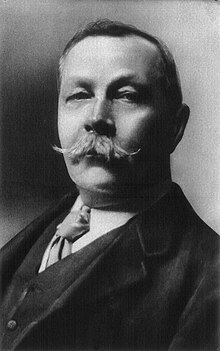
About the Author: Arthur Ignatius Conan Doyle was born on 22 May 1859 at 11 Picardy Place, Edinburgh, Scotland. From 1876 to 1881, he studied medicine at the University of Edinburgh, including a period working in the town of Aston (now a district of Birmingham) and in Sheffield, as well as in Shropshire at Ruyton-XI-Towns. While studying, Doyle began writing short stories. His earliest extant fiction, "The Haunted Grange of Goresthorpe", was unsuccessfully submitted to Blackwood's Magazine. His first published piece "The Mystery of Sasassa Valley", a story set in South Africa, was printed in Chambers's Edinburgh Journal on 6 September 1879. On 20 September 1879, he published his first non-fiction article, "Gelsemium as a Poison" in the British Medical Journal. In 1882 he joined former classmate George Turnavine Budd as his partner at a medical practice in Plymouth, but their relationship proved difficult, and Doyle soon left to set up an independent practice. Arriving in Portsmouth in June of that year with less than £10 (£900 today) to his name, he set up a medical practice at 1 Bush Villas in Elm Grove, Southsea. The practice was initially not very successful. While waiting for patients, Doyle again began writing stories and composed his first novels, The Mystery of Cloomber, not published until 1888, and the unfinished Narrative of John Smith, which would go unpublished until 2011. He amassed a portfolio of short stories including "The Captain of the Pole-Star" and "J. Habakuk Jephson's Statement", both inspired by Doyle's time at sea, the latter of which popularized the mystery of the Mary Celeste and added fictional details such as the perfect condition of the ship (which had actually taken on water by the time it was discovered) and its boats remaining on board (the one boat was in fact missing) that have come to dominate popular accounts of the incident. Doyle struggled to find a publisher for his work. His first significant piece, A Study in Scarlet, was taken by Ward Lock Co. on 20 November 1886, giving Doyle £25 for all rights to the story. The piece appeared later that year in the Beeton's Christmas Annual and received good reviews in The Scotsman and the Glasgow Herald. The story featured the first appearance of Watson and Sherlock Holmes, partially modeled after his former university teacher Joseph Bell. Doyle wrote to him, "It is most certainly to you that I owe Sherlock Holmes ... Round the center of deduction and inference and observation which I have heard you inculcate I have tried to build up a man." Robert Louis Stevenson was able, even in faraway Samoa, to recognize the strong similarity between Joseph Bell and Sherlock Holmes: "My compliments on your very ingenious and very interesting adventures of Sherlock Holmes. ... Can this be my old friend Joe Bell?" Other authors sometimes suggest additional influences—for instance, the famous Edgar Allan Poe character C. Auguste Dupin. A sequel to A Study in Scarlet was commissioned and The Sign of the Four appeared in Lippincott's Magazine in February 1890, under agreement with the Ward Lock company. Doyle felt grievously exploited by Ward Lock as an author new to the publishing world and he left them. Short stories featuring Sherlock Holmes were published in the Strand Magazine. Doyle first began to write for the 'Strand' from his home at 2 Upper Wimpole Street, now marked by a memorial plaque. In this period, however, Holmes was not his sole subject and in 1893, he collaborated with J.M. Barrie on the libretto of Jane Annie. Doyle was found clutching his chest in the hall of Windlesham Manor, his house in Crowborough, East Sussex, on 7 July 1930. He died of a heart attack at the age of 71. His last words were directed toward his wife: "You are wonderful." At the time of his death, there was some controversy concerning his burial place, as he was avowedly not a Christian, considering himself a Spiritualist. He was first buried on 11 July 1930 in Windlesham rose garden. He was later re-interred together with his wife in Minstead churchyard in the New Forest, Hampshire. Carved wooden tablets to his memory and to the memory of his wife are held privately and are inaccessible to the public. That inscription reads, "Blade straight / Steel true / Arthur Conan Doyle / Born May 22nd 1859 / Passed On 7th July 1930." The epitaph on his gravestone in the churchyard reads, in part: "Steel true/Blade straight/Arthur Conan Doyle/Knight/Patriot, Physician, and man of letters". Undershaw, the home near Hindhead, Haslemere, south of London, that Doyle had built and lived in between October 1897 and September 1907, was a hotel and restaurant from 1924 until 2004. It was then bought by a developer and stood empty while conservationists and Doyle fans fought to preserve it. In 2012 the High Court ruled that the redevelopment permission be quashed because proper procedure had not been followed. A statue honors Doyle at Crowborough Cross in Crowborough, where he lived for 23 years. There is also a statue of Sherlock Holmes in Picardy Place, Edinburgh, close to the house where Doyle was born.
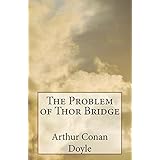
My Review: In this story, Neil Gibson, the Gold King and former Senator for "some Western state", approaches Holmes to investigate the murder of his wife Maria in order to clear his children's governess, Grace Dunbar, of the crime. It soon emerges that Mr. Gibson's marriage had been unhappy and he treated his wife very badly. He had fallen in love with her when he met her in Brazil, but soon realised they had nothing in common. He became attracted to Miss Dunbar; since he could not marry her, he had attempted to please her in other ways, such as trying to help people less fortunate than himself.
Maria Gibson was found lying in a pool of blood on Thor Bridge with a bullet through the head and note from the governess, agreeing to a meeting at that location, in her hand. A recently discharged revolver with one shot fired is found in Miss Dunbar's wardrobe. Holmes agrees to look at the situation in spite of the damning evidence.
From the outset, Holmes observes some rather odd things about the case. How could Miss Dunbar so coolly and rationally have planned and carried out the murder and then carelessly tossed the murder weapon into her wardrobe? What was the strange chip on the underside of the bridge's stone balustrade? Why was Mrs. Gibson clutching the note from Miss Dunbar when she died? If the murder weapon was one of a matched pair of pistols, why couldn't the other one be found in Mr. Gibson's collection?
Holmes uses his powers of deduction to solve the crime, and demonstrates, using Watson's revolver, how it was perpetrated: Mrs Gibson, outraged and jealous of Miss Dunbar's relationship with her husband, resolved to end her own life and frame her rival for the crime. After arranging a meeting with Miss Dunbar, requesting her to leave her response in a note, Mrs Gibson tied a rock on a piece of string to the end of a revolver, and shot herself, the rock pulling the revolver over the side of the bridge; the revolver found in Miss Dunbar's wardrobe was the other pistol of the pair, which had been fired off in the woods earlier, and the chip in the bridge was caused by the pistol hitting the stonework as it was pulled off by the rock. Holmes's reconstruction using Watson's revolver reproduces the damage to the balustrade of the bridge. He asks the police to drag the lake for the revolvers of Watson and Gibson.
Excellent plot, I recommend this book to all readers that appreciate a well written mystery short story.

Tuesday, January 27, 2015

Book "His Last Bow" by Sir Arthur Conan Doyle


About the Book: "His Last Bow", published in September 1917, is one of 56 short stories about Sherlock Holmes written by Sir Arthur Conan Doyle. It was first published in Strand Magazine, and, amongst six other stories, was collected in an anthology titled His Last Bow, also called Reminiscensces of Mr. Sherlock Holmes. The narration is in the third person, not, as usual, by Dr. Watson, and it is a spy story, rather than a murder mystery. Due to its portrayal of British and German spies, its publication during the First World War and its patriotic themes, the story has been interpreted as a propaganda tool intended to boost morale for British readers.

About the Author: Arthur Ignatius Conan Doyle was born on 22 May 1859 at 11 Picardy Place, Edinburgh, Scotland. From 1876 to 1881, he studied medicine at the University of Edinburgh, including a period working in the town of Aston (now a district of Birmingham) and in Sheffield, as well as in Shropshire at Ruyton-XI-Towns. While studying, Doyle began writing short stories. His earliest extant fiction, "The Haunted Grange of Goresthorpe", was unsuccessfully submitted to Blackwood's Magazine. His first published piece "The Mystery of Sasassa Valley", a story set in South Africa, was printed in Chambers's Edinburgh Journal on 6 September 1879. On 20 September 1879, he published his first non-fiction article, "Gelsemium as a Poison" in the British Medical Journal. In 1882 he joined former classmate George Turnavine Budd as his partner at a medical practice in Plymouth, but their relationship proved difficult, and Doyle soon left to set up an independent practice. Arriving in Portsmouth in June of that year with less than £10 (£900 today) to his name, he set up a medical practice at 1 Bush Villas in Elm Grove, Southsea. The practice was initially not very successful. While waiting for patients, Doyle again began writing stories and composed his first novels, The Mystery of Cloomber, not published until 1888, and the unfinished Narrative of John Smith, which would go unpublished until 2011. He amassed a portfolio of short stories including "The Captain of the Pole-Star" and "J. Habakuk Jephson's Statement", both inspired by Doyle's time at sea, the latter of which popularized the mystery of the Mary Celeste and added fictional details such as the perfect condition of the ship (which had actually taken on water by the time it was discovered) and its boats remaining on board (the one boat was in fact missing) that have come to dominate popular accounts of the incident. Doyle struggled to find a publisher for his work. His first significant piece, A Study in Scarlet, was taken by Ward Lock Co. on 20 November 1886, giving Doyle £25 for all rights to the story. The piece appeared later that year in the Beeton's Christmas Annual and received good reviews in The Scotsman and the Glasgow Herald. The story featured the first appearance of Watson and Sherlock Holmes, partially modeled after his former university teacher Joseph Bell. Doyle wrote to him, "It is most certainly to you that I owe Sherlock Holmes ... Round the center of deduction and inference and observation which I have heard you inculcate I have tried to build up a man." Robert Louis Stevenson was able, even in faraway Samoa, to recognize the strong similarity between Joseph Bell and Sherlock Holmes: "My compliments on your very ingenious and very interesting adventures of Sherlock Holmes. ... Can this be my old friend Joe Bell?" Other authors sometimes suggest additional influences—for instance, the famous Edgar Allan Poe character C. Auguste Dupin. A sequel to A Study in Scarlet was commissioned and The Sign of the Four appeared in Lippincott's Magazine in February 1890, under agreement with the Ward Lock company. Doyle felt grievously exploited by Ward Lock as an author new to the publishing world and he left them. Short stories featuring Sherlock Holmes were published in the Strand Magazine. Doyle first began to write for the 'Strand' from his home at 2 Upper Wimpole Street, now marked by a memorial plaque. In this period, however, Holmes was not his sole subject and in 1893, he collaborated with J.M. Barrie on the libretto of Jane Annie. Doyle was found clutching his chest in the hall of Windlesham Manor, his house in Crowborough, East Sussex, on 7 July 1930. He died of a heart attack at the age of 71. His last words were directed toward his wife: "You are wonderful." At the time of his death, there was some controversy concerning his burial place, as he was avowedly not a Christian, considering himself a Spiritualist. He was first buried on 11 July 1930 in Windlesham rose garden. He was later re-interred together with his wife in Minstead churchyard in the New Forest, Hampshire. Carved wooden tablets to his memory and to the memory of his wife are held privately and are inaccessible to the public. That inscription reads, "Blade straight / Steel true / Arthur Conan Doyle / Born May 22nd 1859 / Passed On 7th July 1930." The epitaph on his gravestone in the churchyard reads, in part: "Steel true/Blade straight/Arthur Conan Doyle/Knight/Patriot, Physician, and man of letters". Undershaw, the home near Hindhead, Haslemere, south of London, that Doyle had built and lived in between October 1897 and September 1907, was a hotel and restaurant from 1924 until 2004. It was then bought by a developer and stood empty while conservationists and Doyle fans fought to preserve it. In 2012 the High Court ruled that the redevelopment permission be quashed because proper procedure had not been followed. A statue honors Doyle at Crowborough Cross in Crowborough, where he lived for 23 years. There is also a statue of Sherlock Holmes in Picardy Place, Edinburgh, close to the house where Doyle was born.

My Review: In this story, we are on the eve of the First World War, and Von Bork, a German agent, is getting ready to leave England with his vast collection of intelligence, gathered over a four-year period. His wife and household have already left Harwich for Flushing in the Netherlands, leaving only him and his elderly housekeeper. Von Bork's diplomat friend, Baron von Herling, is impressed by his collection of vital British military secrets, and tells Von Bork that he will be received in Berlin as a hero. Von Bork indicates that he is waiting for one last transaction with his Irish-American informant, Altamont, who will arrive shortly with a rich treasure: naval signals.
Von Herling leaves. Von Bork then hears another car arriving. It is Altamont. By this time, the old housekeeper has turned her light off and retired. Altamont shows him a package.
Altamont proceeds to disparage Von Bork's safe, but Von Bork proudly says that nothing can cut through the metal, and that it has a double combination lock. He even tells Altamont the combination: "August 1914". Altamont then insinuates that German agents get rid of their informants when they are finished with them, naming several who have ended up in prison. Altamont's mistrust of Von Bork is evident in his refusal to hand over the package before he gets his check. Von Bork, for his part, wants to examine the document before handing over the check.
Altamont hands him the package. Upon opening it, he finds it to be a book called Practical Handbook of Bee Culture, hardly what he expected. Even less expected is the chloroform-soaked rag that is held in his face by Altamont a moment later. Altamont, it turns out, is none other than Sherlock Holmes, and the chauffeur who brought him is Dr. Watson. Now much older than in their heyday, they have nonetheless not only caught several spies (Holmes is actually responsible for the imprisoned agents of whom he spoke) in their return from retirement, but fed the Germans some thoroughly untrustworthy intelligence. Holmes has been on this case for two years, and it has taken him to Chicago, Buffalo, and Ireland, where he learnt to play the part of a bitter Irish-American, even gaining the credentials of a member of a secret society. He then identified the security leak through which British secrets were reaching the Germans.
The housekeeper was part of the plot too. The light that she switched off was the signal to Holmes and Watson that the coast was clear.
They drive Von Bork and all of the evidence to Scotland Yard.
At the end, it is revealed that Holmes has retired from active detective work. He spends his days beekeeping in the countryside and writing his definitive work on investigation.
The story is the last chronological installment of the series, though yet another collection (The Case Book of Sherlock Holmes), set before the story, was published four years later. In reference to the impending World War I, Holmes concludes,
"There's an east wind coming, Watson."
"I think not, Holmes. It is very warm."
"Good old Watson! You are the one fixed point in a changing age. There's an east wind coming all the same, such a wind as never blew on England yet. It will be cold and bitter, Watson, and a good many of us may wither before its blast. But it's God's own wind none the less, and a cleaner, better, stronger land will lie in the sunshine when the storm has cleared."
The patriotic sentiment of the above passage has been widely quoted, and was later used in the final scene of the Basil Rathbone film Sherlock Holmes and the Voice of Terror (1942), set in World War II, implied to have been a fictitious quote of Winston Churchill.
Another excellent plot, I recommend this book to the permanent library of any reader that appreciates a well written mystery story, mainly featuring Mr. Sherlock Holmes.

If you read this review, feel free to leave a comment!

Tuesday, December 9, 2014

Book "The Adventure of The Abbey Grange" by Sir Arthur Conan Doyle


http://bookscrier.com/the-adventure-of-the-six-napoleons


About the Book: "The Adventure of the Abbey Grange", one of the 56 Sherlock Holmes short stories written by British author Sir Arthur Conan Doyle, is one of 13 stories in the cycle collected as The Return of Sherlock Holmes.

About the Author: Arthur Ignatius Conan Doyle was born on 22 May 1859 at 11 Picardy Place, Edinburgh, Scotland. From 1876 to 1881, he studied medicine at the University of Edinburgh, including a period working in the town of Aston (now a district of Birmingham) and in Sheffield, as well as in Shropshire at Ruyton-XI-Towns. While studying, Doyle began writing short stories. His earliest extant fiction, "The Haunted Grange of Goresthorpe", was unsuccessfully submitted to Blackwood's Magazine. His first published piece "The Mystery of Sasassa Valley", a story set in South Africa, was printed in Chambers's Edinburgh Journal on 6 September 1879. On 20 September 1879, he published his first non-fiction article, "Gelsemium as a Poison" in the British Medical Journal. In 1882 he joined former classmate George Turnavine Budd as his partner at a medical practice in Plymouth, but their relationship proved difficult, and Doyle soon left to set up an independent practice. Arriving in Portsmouth in June of that year with less than £10 (£900 today) to his name, he set up a medical practice at 1 Bush Villas in Elm Grove, Southsea. The practice was initially not very successful. While waiting for patients, Doyle again began writing stories and composed his first novels, The Mystery of Cloomber, not published until 1888, and the unfinished Narrative of John Smith, which would go unpublished until 2011. He amassed a portfolio of short stories including "The Captain of the Pole-Star" and "J. Habakuk Jephson's Statement", both inspired by Doyle's time at sea, the latter of which popularized the mystery of the Mary Celeste and added fictional details such as the perfect condition of the ship (which had actually taken on water by the time it was discovered) and its boats remaining on board (the one boat was in fact missing) that have come to dominate popular accounts of the incident. Doyle struggled to find a publisher for his work. His first significant piece, A Study in Scarlet, was taken by Ward Lock Co. on 20 November 1886, giving Doyle £25 for all rights to the story. The piece appeared later that year in the Beeton's Christmas Annual and received good reviews in The Scotsman and the Glasgow Herald. The story featured the first appearance of Watson and Sherlock Holmes, partially modeled after his former university teacher Joseph Bell. Doyle wrote to him, "It is most certainly to you that I owe Sherlock Holmes ... Round the center of deduction and inference and observation which I have heard you inculcate I have tried to build up a man." Robert Louis Stevenson was able, even in faraway Samoa, to recognize the strong similarity between Joseph Bell and Sherlock Holmes: "My compliments on your very ingenious and very interesting adventures of Sherlock Holmes. ... Can this be my old friend Joe Bell?" Other authors sometimes suggest additional influences—for instance, the famous Edgar Allan Poe character C. Auguste Dupin. A sequel to A Study in Scarlet was commissioned and The Sign of the Four appeared in Lippincott's Magazine in February 1890, under agreement with the Ward Lock company. Doyle felt grievously exploited by Ward Lock as an author new to the publishing world and he left them. Short stories featuring Sherlock Holmes were published in the Strand Magazine. Doyle first began to write for the 'Strand' from his home at 2 Upper Wimpole Street, now marked by a memorial plaque. In this period, however, Holmes was not his sole subject and in 1893, he collaborated with J.M. Barrie on the libretto of Jane Annie. Doyle was found clutching his chest in the hall of Windlesham Manor, his house in Crowborough, East Sussex, on 7 July 1930. He died of a heart attack at the age of 71. His last words were directed toward his wife: "You are wonderful." At the time of his death, there was some controversy concerning his burial place, as he was avowedly not a Christian, considering himself a Spiritualist. He was first buried on 11 July 1930 in Windlesham rose garden. He was later re-interred together with his wife in Minstead churchyard in the New Forest, Hampshire. Carved wooden tablets to his memory and to the memory of his wife are held privately and are inaccessible to the public. That inscription reads, "Blade straight / Steel true / Arthur Conan Doyle / Born May 22nd 1859 / Passed On 7th July 1930." The epitaph on his gravestone in the churchyard reads, in part: "Steel true/Blade straight/Arthur Conan Doyle/Knight/Patriot, Physician, and man of letters". Undershaw, the home near Hindhead, Haslemere, south of London, that Doyle had built and lived in between October 1897 and September 1907, was a hotel and restaurant from 1924 until 2004. It was then bought by a developer and stood empty while conservationists and Doyle fans fought to preserve it. In 2012 the High Court ruled that the redevelopment permission be quashed because proper procedure had not been followed. A statue honors Doyle at Crowborough Cross in Crowborough, where he lived for 23 years. There is also a statue of Sherlock Holmes in Picardy Place, Edinburgh, close to the house where Doyle was born.

My Review: In this story, Holmes wakes Doctor Watson up early one winter morning to rush to a murder scene at the Abbey Grange near Chislehurst. Sir Eustace Brackenstall has been killed, apparently by burglars. Inspector Stanley Hopkins believes that it was the infamous Randall gang, a father and two sons, who have committed several other burglaries in the neighborhood.
Holmes and Watson arrive at Abbey Grange, where Lady Brackenstall is resting with a purple swelling over one eye, the result of a blow during the previous night's incident. There are also two red spots on her arm. Her maid, Theresa Wright, who has been with her mistress since she was born, later tells Holmes that Sir Eustace stabbed her with a hatpin.
Lady Brackenstall tells Holmes that her marriage was not happy. Sir Eustace Brackenstall was a violent, abusive drunkard. Moreover, Lady Brackenstall found it hard to adjust to life in England after the freedom that she enjoyed in her native Australia, which she left 18 months before. She had been married for about a year.
She then tells what happened. She says that about 11 o'clock, she walked around the house to check it was secure before going to a bed. In the dining room, she encountered an elderly man coming in the French window, followed by two younger men. The older man struck her in the face, knocking her out. When she came to, she was tied to an oaken chair with the bellrope, which they had torn down, and gagged. Then Sir Eustace came into the room, and rushed at the intruders with a cudgel. One of them struck and killed him with a poker. Lady Brackenstall fainted again for a minute or two. She saw the intruders drinking wine from a bottle taken from the sideboard. Then they left, taking some silver plate.
Sir Eustace's body is still lying at the murder scene. The poker has been bent into a curve, suggesting a strong attacker. Hopkins tells Holmes some unsavory things about Sir Eustace: He poured petroleum over his wife's dog and set it alight, and once threw a decanter at Theresa. Theresa says Sir Eustace physically and verbally assaulted his wife, especially when he was drunk.
Holmes examines the knots in the bell-rope, and the frayed end. He notes that if the bell-rope was tugged hard enough to tear it down, the bell would have rung in the kitchen, and asks why nobody heard it. Hopkins answers that it was late, and the kitchen is at the back of the house, where none of the servants would have heard. This suggests that the burglars must have known this, indicating a link between them and one of the servants.
Oddly, the thieves did not take much, only a few items of silver plate from dining room.
The half-empty wine bottle and glasses interest Holmes. The cork had been drawn with the corkscrew of a "multiplex knife", not the long corkscrew in the drawer, and one of the glasses has beeswing dregs in it, but the others have none.
Holmes is already annoyed at being called to investigate a case that apparently has a ready-made solution, so he and Watson catch the train back to London. On the way, however, Holmes thinks better of his haste, and pulls Watson off the train at a suburban station, announcing that they are going back to the Abbey Grange. Having mulled things over while on the train, Holmes has reached the following conclusions:
The Randall gang was clearly described in the papers, and anyone making up a story about burglars breaking into the house could use the descriptions;
Burglars who have recently made off with a rich haul don't usually do another job so soon after;
It was an uncommonly early hour for burglars;
It is odd that they struck Lady Brackenstall to stop her screaming, as this would most likely start her screaming;
It is odd that they resorted to murder when the three of them could have overpowered Sir Eustace;
It is odd that they did not ransack the house;
It is odd that they didn't drink the entire bottle.
Holmes also draws Watson's attention to the wineglasses. The presence of beeswing in only one indicates that only two people used the glasses; they poured the dregs into the third to make it look as though there were three. Holmes deduces from this that Lady Brackenstall and her maid lied.
Upon returning to the Abbey Grange, Holmes climbs on the mantelpiece, examining the severed end of the bellrope, and a bracket upon which he must kneel to reach it. Holmes has now developed the killer's profile: 6 ft 3 in (191 cm) tall, active, dextrous, and quick-witted. He cut the bell-rope with a knife, and frayed the loose end to make it look broken. But he could not reach the end still hanging from the ceiling, which is cut clean. Sir Eustace's blood is on the seat of the oaken chair. How could a splatter have landed there if Lady Brackenstall was bound there before her husband's murder?
Holmes confronts Lady Brackenstall and Theresa. He tells them he knows they are lying and demands the truth. But Lady Brackenstall stands by her story.
On the way out, Holmes notices a hole in the ice on the pond, and writes a note for Hopkins.
Holmes searches for the killer: almost certainly a sailor (indicated by the knots and the active physique), who was previously acquainted with Lady Brackenstall, and whom she and Theresa would protect. Her only contact with sailors was on her voyage from Australia, and only with the officers of her ship (her social equals).
Lady Brackenstall traveled by the Rock of Gibraltar of the Adelaide-Southampton Line, which is now halfway to Australia. However, the ship's first officer, Jack Croker, has been promoted to captain. He has remained in England and in two days will take command of the company's new ship, Bass Rock. His employers describe him as a splendid fellow - hot-headed ashore, "but loyal, honest, and kindhearted."
Holmes takes a cab to Scotland Yard, but does not go in. He tells Watson he is reluctant to name the criminal to the police until he knows more.
That evening, Inspector Hopkins calls at 221B Baker Street, with two items of news. As suggested in Holmes' note, the stolen silver was found at the bottom of the pond. Why should the burglars have put it there? Holmes suggests that the theft was a blind - a deliberate false clue. But Hopkins rationalizes that the pond was chosen as a temporary hiding place.
The other news is even more problematic. The Randall gang was arrested in New York that morning, so they couldn't commit a murder in Kent the previous night. But there are other gangs of three burglars; Hopkins will look for them. He asks Holmes if he has any hints to offer. Holmes reminds him of his suggestion of a blind, but Hopkins pays no heed, and leaves.
Later that evening, Captain Croker comes to Baker Street, summoned by a telegram from Holmes. Holmes demands a full account of what happened at the Abbey Grange that night. He warns Croker that he has already deduced most of it: if Croker lies or conceals anything, he will summon the police.
Croker met Mary (Lady Brackenstall) on the voyage from Australia. He fell in love with her, but not she with him. He was even pleased to hear of her marriage to a wealthy gentleman. Then he happened to meet Theresa, who told him of Sir Eustace's abusive behavior. He met secretly with Mary at the house; the last time on the previous night.
They were in the dining room when Sir Eustace burst in, insulted Mary, and struck her with the cudgel. He then attacked Croker, who killed him with the poker, in self-defense. Croker adds that he has no regret whatever, for he would not leave Mary in "in the power of this madman".
To avoid the scandal that could ensue, Croker and Theresa concocted the cover story of burglars caught in the act. He cut down the bell-rope exactly as Holmes deduced; he opened the wine bottle with his pocket knife's corkscrew; he took some silver plate, and dropped it in the pond.
Holmes tells Crocker that the police don't yet know the truth, and that he will wait 24 hours before revealing it, allowing Croker to get away. Croker indignantly refuses the offer - he will not leave Mary to "face the music" as an accomplice. He offers to agree to any version of the case that will leave Mary out of it.
But Holmes was only testing him, and is impressed by his loyalty to Mary. He has given Hopkins "an excellent hint" and doesn't feel he must do more. He designates Watson as the "jury", and asks him to "render a verdict". Watson declares Croker "Not guilty."
Holmes tells Croker he will keep silent unless someone else is charged, and that he may come back to Mary in a year.
Excellent plot, I recommend this book to any reader who appreciates a well written mystery story.

Friday, November 7, 2014

Book "The Adventure of the Six Napoleons" by Sir Arthur Conan Doyle


http://bookscrier.com/the-adventure-of-the-six-napoleons


About the Book: "The Adventure of the Six Napoleons", one of the 56 Sherlock Holmes short stories written by British author Sir Arthur Conan Doyle, is one of 13 stories in the cycle collected as The Return of Sherlock Holmes.

About the Author: Arthur Ignatius Conan Doyle was born on 22 May 1859 at 11 Picardy Place, Edinburgh, Scotland. From 1876 to 1881, he studied medicine at the University of Edinburgh, including a period working in the town of Aston (now a district of Birmingham) and in Sheffield, as well as in Shropshire at Ruyton-XI-Towns. While studying, Doyle began writing short stories. His earliest extant fiction, "The Haunted Grange of Goresthorpe", was unsuccessfully submitted to Blackwood's Magazine. His first published piece "The Mystery of Sasassa Valley", a story set in South Africa, was printed in Chambers's Edinburgh Journal on 6 September 1879. On 20 September 1879, he published his first non-fiction article, "Gelsemium as a Poison" in the British Medical Journal. In 1882 he joined former classmate George Turnavine Budd as his partner at a medical practice in Plymouth, but their relationship proved difficult, and Doyle soon left to set up an independent practice. Arriving in Portsmouth in June of that year with less than £10 (£900 today) to his name, he set up a medical practice at 1 Bush Villas in Elm Grove, Southsea. The practice was initially not very successful. While waiting for patients, Doyle again began writing stories and composed his first novels, The Mystery of Cloomber, not published until 1888, and the unfinished Narrative of John Smith, which would go unpublished until 2011. He amassed a portfolio of short stories including "The Captain of the Pole-Star" and "J. Habakuk Jephson's Statement", both inspired by Doyle's time at sea, the latter of which popularized the mystery of the Mary Celeste and added fictional details such as the perfect condition of the ship (which had actually taken on water by the time it was discovered) and its boats remaining on board (the one boat was in fact missing) that have come to dominate popular accounts of the incident. Doyle struggled to find a publisher for his work. His first significant piece, A Study in Scarlet, was taken by Ward Lock Co. on 20 November 1886, giving Doyle £25 for all rights to the story. The piece appeared later that year in the Beeton's Christmas Annual and received good reviews in The Scotsman and the Glasgow Herald. The story featured the first appearance of Watson and Sherlock Holmes, partially modeled after his former university teacher Joseph Bell. Doyle wrote to him, "It is most certainly to you that I owe Sherlock Holmes ... Round the center of deduction and inference and observation which I have heard you inculcate I have tried to build up a man." Robert Louis Stevenson was able, even in faraway Samoa, to recognize the strong similarity between Joseph Bell and Sherlock Holmes: "My compliments on your very ingenious and very interesting adventures of Sherlock Holmes. ... Can this be my old friend Joe Bell?" Other authors sometimes suggest additional influences—for instance, the famous Edgar Allan Poe character C. Auguste Dupin. A sequel to A Study in Scarlet was commissioned and The Sign of the Four appeared in Lippincott's Magazine in February 1890, under agreement with the Ward Lock company. Doyle felt grievously exploited by Ward Lock as an author new to the publishing world and he left them. Short stories featuring Sherlock Holmes were published in the Strand Magazine. Doyle first began to write for the 'Strand' from his home at 2 Upper Wimpole Street, now marked by a memorial plaque. In this period, however, Holmes was not his sole subject and in 1893, he collaborated with J.M. Barrie on the libretto of Jane Annie. Doyle was found clutching his chest in the hall of Windlesham Manor, his house in Crowborough, East Sussex, on 7 July 1930. He died of a heart attack at the age of 71. His last words were directed toward his wife: "You are wonderful." At the time of his death, there was some controversy concerning his burial place, as he was avowedly not a Christian, considering himself a Spiritualist. He was first buried on 11 July 1930 in Windlesham rose garden. He was later re-interred together with his wife in Minstead churchyard in the New Forest, Hampshire. Carved wooden tablets to his memory and to the memory of his wife are held privately and are inaccessible to the public. That inscription reads, "Blade straight / Steel true / Arthur Conan Doyle / Born May 22nd 1859 / Passed On 7th July 1930." The epitaph on his gravestone in the churchyard reads, in part: "Steel true/Blade straight/Arthur Conan Doyle/Knight/Patriot, Physician, and man of letters". Undershaw, the home near Hindhead, Haslemere, south of London, that Doyle had built and lived in between October 1897 and September 1907, was a hotel and restaurant from 1924 until 2004. It was then bought by a developer and stood empty while conservationists and Doyle fans fought to preserve it. In 2012 the High Court ruled that the redevelopment permission be quashed because proper procedure had not been followed. A statue honors Doyle at Crowborough Cross in Crowborough, where he lived for 23 years. There is also a statue of Sherlock Holmes in Picardy Place, Edinburgh, close to the house where Doyle was born.

My Review: In this story, Inspector Lestrade of Scotland Yard brings Holmes a seemingly trivial problem about a man who shatters plaster busts of Napoleon. One was shattered in Morse Hudson’s shop, and two others, sold by Hudson to a Dr. Barnicot, were smashed after the doctor’s house and branch office had been burgled. Nothing else was taken. In the former case, the bust was taken outside before being broken.
Holmes knows that Lestrade’s theory about a Napoleon-hating lunatic must be wrong. The busts in question all came from the same mould. Why is he breaking them?
The next day, Lestrade calls Holmes to a house where there has been yet another bust-shattering, but there has also been a murder. Mr. Horace Harker found the dead man on his doorstep after investigating a noise. His Napoleon bust was also taken by a burglar entering through a window. It, too, was from the same mould. Also, a photograph of a rather apish-looking man is found in the dead man’s pocket.
The fragments of Harker's bust are in the front garden of an empty house up the street. Obviously the burglar wanted to see what he was doing, for there is a streetlamp here, whereas the bust could have been broken at another empty house nearer Harker’s, but it had been dark there.
Holmes tells Lestrade to tell Harker, a journalist for the Central Press Syndicate, that he is convinced that the culprit is a lunatic. Holmes knows that this is not true, but it is expedient to use the press to convince the culprit that this is what the investigators believe.
Holmes interviews the two shopkeepers who sold the busts and finds out whom they were sold to, and where they were made, Gelder & Co. A couple of his informants also recognize the apish man in the picture. They know him as Beppo, an Italian immigrant. He even worked in the shop where the first bust was broken, having left his job there only two days earlier.
Holmes goes to Gelder & Co. and finds out that the busts were part of a batch of six, but other than that, the manager can think of no reason why they should be special, or why anyone would want to destroy them. He recognizes Beppo’s picture, and describes him as a rascal. He was imprisoned for a street-fight stabbing a year earlier, but has likely been released now. He once worked at Gelder & Co., but has not been back. His cousin still works there. Holmes begs the manager not to talk to the cousin about Beppo.
That evening, Lestrade brings news that the dead man has been identified as Pietro Venucci, a Mafioso. Lestrade believes that Venucci was sent to kill Beppo, but wound up dead himself. Why is the Mafia after Beppo?
After sending an express message, Holmes invites Dr. Watson and Lestrade to join him outside a house in Chiswick where apparently Holmes is expecting another bust-breaking. Lestrade by now is exasperated with Holmes’s preoccupation with the busts, but comes. They are not disappointed. Beppo shows up, enters the house, and comes back out of the window minutes later with a Napoleon bust, which he proceeds to shatter. He then examines the pieces, quite unaware that Holmes and Lestrade are sneaking up behind him. They pounce, and Beppo is arrested. He will not talk, however.
The mystery is at last laid bare after Holmes offers £10 to the owner of the last existing bust, making him sign a document transferring all rights and ownership of the bust to Holmes. After the seller has left, Holmes smashes the bust and among the plaster shards is a gem, the black pearl of the Borgias. Holmes was aware of the case of its disappearance from the beginning. Suspicion had fallen on the owner’s maid, whose name was Lucretia Venucci – the dead man’s sister. Beppo somehow got the pearl from Pietro Venucci, and hid it inside a still-soft plaster bust at the factory where he worked, moments before his arrest for the street-fight stabbing.
After serving his one-year sentence, he sought to retrieve the hidden pearl. He found out from his cousin who bought the busts, and through his own efforts and confederates’, even found out who the end buyers were. He then proceeded to seek the busts out, smashing them one by one to find the pearl.
Although he appears in later published works, this is one of Lestrade's last appearances within the canon. After this he is only mentioned by Holmes or Watson, in "The Disappearance of Lady Frances Carfax" and "The Adventure of the Three Garridebs" as a working member of the Yard.
I recommend this book to all readers who appreciate a well written mystery story, mainly for those who love Sherlock Holmes.

Friday, August 29, 2014

Book "Silver Blaze" by Sir Arthur Conan Doyle


About the Book: "Silver Blaze", one of the 56 Sherlock Holmes short stories written by British author Sir Arthur Conan Doyle, is one of 12 in the cycle collected as The Memoirs of Sherlock Holmes. Doyle ranked "Silver Blaze" 13th in a list of his 19 favourite Sherlock Holmes stories.

About the Author: Arthur Ignatius Conan Doyle was born on 22 May 1859 at 11 Picardy Place, Edinburgh, Scotland. From 1876 to 1881, he studied medicine at the University of Edinburgh, including a period working in the town of Aston (now a district of Birmingham) and in Sheffield, as well as in Shropshire at Ruyton-XI-Towns. While studying, Doyle began writing short stories. His earliest extant fiction, "The Haunted Grange of Goresthorpe", was unsuccessfully submitted to Blackwood's Magazine. His first published piece "The Mystery of Sasassa Valley", a story set in South Africa, was printed in Chambers's Edinburgh Journal on 6 September 1879. On 20 September 1879, he published his first non-fiction article, "Gelsemium as a Poison" in the British Medical Journal. In 1882 he joined former classmate George Turnavine Budd as his partner at a medical practice in Plymouth, but their relationship proved difficult, and Doyle soon left to set up an independent practice. Arriving in Portsmouth in June of that year with less than £10 (£900 today) to his name, he set up a medical practice at 1 Bush Villas in Elm Grove, Southsea. The practice was initially not very successful. While waiting for patients, Doyle again began writing stories and composed his first novels, The Mystery of Cloomber, not published until 1888, and the unfinished Narrative of John Smith, which would go unpublished until 2011. He amassed a portfolio of short stories including "The Captain of the Pole-Star" and "J. Habakuk Jephson's Statement", both inspired by Doyle's time at sea, the latter of which popularized the mystery of the Mary Celeste and added fictional details such as the perfect condition of the ship (which had actually taken on water by the time it was discovered) and its boats remaining on board (the one boat was in fact missing) that have come to dominate popular accounts of the incident. Doyle struggled to find a publisher for his work. His first significant piece, A Study in Scarlet, was taken by Ward Lock Co. on 20 November 1886, giving Doyle £25 for all rights to the story. The piece appeared later that year in the Beeton's Christmas Annual and received good reviews in The Scotsman and the Glasgow Herald. The story featured the first appearance of Watson and Sherlock Holmes, partially modeled after his former university teacher Joseph Bell. Doyle wrote to him, "It is most certainly to you that I owe Sherlock Holmes ... Round the center of deduction and inference and observation which I have heard you inculcate I have tried to build up a man." Robert Louis Stevenson was able, even in faraway Samoa, to recognize the strong similarity between Joseph Bell and Sherlock Holmes: "My compliments on your very ingenious and very interesting adventures of Sherlock Holmes. ... Can this be my old friend Joe Bell?" Other authors sometimes suggest additional influences—for instance, the famous Edgar Allan Poe character C. Auguste Dupin. A sequel to A Study in Scarlet was commissioned and The Sign of the Four appeared in Lippincott's Magazine in February 1890, under agreement with the Ward Lock company. Doyle felt grievously exploited by Ward Lock as an author new to the publishing world and he left them. Short stories featuring Sherlock Holmes were published in the Strand Magazine. Doyle first began to write for the 'Strand' from his home at 2 Upper Wimpole Street, now marked by a memorial plaque. In this period, however, Holmes was not his sole subject and in 1893, he collaborated with J.M. Barrie on the libretto of Jane Annie. Doyle was found clutching his chest in the hall of Windlesham Manor, his house in Crowborough, East Sussex, on 7 July 1930. He died of a heart attack at the age of 71. His last words were directed toward his wife: "You are wonderful." At the time of his death, there was some controversy concerning his burial place, as he was avowedly not a Christian, considering himself a Spiritualist. He was first buried on 11 July 1930 in Windlesham rose garden. He was later reinterred together with his wife in Minstead churchyard in the New Forest, Hampshire. Carved wooden tablets to his memory and to the memory of his wife are held privately and are inaccessible to the public. That inscription reads, "Blade straight / Steel true / Arthur Conan Doyle / Born May 22nd 1859 / Passed On 7th July 1930." The epitaph on his gravestone in the churchyard reads, in part: "Steel true/Blade straight/Arthur Conan Doyle/Knight/Patriot, Physician, and man of letters". Undershaw, the home near Hindhead, Haslemere, south of London, that Doyle had built and lived in between October 1897 and September 1907, was a hotel and restaurant from 1924 until 2004. It was then bought by a developer and stood empty while conservationists and Doyle fans fought to preserve it. In 2012 the High Court ruled that the redevelopment permission be quashed because proper procedure had not been followed. A statue honours Doyle at Crowborough Cross in Crowborough, where he lived for 23 years. There is also a statue of Sherlock Holmes in Picardy Place, Edinburgh, close to the house where Doyle was born.

My Review: In my opinion, one of the best short stories featuring Sherlock Holmes. The plot is simple, yet superb: Sherlock Holmes and his friend Dr. Watson travel by train to Dartmoor, summoned to investigate a crime that has convulsed the newspapers: the disappearance of the great race horse Silver Blaze and the murder of the horse's trainer, John Straker. Inspector Gregory has already arrested a man in connection with John Straker's murder by the time Holmes and Watson arrive at King's Pyland, the Dartmoor stable owned by Colonel Ross, from which Silver Blaze is missing. The suspect is Fitzroy Simpson, a London bookmaker who has come to Dartmoor (and specifically to King's Pyland) to gather information relating to his professional activities (which include wagers placed on favourites for the Wessex Cup, the race in which Silver Blaze is to run). However, to Holmes, from the outset, there seem to be a number of facts that do not fit the inspector's case against Simpson, damning as it looks. It seems odd, for instance, that he would lead the horse out on to the moor simply to injure or kill him. That could be done right in his stall. He could not have stolen the animal. What good would such a famous thoroughbred be to him? Why has an exhaustive search of the neighbourhood not turned up Silver Blaze? What has Simpson done with him?
Sherlock Holmes soon tracks down Silver Blaze, literally: his tracks (along with a man's) are clearly visible in the soil, albeit intermittently. Holmes also deduces why the police could not find the horse, despite having looked right at him. Holmes ensures Silver Blaze's safety, and turns his mind to other aspects of the case.
John Straker, Silver Blaze's late trainer, has been killed by a blow to the skull, presumably administered by Simpson with his "Penang lawyer", a clublike walking stick. Simpson's cravat is also found in Straker's hand, and the latter's coat is found draped over a furze bush. A knife is found at the crime scene—a peculiarly delicate-looking one, with a small blade. Dr. Watson, from his medical experience, identifies it as a cataract knife (used for the most delicate surgery). It is marked Weiss & Co., London. Useful as it is for that purpose, it would be unsuitable as a weapon; in addition, Straker also seems to have stabbed himself in the hip with it.
One of the stable lads, Ned Hunter, was on guard duty the night of the crime, but he proves to have been drugged with powdered opium placed in his supper. No one else who ate the curried mutton made at the Strakers' house that evening suffered any ill effects, but Hunter was in a profound stupor well into the next day.[3] Straker's pockets contained two interesting items: a tallow candle and a milliner's bill for (among other things) a 22-guinea dress, made out to one William Derbyshire. There is the curious incident with the dog, and a problem with the sheep kept at the stable: a shepherd tells Holmes that three of his animals have recently become suddenly lame.
Holmes's powers unravel the mystery, and lay bare what villainies there are to be exposed. He visits the milliner's shop in London and determines, using Straker's photograph, that Straker posed as Derbyshire. This establishes his motive: he had a mistress with expensive tastes, and tried to influence the race's outcome to earn himself a large sum of money.
The curried mutton was a clue, also; only such a spicy dish could have masked the taste of powdered opium, and it was impossible for Simpson to arrange a highly seasoned meal that evening for his purposes. Therefore, someone in the household must have conceived the idea—namely, Straker himself.
The "curious incident of the dog in the night-time" is easily explained: the dog made no noise, because no stranger was there. As Holmes explains: “I had grasped the significance of the silence of the dog, for one true inference invariably suggests others....Obviously the midnight visitor was someone whom the dog knew well. It was Straker who removed Silver Blaze from his stall and led him out on to the moor." Straker's purpose in doing this was to use the cataract knife to inflict a slight injury upon one of the horse's legs. He had thought to use Simpson's cravat (which the latter dropped when he was expelled from King's Pyland) as a sling to hold the horse's leg to cut it. But instead, Straker was killed when the horse, sensing that something was wrong, panicked and kicked the trainer in the head. The lame sheep had been used by Straker for practice.
Colonel Ross's main concern, of course, is getting his horse back safely. Holmes chooses not to tell Ross where his horse has been (although he has known all along) until after the Wessex Cup, which is won by Silver Blaze. At first the Colonel does not recognize his own horse, since the animal's distinguishing white markings have been covered with dye. The horse had been looked after by one of the Colonel's neighbours, Silas Brown, who had found him wandering the moor and hidden him in his barn. Holmes then explains the details of the case step-by-step to the satisfaction of the Colonel, Watson, and Inspector Gregory.
Gregory is one of the more competent police detectives Holmes works with in the course of his career. He conducts a thorough investigation of the crime before Holmes's arrival, and gathers all the evidence Holmes needs to solve the case. Holmes notes that Gregory is "an extremely good officer," and observes that the only quality he lacks is imagination—the ability to imagine what might have happened on a given occasion, and act on this intuition.
I recommend this book to the permanent library of any reader who appreciates a well written mystery.

If you read this review, feel free to leave a comment!

Wednesday, April 9, 2014

Book "The Hound of the Baskervilles" by Sir Arthur Conan Doyle


About the Book: At Baskerville Hall on the grim moors of Devonshire, a legendary curse has apparently claimed one more victim. Sir Charles Baskerville has been found dead. There are no signs of violence, but his face is hideously distorted with terror. Years earlier, a hound-like beast with blazing eyes and dripping jaws was reported to have torn out the throat of Hugo Baskerville. Has the spectral destroyer struck again? More important, is Sir Henry Baskerville, younger heir to the estate, now in danger? Enter Sherlock Holmes, summoned to protect Sir Henry from the fate that has threatened the Baskerville family. As Holmes and Watson begin to investigate, a blood-chilling howl from the fog-shrouded edges of the great Grimpen Mire signals that the legendary hound of the Baskervilles is poised for yet another murderous attack. The Hound of the Baskerville first appeared as a serial in The Strand Magazine in 1901. By the time of its publication in book form eight months later, this brilliantly plotted, richly atmospheric detective story had already achieved the status of a classic. It has often been called he best detective story ever written. It remains a thrilling tale of suspense, must reading for every lover of detective fiction.

About the Author: Arthur Ignatius Conan Doyle was born on 22 May 1859 at 11 Picardy Place, Edinburgh, Scotland. From 1876 to 1881, he studied medicine at the University of Edinburgh, including a period working in the town of Aston (now a district of Birmingham) and in Sheffield, as well as in Shropshire at Ruyton-XI-Towns. While studying, Doyle began writing short stories. His earliest extant fiction, "The Haunted Grange of Goresthorpe", was unsuccessfully submitted to Blackwood's Magazine. His first published piece "The Mystery of Sasassa Valley", a story set in South Africa, was printed in Chambers's Edinburgh Journal on 6 September 1879. On 20 September 1879, he published his first non-fiction article, "Gelsemium as a Poison" in the British Medical Journal. In 1882 he joined former classmate George Turnavine Budd as his partner at a medical practice in Plymouth, but their relationship proved difficult, and Doyle soon left to set up an independent practice. Arriving in Portsmouth in June of that year with less than £10 (£900 today) to his name, he set up a medical practice at 1 Bush Villas in Elm Grove, Southsea. The practice was initially not very successful. While waiting for patients, Doyle again began writing stories and composed his first novels, The Mystery of Cloomber, not published until 1888, and the unfinished Narrative of John Smith, which would go unpublished until 2011. He amassed a portfolio of short stories including "The Captain of the Pole-Star" and "J. Habakuk Jephson's Statement", both inspired by Doyle's time at sea, the latter of which popularized the mystery of the Mary Celeste and added fictional details such as the perfect condition of the ship (which had actually taken on water by the time it was discovered) and its boats remaining on board (the one boat was in fact missing) that have come to dominate popular accounts of the incident. Doyle struggled to find a publisher for his work. His first significant piece, A Study in Scarlet, was taken by Ward Lock Co. on 20 November 1886, giving Doyle £25 for all rights to the story. The piece appeared later that year in the Beeton's Christmas Annual and received good reviews in The Scotsman and the Glasgow Herald. The story featured the first appearance of Watson and Sherlock Holmes, partially modeled after his former university teacher Joseph Bell. Doyle wrote to him, "It is most certainly to you that I owe Sherlock Holmes ... Round the center of deduction and inference and observation which I have heard you inculcate I have tried to build up a man." Robert Louis Stevenson was able, even in faraway Samoa, to recognize the strong similarity between Joseph Bell and Sherlock Holmes: "My compliments on your very ingenious and very interesting adventures of Sherlock Holmes. ... Can this be my old friend Joe Bell?" Other authors sometimes suggest additional influences—for instance, the famous Edgar Allan Poe character C. Auguste Dupin. A sequel to A Study in Scarlet was commissioned and The Sign of the Four appeared in Lippincott's Magazine in February 1890, under agreement with the Ward Lock company. Doyle felt grievously exploited by Ward Lock as an author new to the publishing world and he left them. Short stories featuring Sherlock Holmes were published in the Strand Magazine. Doyle first began to write for the 'Strand' from his home at 2 Upper Wimpole Street, now marked by a memorial plaque. In this period, however, Holmes was not his sole subject and in 1893, he collaborated with J.M. Barrie on the libretto of Jane Annie. Doyle was found clutching his chest in the hall of Windlesham Manor, his house in Crowborough, East Sussex, on 7 July 1930. He died of a heart attack at the age of 71. His last words were directed toward his wife: "You are wonderful." At the time of his death, there was some controversy concerning his burial place, as he was avowedly not a Christian, considering himself a Spiritualist. He was first buried on 11 July 1930 in Windlesham rose garden. He was later reinterred together with his wife in Minstead churchyard in the New Forest, Hampshire. Carved wooden tablets to his memory and to the memory of his wife are held privately and are inaccessible to the public. That inscription reads, "Blade straight / Steel true / Arthur Conan Doyle / Born May 22nd 1859 / Passed On 7th July 1930." The epitaph on his gravestone in the churchyard reads, in part: "Steel true/Blade straight/Arthur Conan Doyle/Knight/Patriot, Physician, and man of letters". Undershaw, the home near Hindhead, Haslemere, south of London, that Doyle had built and lived in between October 1897 and September 1907, was a hotel and restaurant from 1924 until 2004. It was then bought by a developer and stood empty while conservationists and Doyle fans fought to preserve it. In 2012 the High Court ruled that the redevelopment permission be quashed because proper procedure had not been followed. A statue honours Doyle at Crowborough Cross in Crowborough, where he lived for 23 years. There is also a statue of Sherlock Holmes in Picardy Place, Edinburgh, close to the house where Doyle was born.

My Review: In this particular adventure, Sherlock Holmes and Dr. Watson deal with a legendary hound who kills Baskervilles family members, a curse that Holmes and Dr. Watson are not buying into it. After the death of Charles Baskerville from pure terror, the legend get strength and the heir of the state (Hugo Baskerville) asks for Holmes help to solve the mystery involving his uncle's death. Dr. Watson accompanies Hugo at Baskerville Hall in Devonshire, as Holmes have to stay in London so finish some other cases he is working on. While there, Watson hear on the moor the creepy sound of a hound... All the relationship with the neighbors and the employees of the house are well developed and the surprising appearance of Holmes just in time to prevent another crime is superb. 
If you enjoy reading mystery stories, definitely you cannot miss this one, a classic among mystery stories. Very entertaining and with surprising twists on the plot, it took me around 4 hours to read the whole book.