Sunday, June 7, 2015

Book "The Adventure of the Veiled Lodger" by Sir Arthur Conan Doyle

About the Book: "The Adventure of the Veiled Lodger" (1927), one of the 56 Sherlock Holmes short stories written by British author Sir Arthur Conan Doyle, is one of 12 stories in the cycle collected as The Case Book of Sherlock Holmes.
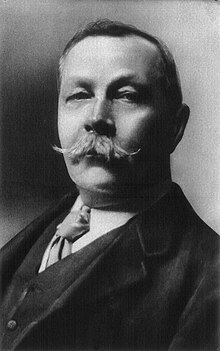
About the Author: Arthur Ignatius Conan Doyle was born on 22 May 1859 at 11 Picardy Place, Edinburgh, Scotland. From 1876 to 1881, he studied medicine at the University of Edinburgh, including a period working in the town of Aston (now a district of Birmingham) and in Sheffield, as well as in Shropshire at Ruyton-XI-Towns. While studying, Doyle began writing short stories. His earliest extant fiction, "The Haunted Grange of Goresthorpe", was unsuccessfully submitted to Blackwood's Magazine. His first published piece "The Mystery of Sasassa Valley", a story set in South Africa, was printed in Chambers's Edinburgh Journal on 6 September 1879. On 20 September 1879, he published his first non-fiction article, "Gelsemium as a Poison" in the British Medical Journal. In 1882 he joined former classmate George Turnavine Budd as his partner at a medical practice in Plymouth, but their relationship proved difficult, and Doyle soon left to set up an independent practice. Arriving in Portsmouth in June of that year with less than £10 (£900 today) to his name, he set up a medical practice at 1 Bush Villas in Elm Grove, Southsea. The practice was initially not very successful. While waiting for patients, Doyle again began writing stories and composed his first novels, The Mystery of Cloomber, not published until 1888, and the unfinished Narrative of John Smith, which would go unpublished until 2011. He amassed a portfolio of short stories including "The Captain of the Pole-Star" and "J. Habakuk Jephson's Statement", both inspired by Doyle's time at sea, the latter of which popularized the mystery of the Mary Celeste and added fictional details such as the perfect condition of the ship (which had actually taken on water by the time it was discovered) and its boats remaining on board (the one boat was in fact missing) that have come to dominate popular accounts of the incident. Doyle struggled to find a publisher for his work. His first significant piece, A Study in Scarlet, was taken by Ward Lock Co. on 20 November 1886, giving Doyle £25 for all rights to the story. The piece appeared later that year in the Beeton's Christmas Annual and received good reviews in The Scotsman and the Glasgow Herald. The story featured the first appearance of Watson and Sherlock Holmes, partially modeled after his former university teacher Joseph Bell. Doyle wrote to him, "It is most certainly to you that I owe Sherlock Holmes ... Round the center of deduction and inference and observation which I have heard you inculcate I have tried to build up a man." Robert Louis Stevenson was able, even in faraway Samoa, to recognize the strong similarity between Joseph Bell and Sherlock Holmes: "My compliments on your very ingenious and very interesting adventures of Sherlock Holmes. ... Can this be my old friend Joe Bell?" Other authors sometimes suggest additional influences—for instance, the famous Edgar Allan Poe character C. Auguste Dupin. A sequel to A Study in Scarlet was commissioned and The Sign of the Four appeared in Lippincott's Magazine in February 1890, under agreement with the Ward Lock company. Doyle felt grievously exploited by Ward Lock as an author new to the publishing world and he left them. Short stories featuring Sherlock Holmes were published in the Strand Magazine. Doyle first began to write for the 'Strand' from his home at 2 Upper Wimpole Street, now marked by a memorial plaque. In this period, however, Holmes was not his sole subject and in 1893, he collaborated with J.M. Barrie on the libretto of Jane Annie. Doyle was found clutching his chest in the hall of Windlesham Manor, his house in Crowborough, East Sussex, on 7 July 1930. He died of a heart attack at the age of 71. His last words were directed toward his wife: "You are wonderful." At the time of his death, there was some controversy concerning his burial place, as he was avowedly not a Christian, considering himself a Spiritualist. He was first buried on 11 July 1930 in Windlesham rose garden. He was later re-interred together with his wife in Minstead churchyard in the New Forest, Hampshire. Carved wooden tablets to his memory and to the memory of his wife are held privately and are inaccessible to the public. That inscription reads, "Blade straight / Steel true / Arthur Conan Doyle / Born May 22nd 1859 / Passed On 7th July 1930." The epitaph on his gravestone in the churchyard reads, in part: "Steel true/Blade straight/Arthur Conan Doyle/Knight/Patriot, Physician, and man of letters". Undershaw, the home near Hindhead, Haslemere, south of London, that Doyle had built and lived in between October 1897 and September 1907, was a hotel and restaurant from 1924 until 2004. It was then bought by a developer and stood empty while conservationists and Doyle fans fought to preserve it. In 2012 the High Court ruled that the redevelopment permission be quashed because proper procedure had not been followed. A statue honors Doyle at Crowborough Cross in Crowborough, where he lived for 23 years. There is also a statue of Sherlock Holmes in Picardy Place, Edinburgh, close to the house where Doyle was born.

My Review: In this story, Sherlock Holmes is visited by Mrs. Merrilow, a landlady from South Brixton who has an unusual lodger who never shows her face. She saw it once accidentally and it was hideously mutilated. This woman, formerly very quiet, has recently taken to cursing in the night, shouting “Murder, murder!” and “You cruel beast! You monster!”
Also, her health has taken a turn for the worse, and she is wasting away.
Mrs. Merrilow has brought this case to Holmes’s attention as her tenant, Mrs. Ronder, will not involve the clergy or the police in something that she would like to say. She has told her landlady to mention Abbas Parva, knowing that Holmes would understand the reference.
Indeed he does. It was a most tragic case in which a circus lion somehow got loose and savaged two people, one of whom was killed, and the other badly disfigured. The latter is apparently this lodger. The former was her husband. Holmes could make little of the case at the time, but perhaps if someone had actually hired him, the outcome would have been different. As it was, the inquest ruled that Mr. Ronder was the victim of death by misadventure.
Still, even the local police were a bit disturbed at the time by some seeming inconsistencies in the accounts. The lion was part of an act which Mr. and Mrs. Ronder performed right in its cage, and they were the ones who fed it. Why had it suddenly turned on its feeders? Why had it not tried to escape? Who was that man that several people heard screaming when supposedly Mr. Ronder had already been killed?
Upon arriving at Brixton, Holmes and Watson are shown into Mrs. Ronder’s room, which she seldom leaves. She is wearing her veil. Her purpose, it seems, is to make a clean breast of the matter before she dies.
Mr. Ronder was a terrible husband, cruel and violent in the extreme, even to the circus animals, but he didn’t care, even though he wound up in the dock for it several times. He was rich and the fines meant nothing.
Mrs. Ronder had an extramarital lover, the circus strongman, Leonardo. They conceived a plan to get rid of the piglike Mr. Ronder. Leonardo made a club with five nails in it, whose wounds might be taken for a lion’s. Then, one night at Abbas Parva, a small village in Berkshire where the circus had camped for the night, Leonardo smashed Ronder’s head in with the club, and his wife released the lion to make it appear that it had broken free and done the deed. However, the lion turned and pounced on Mrs. Ronder, chewing her face up badly. Leonardo began screaming and ran away. He could have helped his lover, but he was a coward.
She could not bring herself to implicate Leonardo in her husband’s murder at the inquest, and is only now telling Holmes and Watson this story because she believes that she will soon die. Ever since that night, she has lived alone and veiled.
Holmes only has advice to offer. Realizing that Mrs. Ronder is contemplating suicide, he reminds her that her life is worth something as an example of patient suffering in an impatient world. She responds by lifting her veil, and the sight is ghastly.
Nevertheless, two days later, Holmes receives a bottle of prussic acid, from Mrs. Ronder. She was going to use it, but has apparently thought better of it.
Another good plot, I recommend this book to all readers that appreciate a well written mystery short story.

Friday, June 5, 2015

Book "The Adventure of the Lion's Mane" by Sir Arthur Conan Doyle

About the Book: "The Adventure of the Lion's Mane" (1926), one of the 56 Sherlock Holmes short stories written by British author Sir Arthur Conan Doyle, is one of 12 stories in the cycle collected as The Case Book of Sherlock Holmes. It is notable for being narrated by Holmes himself, instead of by Dr. Watson (who does not appear in the story).

About the Author: Arthur Ignatius Conan Doyle was born on 22 May 1859 at 11 Picardy Place, Edinburgh, Scotland. From 1876 to 1881, he studied medicine at the University of Edinburgh, including a period working in the town of Aston (now a district of Birmingham) and in Sheffield, as well as in Shropshire at Ruyton-XI-Towns. While studying, Doyle began writing short stories. His earliest extant fiction, "The Haunted Grange of Goresthorpe", was unsuccessfully submitted to Blackwood's Magazine. His first published piece "The Mystery of Sasassa Valley", a story set in South Africa, was printed in Chambers's Edinburgh Journal on 6 September 1879. On 20 September 1879, he published his first non-fiction article, "Gelsemium as a Poison" in the British Medical Journal. In 1882 he joined former classmate George Turnavine Budd as his partner at a medical practice in Plymouth, but their relationship proved difficult, and Doyle soon left to set up an independent practice. Arriving in Portsmouth in June of that year with less than £10 (£900 today) to his name, he set up a medical practice at 1 Bush Villas in Elm Grove, Southsea. The practice was initially not very successful. While waiting for patients, Doyle again began writing stories and composed his first novels, The Mystery of Cloomber, not published until 1888, and the unfinished Narrative of John Smith, which would go unpublished until 2011. He amassed a portfolio of short stories including "The Captain of the Pole-Star" and "J. Habakuk Jephson's Statement", both inspired by Doyle's time at sea, the latter of which popularized the mystery of the Mary Celeste and added fictional details such as the perfect condition of the ship (which had actually taken on water by the time it was discovered) and its boats remaining on board (the one boat was in fact missing) that have come to dominate popular accounts of the incident. Doyle struggled to find a publisher for his work. His first significant piece, A Study in Scarlet, was taken by Ward Lock Co. on 20 November 1886, giving Doyle £25 for all rights to the story. The piece appeared later that year in the Beeton's Christmas Annual and received good reviews in The Scotsman and the Glasgow Herald. The story featured the first appearance of Watson and Sherlock Holmes, partially modeled after his former university teacher Joseph Bell. Doyle wrote to him, "It is most certainly to you that I owe Sherlock Holmes ... Round the center of deduction and inference and observation which I have heard you inculcate I have tried to build up a man." Robert Louis Stevenson was able, even in faraway Samoa, to recognize the strong similarity between Joseph Bell and Sherlock Holmes: "My compliments on your very ingenious and very interesting adventures of Sherlock Holmes. ... Can this be my old friend Joe Bell?" Other authors sometimes suggest additional influences—for instance, the famous Edgar Allan Poe character C. Auguste Dupin. A sequel to A Study in Scarlet was commissioned and The Sign of the Four appeared in Lippincott's Magazine in February 1890, under agreement with the Ward Lock company. Doyle felt grievously exploited by Ward Lock as an author new to the publishing world and he left them. Short stories featuring Sherlock Holmes were published in the Strand Magazine. Doyle first began to write for the 'Strand' from his home at 2 Upper Wimpole Street, now marked by a memorial plaque. In this period, however, Holmes was not his sole subject and in 1893, he collaborated with J.M. Barrie on the libretto of Jane Annie. Doyle was found clutching his chest in the hall of Windlesham Manor, his house in Crowborough, East Sussex, on 7 July 1930. He died of a heart attack at the age of 71. His last words were directed toward his wife: "You are wonderful." At the time of his death, there was some controversy concerning his burial place, as he was avowedly not a Christian, considering himself a Spiritualist. He was first buried on 11 July 1930 in Windlesham rose garden. He was later re-interred together with his wife in Minstead churchyard in the New Forest, Hampshire. Carved wooden tablets to his memory and to the memory of his wife are held privately and are inaccessible to the public. That inscription reads, "Blade straight / Steel true / Arthur Conan Doyle / Born May 22nd 1859 / Passed On 7th July 1930." The epitaph on his gravestone in the churchyard reads, in part: "Steel true/Blade straight/Arthur Conan Doyle/Knight/Patriot, Physician, and man of letters". Undershaw, the home near Hindhead, Haslemere, south of London, that Doyle had built and lived in between October 1897 and September 1907, was a hotel and restaurant from 1924 until 2004. It was then bought by a developer and stood empty while conservationists and Doyle fans fought to preserve it. In 2012 the High Court ruled that the redevelopment permission be quashed because proper procedure had not been followed. A statue honors Doyle at Crowborough Cross in Crowborough, where he lived for 23 years. There is also a statue of Sherlock Holmes in Picardy Place, Edinburgh, close to the house where Doyle was born.

My Review: In this story, Sherlock Holmes is enjoying his retirement in Sussex when one day at the beach, he meets his friend Harold Stackhurst, the headmaster of a nearby preparatory school called The Gables. No sooner have they met than Stackhurst's science master, Fitzroy McPherson, staggers up to them, obviously in agony and wearing only an overcoat and trousers. He collapses, manages to say something about a "lion's mane", and then dies. He is observed to have red welts all over his back, administered by a flexible weapon of some kind, for the marks curve over his shoulder and round his ribs.
Moments later, Ian Murdoch, a mathematics teacher, comes up behind them. He has not seen the attack, and has only just arrived at the beach from the school. Holmes sees a couple of people far up the beach, but thinks they are much too far away to have had anything to do with McPherson's death. Likewise, the few fishing boats off the beach are too far out.
It emerges that Murdoch and McPherson were friends, but had not always been. Murdoch is an enigmatic fellow with an occasional bad temper. He once threw McPherson's dog through a plate-glass window, for instance. Despite this, Stackhurst is sure that they were friends.
McPherson also had a lover, and on further investigation, it turns out that Maud Bellamy was McPherson's fiancée. A note confirming a meeting with her was found on McPherson, but it gave no clear details.
Holmes goes to look at the lagoon formed by a recent storm that local men have been using as a bathing pond. He sees McPherson's towel lying there dry and concludes that he never went into the water. Holmes arranges to have the caves and other nooks at the foot of the cliffs searched, expecting that nothing and no-one will turn up. He is right.
Stackhurst and Holmes decide to go and see Miss Bellamy to see whether she can shed any light on this perplexing mystery. Just as they are approaching The Haven, the Bellamys' house, they see Ian Murdoch emerge. Stackhurst demands to know what he was doing there, and an angry exchange ensues with Murdoch declaring in effect that it was none of Stackhurst's business. Stackhurst loses his temper and sacks Murdoch on the spot. He storms off to get ready to move out.
They visit the Bellamys and find an amazingly beautiful woman in Maud Bellamy, but two most unpleasant men in her father and muscular brother. It seems that they did not approve of the liaison between Maud and McPherson. They do not even find out about the engagement until this meeting, such has been the secrecy of their affair. Maud says that she will help however she can, but it does not seem likely that she can do anything. It emerges, however, that Ian Murdoch was once a potential suitor to Miss Bellamy. Holmes begins to suspect that Murdoch may be responsible for McPherson's death, out of jealousy.
A further mystifying clue presents itself when McPherson's dog is found dead at the very pool where McPherson met his end. It obviously died in agony, much as its master did. At this point, Holmes begins to suspect something else. The dead man's dying words, "lion's mane," have triggered a memory, but he cannot quite call it back to mind.
Inspector Bardle of the Sussex Constabulary visits Holmes to ask if there is enough evidence to arrest Ian Murdoch. Holmes is sure that there is not. The case is most incomplete, especially as Murdoch has an alibi. He also could not have singlehandedly overcome McPherson, who was quite strong, despite having heart trouble. The two men also consider McPherson's wounds. The weals actually looked as though they may have been administered by a hot wire mesh, or perhaps a cat o' nine tails. Holmes has formed a theory which might explain McPherson's death and is about to go back to the bathing pond to test it.
As he is about to leave, Murdoch arrives, helped in by Stackhurst, who is afraid that Murdoch might be dying; he fainted twice in pain. He has the same wounds on him that McPherson had. In great agony, he calls for brandy, passes out, but finally recovers.
At the bathing pond, Holmes spots the murderer: it is a Lion's Mane Jellyfish (Cyanea capillata), a deadly creature about which Holmes has read. Holmes takes a rock and kills it. He shares the story by John George Wood of an encounter with just such a jellyfish with the other men. Murdoch is exonerated, of course. It turns out that he was acting as a go-between for McPherson and Maud, and did not wish to discuss it with anyone. The story ends on an upbeat note as Stackhurst forgives Murdoch and gives him his job back.
Another very entertaining Sherlock Holmes short story! I recommend this book to all readers that appreciate a well written mystery book.

Thursday, June 4, 2015

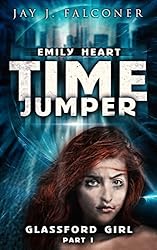
Book “Glassford Girl - Parts 1 & 2” by Jay J.Falconer

About the Book: Teleportation. Telepathy. Superior strength and speed. Abilities no homeless girl should be without. Abilities she never wanted. Abilities she needs to learn how to control.
Despite all her abilities, Emily Heart just wants her old life back. Her life before being abducted and genetically transformed against her will. A life filled with family, friends, and a warm bed to sleep in.
Emily vows to find those responsible and make them pay for what they've done, but it won’t be easy. Not when a gang wants to kill her, cops want to arrest her, and a reporter wants to expose her.
However, Emily’s problems don’t end there. Any uncontrolled burst of emotion can send her jumping randomly across time and space, arriving naked and alone.
Emily doesn't quite know what she is, or what she's capable of, but she knows what she can't afford to do -- feel anything.
And she can’t afford to make any mistakes.

About the Author: Jay J. Falconer is an independent author, publisher, blogger, editor, engineer and Sci-Fi junkie who lives in the mountains of northern Arizona where the brisk, clean air and stunning mountain views inspire his workday.
He makes his online home at www.JayFalconer.com and is the author of the critically acclaimed Narrows of Time book series. If the mood strikes you, please use the Contact the Author form on his website to connect with him. Mr. Falconer would love to hear from you. He personally reads and responds to all inquiries. You may also connect with him on Facebook
www.facebook.com/NarrowsOfTime
Mr. Falconer is currently developing an all new action Sci-Fi series called Redfall. The first season is expected to be released in 2015.
His blog can be found online at www.IncursionMag.com.
Check it out if you're interested in reading about the latest breakthroughs and announcements within the science and technology fields.

My Review: Emily Heart, our heroine, is a high student that is abducted together with her mother, when they are going to church. The abductors ended up killing her mother and she manage to scape. Having her body genetically altered, she now possess abilities that she cannot control. She starts jumping forward in time when she goes over strong emotional stress. Now she is homeless in Phoenix, trying to survive between her jumps in time. One of the most important rule she created is to never get involved with anyone, but she ends up meeting Junie in a homeless shelter. Junie is a young girl that lives in the streets. Emily also meets Derek, another street character, member of a dangerous street gang. One of Emily’s new abilities is to sense the real interior goodness of people when they are close to her and she knows that deep inside Derek is a good person. Another character is Jim Miller, a reporter that is following Emily’s appearance and has a full folder on her, with photos over a 30 year span showing that she did not age at all during this period. He tries to contact and protect her.
But the abductors did not give up on getting her back and are on her persecution, with highly advanced technology… How will that story end? The author did and incredible job creating a whole plot with his innovative way of exploring time travel. His characters are real, credible, and fully developed, in a way that we start cheering for Emily in every turn of the pages. The world he describes is our world and we start believing that everything is possible in his science fiction novel. It has been a while since I read such a good and stimulating book. Very well written, with excellent grammar and vocabulary, Kudos to the author. He got me hooked and I will be buying the remaining of the series to find out what will happen to Emily Heart.


Wednesday, June 3, 2015

Book "The Adventure of the Creeping Man" by Sir Arthur Conan Doyle

About the Book: "The Adventure of the Creeping Man" 1923 is one of 12 Sherlock Holmes short stories (56 total) by Arthur Conan Doyle in The Case-Book of Sherlock Holmes first published in Strand Magazine.

About the Author: Arthur Ignatius Conan Doyle was born on 22 May 1859 at 11 Picardy Place, Edinburgh, Scotland. From 1876 to 1881, he studied medicine at the University of Edinburgh, including a period working in the town of Aston (now a district of Birmingham) and in Sheffield, as well as in Shropshire at Ruyton-XI-Towns. While studying, Doyle began writing short stories. His earliest extant fiction, "The Haunted Grange of Goresthorpe", was unsuccessfully submitted to Blackwood's Magazine. His first published piece "The Mystery of Sasassa Valley", a story set in South Africa, was printed in Chambers's Edinburgh Journal on 6 September 1879. On 20 September 1879, he published his first non-fiction article, "Gelsemium as a Poison" in the British Medical Journal. In 1882 he joined former classmate George Turnavine Budd as his partner at a medical practice in Plymouth, but their relationship proved difficult, and Doyle soon left to set up an independent practice. Arriving in Portsmouth in June of that year with less than £10 (£900 today) to his name, he set up a medical practice at 1 Bush Villas in Elm Grove, Southsea. The practice was initially not very successful. While waiting for patients, Doyle again began writing stories and composed his first novels, The Mystery of Cloomber, not published until 1888, and the unfinished Narrative of John Smith, which would go unpublished until 2011. He amassed a portfolio of short stories including "The Captain of the Pole-Star" and "J. Habakuk Jephson's Statement", both inspired by Doyle's time at sea, the latter of which popularized the mystery of the Mary Celeste and added fictional details such as the perfect condition of the ship (which had actually taken on water by the time it was discovered) and its boats remaining on board (the one boat was in fact missing) that have come to dominate popular accounts of the incident. Doyle struggled to find a publisher for his work. His first significant piece, A Study in Scarlet, was taken by Ward Lock Co. on 20 November 1886, giving Doyle £25 for all rights to the story. The piece appeared later that year in the Beeton's Christmas Annual and received good reviews in The Scotsman and the Glasgow Herald. The story featured the first appearance of Watson and Sherlock Holmes, partially modeled after his former university teacher Joseph Bell. Doyle wrote to him, "It is most certainly to you that I owe Sherlock Holmes ... Round the center of deduction and inference and observation which I have heard you inculcate I have tried to build up a man." Robert Louis Stevenson was able, even in faraway Samoa, to recognize the strong similarity between Joseph Bell and Sherlock Holmes: "My compliments on your very ingenious and very interesting adventures of Sherlock Holmes. ... Can this be my old friend Joe Bell?" Other authors sometimes suggest additional influences—for instance, the famous Edgar Allan Poe character C. Auguste Dupin. A sequel to A Study in Scarlet was commissioned and The Sign of the Four appeared in Lippincott's Magazine in February 1890, under agreement with the Ward Lock company. Doyle felt grievously exploited by Ward Lock as an author new to the publishing world and he left them. Short stories featuring Sherlock Holmes were published in the Strand Magazine. Doyle first began to write for the 'Strand' from his home at 2 Upper Wimpole Street, now marked by a memorial plaque. In this period, however, Holmes was not his sole subject and in 1893, he collaborated with J.M. Barrie on the libretto of Jane Annie. Doyle was found clutching his chest in the hall of Windlesham Manor, his house in Crowborough, East Sussex, on 7 July 1930. He died of a heart attack at the age of 71. His last words were directed toward his wife: "You are wonderful." At the time of his death, there was some controversy concerning his burial place, as he was avowedly not a Christian, considering himself a Spiritualist. He was first buried on 11 July 1930 in Windlesham rose garden. He was later re-interred together with his wife in Minstead churchyard in the New Forest, Hampshire. Carved wooden tablets to his memory and to the memory of his wife are held privately and are inaccessible to the public. That inscription reads, "Blade straight / Steel true / Arthur Conan Doyle / Born May 22nd 1859 / Passed On 7th July 1930." The epitaph on his gravestone in the churchyard reads, in part: "Steel true/Blade straight/Arthur Conan Doyle/Knight/Patriot, Physician, and man of letters". Undershaw, the home near Hindhead, Haslemere, south of London, that Doyle had built and lived in between October 1897 and September 1907, was a hotel and restaurant from 1924 until 2004. It was then bought by a developer and stood empty while conservationists and Doyle fans fought to preserve it. In 2012 the High Court ruled that the redevelopment permission be quashed because proper procedure had not been followed. A statue honors Doyle at Crowborough Cross in Crowborough, where he lived for 23 years. There is also a statue of Sherlock Holmes in Picardy Place, Edinburgh, close to the house where Doyle was born.

My Review: In this story, Mr. Trevor Bennett comes to Sherlock Holmes with a most unusual problem. He is Professor Presbury's personal secretary, and Mr. Bennett is also engaged to the professor's only daughter, Edith.
Professor Presbury is himself engaged to a young lady, Alice Morphy, a colleague's daughter, although he himself is already sixty-one years old. Their impending marriage does not seem to have caused a great scandal; so that is not Mr. Bennett's problem. Nonetheless, the trouble seems to have begun at about the time of Professor Presbury's and Alice's engagement.
First, the professor suddenly left home for a fortnight without telling anyone where he was going. He returned looking rather travel-worn. It was only through a letter from a friend sent to Mr. Bennett that the family learnt that Professor Presbury had been to Prague.
Also, the professor's usually faithful Irish Wolfhound has taken to attacking him on occasion, and has had to be tied up outside. Holmes knows from his study of dogs that this is significant.
Upon returning from Prague, Professor Presbury told Mr. Bennett that certain letters would arrive with a cross under the stamp, and he was not to open these. Until this time, Mr. Bennett had enjoyed the professor's implicit trust and had opened all his letters as part of his job. As the professor said, such letters did arrive, and he gave them straight to the professor. Whether any replies were sent Mr. Bennett does not know, as they never passed through his hands.
The whole household feels that they are living with another man, not the Professor Presbury that they once knew. He has become furtive and sly. There are definite changes in his moods and habits, some quite bizarre; however, his mind does not seem to be adversely affected. His lectures are still brilliant, and he can still function as a professor.
Mr. Bennett observed a curious behaviour in his employer. He opened his bedroom door one night, as he tells Holmes and Watson, and saw the professor crawling along the hall on his hands and feet. When he spoke to Professor Presbury, his master swore at him and scuttled off to the stairway.
Edith Presbury, who arrives at 221B Baker Street halfway through her fiancé's interview with Holmes says that she saw her father at her bedroom window one night at two o'clock in the morning. Her bedroom is on the second floor, and there is no long ladder in the garden. She is sure that she did not imagine this.
The professor brought a small carved wooden box back with him from Prague. One day, as Mr. Bennett was looking for a cannula, he picked the box up, and the professor became very angry with him. Mr. Bennett was quite shaken by the incident.
Mr. Bennett mentions that the dog attacks came on July 2, 11, and 20. Holmes does not mention it aloud at the time, but these are intervals of nine days each time.
Holmes and Watson go to Camford to see the professor the next day. They decide to pretend that they have an appointment, and that if Professor Presbury does not remember making one, he will likely put it down to the dreamworld that he has been living in lately. Things do not go quite this way. The professor is quite sure that he has made no appointment, and confirms this with his embarrassed secretary, Mr. Bennett. Professor Presbury becomes furiously angry at the intrusion, and Watson believes that they might actually have to fight their way out of the house. Mr. Bennett, though, convinces the professor that violence against a man as well known as Sherlock Holmes would surely bring about a scandal. Holmes and Watson leave, and then Holmes confides to Watson that the visit has been worthwhile, as he has learnt much about the professor's mind, namely that it is clear and functional, despite the recent peculiar behaviour.
Mr. Bennett comes out of the house after Holmes and tells him that he has found the address that Professor Presbury has been writing to and receiving the mysterious letters from. The addressee is a man named Dorak, a Central European name. This fits in with the professor's secret journey to Prague. Holmes later finds out from his "general utility man" Mercer that Dorak is indeed a Bohemian, elderly, suave man who keeps a large general store. Before leaving the professor's house, Holmes has a look at Edith's bedroom window, and sees that the only possible way for someone to climb up there is by using the creeper, rather unlikely for a 61-year-old man.
Holmes has formed a theory that every nine days, Professor Presbury takes some kind of drug which causes the odd behaviour. Holmes believed that he became addicted in Prague, and is now supplied by this Dorak in London. Holmes has told Mr. Bennett that he and Watson will be in Camford once again on the next Tuesday. As is usual with Holmes, he does not explain why.
He and Watson show up on the appointed evening, and Holmes suddenly realizes something. He has observed the professor's thick and horny knuckles, and until now, has not made the connection between these, the odd behaviour, the dog's change in attitude towards his master, and the creeper. The professor is behaving like a monkey!
Shortly after the realization, Holmes and Watson are treated to a firsthand display of Professor Presbury's odd behaviour. He comes out of the house, scampers about on all fours, climbs on the creeper, and torments the tied-up dog. Unfortunately, the wolfhound gets loose and attacks the professor. The two of them, with Mr. Bennett's help, manage to get the dog off the professor, but he is wounded badly. Watson and Bennett, who is also a medical man, tend to the professor's injuries.
Holmes then examines the professor's little wooden box after having obtained the key from the now unconscious owner. It contained a drug, as Holmes expected, but there was also a letter there from a man named Lowenstein who, it turns out, is a quack whose help the professor sought out as a way of achieving rejuvenation, which he thought would be advisable if he were going to marry a young woman. The drug is an extract obtained from langurs, and although it has apparently given the professor renewed energy, it has also given him some of the langur's traits, and that is why the dog was attacking its owner.
Good plot, I recommend this book to all readers that appreciate a well written mystery book, mainly featuring Sherlock Holmes.

Monday, June 1, 2015

Book "The Problem of the Thor Bridge" by Sir Arthur Conan Doyle


About the Book: "The Problem of Thor Bridge" is a Sherlock Holmes murder mystery by Arthur Conan Doyle in The Case-Book of Sherlock Holmes, first published in 1922 from Strand Magazine.

About the Author: Arthur Ignatius Conan Doyle was born on 22 May 1859 at 11 Picardy Place, Edinburgh, Scotland. From 1876 to 1881, he studied medicine at the University of Edinburgh, including a period working in the town of Aston (now a district of Birmingham) and in Sheffield, as well as in Shropshire at Ruyton-XI-Towns. While studying, Doyle began writing short stories. His earliest extant fiction, "The Haunted Grange of Goresthorpe", was unsuccessfully submitted to Blackwood's Magazine. His first published piece "The Mystery of Sasassa Valley", a story set in South Africa, was printed in Chambers's Edinburgh Journal on 6 September 1879. On 20 September 1879, he published his first non-fiction article, "Gelsemium as a Poison" in the British Medical Journal. In 1882 he joined former classmate George Turnavine Budd as his partner at a medical practice in Plymouth, but their relationship proved difficult, and Doyle soon left to set up an independent practice. Arriving in Portsmouth in June of that year with less than £10 (£900 today) to his name, he set up a medical practice at 1 Bush Villas in Elm Grove, Southsea. The practice was initially not very successful. While waiting for patients, Doyle again began writing stories and composed his first novels, The Mystery of Cloomber, not published until 1888, and the unfinished Narrative of John Smith, which would go unpublished until 2011. He amassed a portfolio of short stories including "The Captain of the Pole-Star" and "J. Habakuk Jephson's Statement", both inspired by Doyle's time at sea, the latter of which popularized the mystery of the Mary Celeste and added fictional details such as the perfect condition of the ship (which had actually taken on water by the time it was discovered) and its boats remaining on board (the one boat was in fact missing) that have come to dominate popular accounts of the incident. Doyle struggled to find a publisher for his work. His first significant piece, A Study in Scarlet, was taken by Ward Lock Co. on 20 November 1886, giving Doyle £25 for all rights to the story. The piece appeared later that year in the Beeton's Christmas Annual and received good reviews in The Scotsman and the Glasgow Herald. The story featured the first appearance of Watson and Sherlock Holmes, partially modeled after his former university teacher Joseph Bell. Doyle wrote to him, "It is most certainly to you that I owe Sherlock Holmes ... Round the center of deduction and inference and observation which I have heard you inculcate I have tried to build up a man." Robert Louis Stevenson was able, even in faraway Samoa, to recognize the strong similarity between Joseph Bell and Sherlock Holmes: "My compliments on your very ingenious and very interesting adventures of Sherlock Holmes. ... Can this be my old friend Joe Bell?" Other authors sometimes suggest additional influences—for instance, the famous Edgar Allan Poe character C. Auguste Dupin. A sequel to A Study in Scarlet was commissioned and The Sign of the Four appeared in Lippincott's Magazine in February 1890, under agreement with the Ward Lock company. Doyle felt grievously exploited by Ward Lock as an author new to the publishing world and he left them. Short stories featuring Sherlock Holmes were published in the Strand Magazine. Doyle first began to write for the 'Strand' from his home at 2 Upper Wimpole Street, now marked by a memorial plaque. In this period, however, Holmes was not his sole subject and in 1893, he collaborated with J.M. Barrie on the libretto of Jane Annie. Doyle was found clutching his chest in the hall of Windlesham Manor, his house in Crowborough, East Sussex, on 7 July 1930. He died of a heart attack at the age of 71. His last words were directed toward his wife: "You are wonderful." At the time of his death, there was some controversy concerning his burial place, as he was avowedly not a Christian, considering himself a Spiritualist. He was first buried on 11 July 1930 in Windlesham rose garden. He was later re-interred together with his wife in Minstead churchyard in the New Forest, Hampshire. Carved wooden tablets to his memory and to the memory of his wife are held privately and are inaccessible to the public. That inscription reads, "Blade straight / Steel true / Arthur Conan Doyle / Born May 22nd 1859 / Passed On 7th July 1930." The epitaph on his gravestone in the churchyard reads, in part: "Steel true/Blade straight/Arthur Conan Doyle/Knight/Patriot, Physician, and man of letters". Undershaw, the home near Hindhead, Haslemere, south of London, that Doyle had built and lived in between October 1897 and September 1907, was a hotel and restaurant from 1924 until 2004. It was then bought by a developer and stood empty while conservationists and Doyle fans fought to preserve it. In 2012 the High Court ruled that the redevelopment permission be quashed because proper procedure had not been followed. A statue honors Doyle at Crowborough Cross in Crowborough, where he lived for 23 years. There is also a statue of Sherlock Holmes in Picardy Place, Edinburgh, close to the house where Doyle was born.

My Review: In this story, Neil Gibson, the Gold King and former Senator for "some Western state", approaches Holmes to investigate the murder of his wife Maria in order to clear his children's governess, Grace Dunbar, of the crime. It soon emerges that Mr. Gibson's marriage had been unhappy and he treated his wife very badly. He had fallen in love with her when he met her in Brazil, but soon realised they had nothing in common. He became attracted to Miss Dunbar; since he could not marry her, he had attempted to please her in other ways, such as trying to help people less fortunate than himself.
Maria Gibson was found lying in a pool of blood on Thor Bridge with a bullet through the head and note from the governess, agreeing to a meeting at that location, in her hand. A recently discharged revolver with one shot fired is found in Miss Dunbar's wardrobe. Holmes agrees to look at the situation in spite of the damning evidence.
From the outset, Holmes observes some rather odd things about the case. How could Miss Dunbar so coolly and rationally have planned and carried out the murder and then carelessly tossed the murder weapon into her wardrobe? What was the strange chip on the underside of the bridge's stone balustrade? Why was Mrs. Gibson clutching the note from Miss Dunbar when she died? If the murder weapon was one of a matched pair of pistols, why couldn't the other one be found in Mr. Gibson's collection?
Holmes uses his powers of deduction to solve the crime, and demonstrates, using Watson's revolver, how it was perpetrated: Mrs Gibson, outraged and jealous of Miss Dunbar's relationship with her husband, resolved to end her own life and frame her rival for the crime. After arranging a meeting with Miss Dunbar, requesting her to leave her response in a note, Mrs Gibson tied a rock on a piece of string to the end of a revolver, and shot herself, the rock pulling the revolver over the side of the bridge; the revolver found in Miss Dunbar's wardrobe was the other pistol of the pair, which had been fired off in the woods earlier, and the chip in the bridge was caused by the pistol hitting the stonework as it was pulled off by the rock. Holmes's reconstruction using Watson's revolver reproduces the damage to the balustrade of the bridge. He asks the police to drag the lake for the revolvers of Watson and Gibson.
Excellent plot, I recommend this book to all readers that appreciate a well written mystery short story.

Sunday, May 31, 2015

Balance of May, 2015

During the month of May, 2015, I reviewed the following:

Books:
- "Mission Barcelona - A Scavenger Hunt Adventure" by Catherine Aragon. Read my review.
- "The Adventure of the Sussex Vampire" by Sir Arthur Conan Doyle. Read my review.
- "Anomie" by Jeffrey Lockwood. Read my review.
- "The Adventure of the Three Garridebs:  by Sir Arthur Conan Doyle. Read my review.

Monday, May 18, 2015

Book "The Adventure of the Three Garridebs" by Sir Arthur Conan Doyle

About the Book: "The Adventure of the Three Garridebs" (1924), one of the 56 Sherlock Holmes short stories written by British author Sir Arthur Conan Doyle, is one of 12 stories in the cycle collected as The Case Book of Sherlock Holmes.
According to Dr. Watson's opening narration, this story is set at "the latter end of June, 1902 ... the same month that Holmes refused a knighthood for services which may perhaps some day be described."

About the Author: Arthur Ignatius Conan Doyle was born on 22 May 1859 at 11 Picardy Place, Edinburgh, Scotland. From 1876 to 1881, he studied medicine at the University of Edinburgh, including a period working in the town of Aston (now a district of Birmingham) and in Sheffield, as well as in Shropshire at Ruyton-XI-Towns. While studying, Doyle began writing short stories. His earliest extant fiction, "The Haunted Grange of Goresthorpe", was unsuccessfully submitted to Blackwood's Magazine. His first published piece "The Mystery of Sasassa Valley", a story set in South Africa, was printed in Chambers's Edinburgh Journal on 6 September 1879. On 20 September 1879, he published his first non-fiction article, "Gelsemium as a Poison" in the British Medical Journal. In 1882 he joined former classmate George Turnavine Budd as his partner at a medical practice in Plymouth, but their relationship proved difficult, and Doyle soon left to set up an independent practice. Arriving in Portsmouth in June of that year with less than £10 (£900 today) to his name, he set up a medical practice at 1 Bush Villas in Elm Grove, Southsea. The practice was initially not very successful. While waiting for patients, Doyle again began writing stories and composed his first novels, The Mystery of Cloomber, not published until 1888, and the unfinished Narrative of John Smith, which would go unpublished until 2011. He amassed a portfolio of short stories including "The Captain of the Pole-Star" and "J. Habakuk Jephson's Statement", both inspired by Doyle's time at sea, the latter of which popularized the mystery of the Mary Celeste and added fictional details such as the perfect condition of the ship (which had actually taken on water by the time it was discovered) and its boats remaining on board (the one boat was in fact missing) that have come to dominate popular accounts of the incident. Doyle struggled to find a publisher for his work. His first significant piece, A Study in Scarlet, was taken by Ward Lock Co. on 20 November 1886, giving Doyle £25 for all rights to the story. The piece appeared later that year in the Beeton's Christmas Annual and received good reviews in The Scotsman and the Glasgow Herald. The story featured the first appearance of Watson and Sherlock Holmes, partially modeled after his former university teacher Joseph Bell. Doyle wrote to him, "It is most certainly to you that I owe Sherlock Holmes ... Round the center of deduction and inference and observation which I have heard you inculcate I have tried to build up a man." Robert Louis Stevenson was able, even in faraway Samoa, to recognize the strong similarity between Joseph Bell and Sherlock Holmes: "My compliments on your very ingenious and very interesting adventures of Sherlock Holmes. ... Can this be my old friend Joe Bell?" Other authors sometimes suggest additional influences—for instance, the famous Edgar Allan Poe character C. Auguste Dupin. A sequel to A Study in Scarlet was commissioned and The Sign of the Four appeared in Lippincott's Magazine in February 1890, under agreement with the Ward Lock company. Doyle felt grievously exploited by Ward Lock as an author new to the publishing world and he left them. Short stories featuring Sherlock Holmes were published in the Strand Magazine. Doyle first began to write for the 'Strand' from his home at 2 Upper Wimpole Street, now marked by a memorial plaque. In this period, however, Holmes was not his sole subject and in 1893, he collaborated with J.M. Barrie on the libretto of Jane Annie. Doyle was found clutching his chest in the hall of Windlesham Manor, his house in Crowborough, East Sussex, on 7 July 1930. He died of a heart attack at the age of 71. His last words were directed toward his wife: "You are wonderful." At the time of his death, there was some controversy concerning his burial place, as he was avowedly not a Christian, considering himself a Spiritualist. He was first buried on 11 July 1930 in Windlesham rose garden. He was later re-interred together with his wife in Minstead churchyard in the New Forest, Hampshire. Carved wooden tablets to his memory and to the memory of his wife are held privately and are inaccessible to the public. That inscription reads, "Blade straight / Steel true / Arthur Conan Doyle / Born May 22nd 1859 / Passed On 7th July 1930." The epitaph on his gravestone in the churchyard reads, in part: "Steel true/Blade straight/Arthur Conan Doyle/Knight/Patriot, Physician, and man of letters". Undershaw, the home near Hindhead, Haslemere, south of London, that Doyle had built and lived in between October 1897 and September 1907, was a hotel and restaurant from 1924 until 2004. It was then bought by a developer and stood empty while conservationists and Doyle fans fought to preserve it. In 2012 the High Court ruled that the redevelopment permission be quashed because proper procedure had not been followed. A statue honors Doyle at Crowborough Cross in Crowborough, where he lived for 23 years. There is also a statue of Sherlock Holmes in Picardy Place, Edinburgh, close to the house where Doyle was born.

My Review: In this story, Holmes receives a letter from a Nathan Garrideb of 136 Little Ryder Street,[2] asking for help in a most peculiar quest. He is looking for another man with his unusual surname, for it will mean a $5,000,000 inheritance for him. He has been approached by another man, John Garrideb of Kansas, who says that he needs to find others with the same last name.
The American Garrideb comes to see Holmes and Watson at 221B Baker Street, and is apparently not very pleased that Nathan Garrideb has involved a detective. Garrideb, who claims to be a lawyer, spins a ridiculous story about Alexander Hamilton Garrideb, a millionaire land tycoon he met in Kansas. Hamilton Garrideb bequeathed his $15,000,000 estate to John Garrideb on the provision that he find two more Garridebs to share it with equally. He came to England to seek out people with the name, having failed in his own country. So far, he has found only Nathan.
During the interview, Holmes detects many discrepancies in John Garrideb's story, ranging from the time he has spent in London being obviously longer than he claims and his knowledge of a completely fictitious mayor of the town where Garrideb claims to have lived in before coming to England, but decides not to confront him. This piques Holmes' interest, and he decides to contact Nathan Garrideb to investigate further. Upon arrival at Little Ryder Street, Holmes observes Nathan Garrideb's nameplate outside the house. It has obviously been there for years; so Holmes concludes that Garrideb is at least his true surname.
It turns out that Nathan Garrideb is an elderly eccentric who collects everything from ancient coins to old bones. Garrideb's rooms look like a small museum. He is obviously a serious collector, but has nothing of great value in his collection. Holmes finds out that John Garrideb has never asked for any money, nor has he suggested any course of action. Nathan Garrideb has no reason, it seems, to be suspicious of John Garrideb. This puzzles Holmes.
During Holmes's and Watson's visit, John Garrideb arrives in a most jolly mood. He has apparently found a third Garrideb, as proof of which he shows a newspaper advertisement purportedly placed by a Howard Garrideb in the course of his everyday business. Holmes sees instantly that John Garrideb has placed the advertisement himself from various Americanisms in the spelling and wording.
Despite Nathan Garrideb's objections — for he is a man who very seldom goes out, much less travels — John Garrideb insists that Nathan go to Birmingham and meet this Howard Garrideb. It has now become clear to Holmes what the "rigmarole of lies" is all about. John Garrideb wants Nathan Garrideb to be out of his rooms for a while.
The next day brings fresh information. Holmes goes to see Inspector Lestrade at Scotland Yard and identifies John Garrideb as James Winter alias Morecroft alias "Killer" Evans, escaped prison after shooting three men in the States. In London, he killed Rodger Presbury, Chicago forger whose description matches the former occupant of Nathan Garrideb's room.
Holmes and Watson go to Garrideb's home armed with revolvers. They do not have to wait long before Winter shows up. From their hiding place, Holmes and Watson see the criminal use a "jemmy" to open a trapdoor revealing a little cellar. They capture Winter, but not before he manages to shoot twice, striking Watson in the leg. For once, Holmes shows his human side; he is distraught over Watson's injury, and strikes Winter on the head with the butt of a gun hard enough to draw blood, vowing that the villain would have never left the rooms alive if he had killed Watson. Fortunately, Watson's wound is superficial. The little cellar contains a printing press and stacks of counterfeit banknotes, hidden there by Presbury, the man that Winter killed.
Winter is sent back to prison. Nathan Garrideb ends up in a nursing home, so great is his disappointment, but many CID men are pleased that Presbury's equipment has at last been found. Watson seems the happiest at the adventure's outcome despite being hurt, declaring "It was worth a wound, it was worth many wounds, to know the depth of loyalty and love which lay behind that cold mask." from the sight of Holmes's panic and rage over his friend's shooting.
Another excellent plot, I recommend this book to the permanent library of all readers that love a very well written mystery book featuring Mr. Sherlock Holmes.

Saturday, May 9, 2015

Book "Anomie" by Jeffrey Lockwood

About the Book: Anomie is a uniquely told story of Michael, a Native American, middle-aged university professor and writer. After a series of tragic events, he seeks closure through myriad experiences, in order to bring balance to his world.

About the Author: Jeffrey Lockwood hails from Michigan's Upper Peninsula, and is a member of the Chippewa tribe there. He is the author of In These Low Mountains (March Street Press), a chapbook of poems and short stories, and has several other poems and short stories published in print. Jeffrey has lived internationally for many years, as a soldier, Fulbright Scholar, Peace Corps volunteer, and teacher. Presently, he writes in Hohhot, Inner Mongolia (Huhehaote, Nei Mongol). Anomie is his first novel.

My Review: The story is about an american professor who feels lost in his life after the death of his love. He feels that he does not really belong anywhere. He isolates himself from the world he knows and end up moving to China, trying to have a new beginning in his teaching career and love life. Some symptoms of schizophrenia shows up and at the end he finally discovers where he belongs and embraces it. Some flashback stories are made known, from his youth. 
This is a very well written book that works with the psychic of the main character (Michael) in a very realistic way. You feel like you are living his story, his agony, his search for a purpose in life. Very well constructed environment, this book will keep you entertained for hours. Excellent effort and surprisingly just the first novel of this author. Hopefully there will be more!

Thursday, May 7, 2015

Book "The Adventure of the Sussex Vampire" by Sir Arthur Conan Doyle

About the Book: "The Adventure of the Sussex Vampire", written by British author Arthur Conan Doyle, is one of 12 Sherlock Holmes stories collected between 1921-1927 as The Case Book of Sherlock Holmes. It was first published in the January 1924 issues of The Strand Magazine in London and Hearst's International Magazine in New York.

About the Author: Arthur Ignatius Conan Doyle was born on 22 May 1859 at 11 Picardy Place, Edinburgh, Scotland. From 1876 to 1881, he studied medicine at the University of Edinburgh, including a period working in the town of Aston (now a district of Birmingham) and in Sheffield, as well as in Shropshire at Ruyton-XI-Towns. While studying, Doyle began writing short stories. His earliest extant fiction, "The Haunted Grange of Goresthorpe", was unsuccessfully submitted to Blackwood's Magazine. His first published piece "The Mystery of Sasassa Valley", a story set in South Africa, was printed in Chambers's Edinburgh Journal on 6 September 1879. On 20 September 1879, he published his first non-fiction article, "Gelsemium as a Poison" in the British Medical Journal. In 1882 he joined former classmate George Turnavine Budd as his partner at a medical practice in Plymouth, but their relationship proved difficult, and Doyle soon left to set up an independent practice. Arriving in Portsmouth in June of that year with less than £10 (£900 today) to his name, he set up a medical practice at 1 Bush Villas in Elm Grove, Southsea. The practice was initially not very successful. While waiting for patients, Doyle again began writing stories and composed his first novels, The Mystery of Cloomber, not published until 1888, and the unfinished Narrative of John Smith, which would go unpublished until 2011. He amassed a portfolio of short stories including "The Captain of the Pole-Star" and "J. Habakuk Jephson's Statement", both inspired by Doyle's time at sea, the latter of which popularized the mystery of the Mary Celeste and added fictional details such as the perfect condition of the ship (which had actually taken on water by the time it was discovered) and its boats remaining on board (the one boat was in fact missing) that have come to dominate popular accounts of the incident. Doyle struggled to find a publisher for his work. His first significant piece, A Study in Scarlet, was taken by Ward Lock Co. on 20 November 1886, giving Doyle £25 for all rights to the story. The piece appeared later that year in the Beeton's Christmas Annual and received good reviews in The Scotsman and the Glasgow Herald. The story featured the first appearance of Watson and Sherlock Holmes, partially modeled after his former university teacher Joseph Bell. Doyle wrote to him, "It is most certainly to you that I owe Sherlock Holmes ... Round the center of deduction and inference and observation which I have heard you inculcate I have tried to build up a man." Robert Louis Stevenson was able, even in faraway Samoa, to recognize the strong similarity between Joseph Bell and Sherlock Holmes: "My compliments on your very ingenious and very interesting adventures of Sherlock Holmes. ... Can this be my old friend Joe Bell?" Other authors sometimes suggest additional influences—for instance, the famous Edgar Allan Poe character C. Auguste Dupin. A sequel to A Study in Scarlet was commissioned and The Sign of the Four appeared in Lippincott's Magazine in February 1890, under agreement with the Ward Lock company. Doyle felt grievously exploited by Ward Lock as an author new to the publishing world and he left them. Short stories featuring Sherlock Holmes were published in the Strand Magazine. Doyle first began to write for the 'Strand' from his home at 2 Upper Wimpole Street, now marked by a memorial plaque. In this period, however, Holmes was not his sole subject and in 1893, he collaborated with J.M. Barrie on the libretto of Jane Annie. Doyle was found clutching his chest in the hall of Windlesham Manor, his house in Crowborough, East Sussex, on 7 July 1930. He died of a heart attack at the age of 71. His last words were directed toward his wife: "You are wonderful." At the time of his death, there was some controversy concerning his burial place, as he was avowedly not a Christian, considering himself a Spiritualist. He was first buried on 11 July 1930 in Windlesham rose garden. He was later re-interred together with his wife in Minstead churchyard in the New Forest, Hampshire. Carved wooden tablets to his memory and to the memory of his wife are held privately and are inaccessible to the public. That inscription reads, "Blade straight / Steel true / Arthur Conan Doyle / Born May 22nd 1859 / Passed On 7th July 1930." The epitaph on his gravestone in the churchyard reads, in part: "Steel true/Blade straight/Arthur Conan Doyle/Knight/Patriot, Physician, and man of letters". Undershaw, the home near Hindhead, Haslemere, south of London, that Doyle had built and lived in between October 1897 and September 1907, was a hotel and restaurant from 1924 until 2004. It was then bought by a developer and stood empty while conservationists and Doyle fans fought to preserve it. In 2012 the High Court ruled that the redevelopment permission be quashed because proper procedure had not been followed. A statue honors Doyle at Crowborough Cross in Crowborough, where he lived for 23 years. There is also a statue of Sherlock Holmes in Picardy Place, Edinburgh, close to the house where Doyle was born.

My Review: In this story, Holmes receives two odd letters that make reference to vampires. Mr. Robert Ferguson, who comes to 221B Baker Street the next morning, has become convinced that his Peruvian wife has been sucking their baby son's blood. The woman is Mr. Ferguson's second wife, and by his first wife he has an adolescent son of 15, who suffered an unfortunate accident as a child and now does not have the full use of his legs, although he can walk. His name is Jack, and he has suffered beatings at his stepmother's hands, although Mr. Ferguson cannot imagine why. Ever since being found out by her husband, she has locked herself in her room and refused to come out. Only her Peruvian maid, Dolores, is ever allowed in. She takes Mrs. Ferguson her meals.
Even before Holmes and Watson set off for Mr. Ferguson's house in Sussex, Holmes has deduced what is going on, and it has nothing to do with vampires. Holmes's trip is made simply to observe and confirm what he has already deduced.
Mrs. Ferguson's maid announces that her mistress is ill, and Dr. Watson offers to help. He finds an agitated woman in the room upstairs. She speaks of all being destroyed, and of sacrificing herself rather than breaking her husband's heart. She also demands her child, who has been with the nurse, Mrs. Mason, ever since Mr. Ferguson has known about the bloodsucking incidents.
Holmes examines the South American weapons displayed in the house, and meets the children. While Mr. Ferguson is doting on his younger son, Watson notices that Holmes is gazing at the window. He cannot imagine why his friend is doing this.
Mrs. Ferguson is relieved that Holmes tells the truth about what has been happening, as this is exactly what she has wanted: for the truth to come from someone else's lips. It seems that the culprit is Jack, Mr. Ferguson's elder son, who is extremely jealous of his young half-brother. Holmes has deduced this, and confirmed it by looking at Jack's reflection in the window while his father's attention was on the baby. Jack has been shooting poisoned darts — thoughtfully provided by the weapon collection at Cheeseman's — at his brother, and his stepmother's behavior of sucking the baby's neck is thereby explained: she was sucking the poison out. The wounds were caused by the darts, not by her biting.
Another entertaining story by Sir Conan Doyle. I recommend this book to any reader that appreciates a well written mystery, mainly featuring Sherlock Holmes.

Wednesday, May 6, 2015

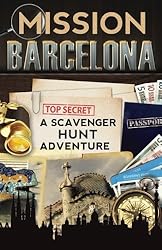
Book "Mission Barcelona - A Scavenger Hunt Adventure" by Catherine Aragon

About the Book: The Scavenger Hunt Adventure series (www.ScavengerHuntAdventures.com) takes your young travelers through the famous sights of cities, engaging them with exciting scavenger hunt activities as you discover city landmarks together.

About the Author: Catherine's favorite quote comes from S. Rao: "There's no destination. The journey is all that there is, and it can be very, very joyful." She believes these words ring true for travel and the joy of the journey - unless that journey happens to be a long plane ride with an energetic toddler (Atlanta to Singapore, 24+ hours, middle seats)!

My Review: This truly is a remarkable book that will keep your kids engaged and enjoying travelling with you. And before you notice, you will also be hunting for the treasures of Barcelona. 
I visited Barcelona when I was a kid and went back there other times as an adult. I just wish I had this book when I first visited Barcelona at the age of 11. It would be a completely different travel. 
The author presents this traveler's guide for kids in an unusual way, as a mission the kids are assigned to, where for each task they succesfuly accomplish, they earn points. Rules are established (most important, "be kind and respectful to team members"). A quick history of the city, its symbols (dragons, bats), emblems etc is presented. And the fun begins! 
Twelve missions are listed (there is a last one called "Anytime Mission", for a total of thirteen). And each one of these missions cover a particular touristic landmark of the city of Barcelona, including La Rambla, Port Vell, La Catedral (St. Eulalia), Plaça Nova, Plaça de Sant Felip Neri, Santa Maria del Mar, Sagrada Familia, La Pedrera, Casa Batlló, Parc de la Ciutadella, Parc Güell, and Castell the Montjuïc. And at each landmark there are lots of details that the kids are asked to search for, or identify some particularity of the place. 
This is a very well written guide for the kids that will keep them entertained during the whole trip, allowing you to enjoy the place you are visiting. And the family interaction that his activity stimulates is simply priceless. I recommend this book to all parents that intent to travel to Barcelona with kids. Give them this book as a gift and enjoy your trip!