
During the month of May, 2015, I reviewed the following:
Books:
- "Mission Barcelona - A Scavenger Hunt Adventure" by Catherine Aragon. Read my review.
- "The Adventure of the Sussex Vampire" by Sir Arthur Conan Doyle. Read my review.
- "Anomie" by Jeffrey Lockwood. Read my review.
- "The Adventure of the Three Garridebs: by Sir Arthur Conan Doyle. Read my review.
Sunday, May 31, 2015


Monday, May 18, 2015
Book "The Adventure of the Three Garridebs" by Sir Arthur Conan Doyle
About the Book: "The Adventure of the Three Garridebs" (1924), one of the 56 Sherlock Holmes short stories written by British author Sir Arthur Conan Doyle, is one of 12 stories in the cycle collected as The Case Book of Sherlock Holmes.
According to Dr. Watson's opening narration, this story is set at "the latter end of June, 1902 ... the same month that Holmes refused a knighthood for services which may perhaps some day be described."
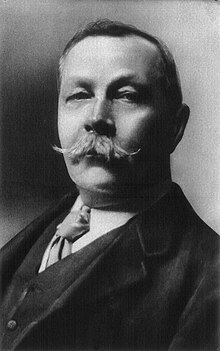
About the Author: Arthur Ignatius Conan Doyle was born on 22 May 1859 at 11 Picardy Place, Edinburgh, Scotland. From 1876 to 1881, he studied medicine at the University of Edinburgh, including a period working in the town of Aston (now a district of Birmingham) and in Sheffield, as well as in Shropshire at Ruyton-XI-Towns. While studying, Doyle began writing short stories. His earliest extant fiction, "The Haunted Grange of Goresthorpe", was unsuccessfully submitted to Blackwood's Magazine. His first published piece "The Mystery of Sasassa Valley", a story set in South Africa, was printed in Chambers's Edinburgh Journal on 6 September 1879. On 20 September 1879, he published his first non-fiction article, "Gelsemium as a Poison" in the British Medical Journal. In 1882 he joined former classmate George Turnavine Budd as his partner at a medical practice in Plymouth, but their relationship proved difficult, and Doyle soon left to set up an independent practice. Arriving in Portsmouth in June of that year with less than £10 (£900 today) to his name, he set up a medical practice at 1 Bush Villas in Elm Grove, Southsea. The practice was initially not very successful. While waiting for patients, Doyle again began writing stories and composed his first novels, The Mystery of Cloomber, not published until 1888, and the unfinished Narrative of John Smith, which would go unpublished until 2011. He amassed a portfolio of short stories including "The Captain of the Pole-Star" and "J. Habakuk Jephson's Statement", both inspired by Doyle's time at sea, the latter of which popularized the mystery of the Mary Celeste and added fictional details such as the perfect condition of the ship (which had actually taken on water by the time it was discovered) and its boats remaining on board (the one boat was in fact missing) that have come to dominate popular accounts of the incident. Doyle struggled to find a publisher for his work. His first significant piece, A Study in Scarlet, was taken by Ward Lock Co. on 20 November 1886, giving Doyle £25 for all rights to the story. The piece appeared later that year in the Beeton's Christmas Annual and received good reviews in The Scotsman and the Glasgow Herald. The story featured the first appearance of Watson and Sherlock Holmes, partially modeled after his former university teacher Joseph Bell. Doyle wrote to him, "It is most certainly to you that I owe Sherlock Holmes ... Round the center of deduction and inference and observation which I have heard you inculcate I have tried to build up a man." Robert Louis Stevenson was able, even in faraway Samoa, to recognize the strong similarity between Joseph Bell and Sherlock Holmes: "My compliments on your very ingenious and very interesting adventures of Sherlock Holmes. ... Can this be my old friend Joe Bell?" Other authors sometimes suggest additional influences—for instance, the famous Edgar Allan Poe character C. Auguste Dupin. A sequel to A Study in Scarlet was commissioned and The Sign of the Four appeared in Lippincott's Magazine in February 1890, under agreement with the Ward Lock company. Doyle felt grievously exploited by Ward Lock as an author new to the publishing world and he left them. Short stories featuring Sherlock Holmes were published in the Strand Magazine. Doyle first began to write for the 'Strand' from his home at 2 Upper Wimpole Street, now marked by a memorial plaque. In this period, however, Holmes was not his sole subject and in 1893, he collaborated with J.M. Barrie on the libretto of Jane Annie. Doyle was found clutching his chest in the hall of Windlesham Manor, his house in Crowborough, East Sussex, on 7 July 1930. He died of a heart attack at the age of 71. His last words were directed toward his wife: "You are wonderful." At the time of his death, there was some controversy concerning his burial place, as he was avowedly not a Christian, considering himself a Spiritualist. He was first buried on 11 July 1930 in Windlesham rose garden. He was later re-interred together with his wife in Minstead churchyard in the New Forest, Hampshire. Carved wooden tablets to his memory and to the memory of his wife are held privately and are inaccessible to the public. That inscription reads, "Blade straight / Steel true / Arthur Conan Doyle / Born May 22nd 1859 / Passed On 7th July 1930." The epitaph on his gravestone in the churchyard reads, in part: "Steel true/Blade straight/Arthur Conan Doyle/Knight/Patriot, Physician, and man of letters". Undershaw, the home near Hindhead, Haslemere, south of London, that Doyle had built and lived in between October 1897 and September 1907, was a hotel and restaurant from 1924 until 2004. It was then bought by a developer and stood empty while conservationists and Doyle fans fought to preserve it. In 2012 the High Court ruled that the redevelopment permission be quashed because proper procedure had not been followed. A statue honors Doyle at Crowborough Cross in Crowborough, where he lived for 23 years. There is also a statue of Sherlock Holmes in Picardy Place, Edinburgh, close to the house where Doyle was born.
My Review: In this story, Holmes receives a letter from a Nathan Garrideb of 136 Little Ryder Street,[2] asking for help in a most peculiar quest. He is looking for another man with his unusual surname, for it will mean a $5,000,000 inheritance for him. He has been approached by another man, John Garrideb of Kansas, who says that he needs to find others with the same last name.
The American Garrideb comes to see Holmes and Watson at 221B Baker Street, and is apparently not very pleased that Nathan Garrideb has involved a detective. Garrideb, who claims to be a lawyer, spins a ridiculous story about Alexander Hamilton Garrideb, a millionaire land tycoon he met in Kansas. Hamilton Garrideb bequeathed his $15,000,000 estate to John Garrideb on the provision that he find two more Garridebs to share it with equally. He came to England to seek out people with the name, having failed in his own country. So far, he has found only Nathan.
During the interview, Holmes detects many discrepancies in John Garrideb's story, ranging from the time he has spent in London being obviously longer than he claims and his knowledge of a completely fictitious mayor of the town where Garrideb claims to have lived in before coming to England, but decides not to confront him. This piques Holmes' interest, and he decides to contact Nathan Garrideb to investigate further. Upon arrival at Little Ryder Street, Holmes observes Nathan Garrideb's nameplate outside the house. It has obviously been there for years; so Holmes concludes that Garrideb is at least his true surname.
It turns out that Nathan Garrideb is an elderly eccentric who collects everything from ancient coins to old bones. Garrideb's rooms look like a small museum. He is obviously a serious collector, but has nothing of great value in his collection. Holmes finds out that John Garrideb has never asked for any money, nor has he suggested any course of action. Nathan Garrideb has no reason, it seems, to be suspicious of John Garrideb. This puzzles Holmes.
During Holmes's and Watson's visit, John Garrideb arrives in a most jolly mood. He has apparently found a third Garrideb, as proof of which he shows a newspaper advertisement purportedly placed by a Howard Garrideb in the course of his everyday business. Holmes sees instantly that John Garrideb has placed the advertisement himself from various Americanisms in the spelling and wording.
Despite Nathan Garrideb's objections — for he is a man who very seldom goes out, much less travels — John Garrideb insists that Nathan go to Birmingham and meet this Howard Garrideb. It has now become clear to Holmes what the "rigmarole of lies" is all about. John Garrideb wants Nathan Garrideb to be out of his rooms for a while.
The next day brings fresh information. Holmes goes to see Inspector Lestrade at Scotland Yard and identifies John Garrideb as James Winter alias Morecroft alias "Killer" Evans, escaped prison after shooting three men in the States. In London, he killed Rodger Presbury, Chicago forger whose description matches the former occupant of Nathan Garrideb's room.
Holmes and Watson go to Garrideb's home armed with revolvers. They do not have to wait long before Winter shows up. From their hiding place, Holmes and Watson see the criminal use a "jemmy" to open a trapdoor revealing a little cellar. They capture Winter, but not before he manages to shoot twice, striking Watson in the leg. For once, Holmes shows his human side; he is distraught over Watson's injury, and strikes Winter on the head with the butt of a gun hard enough to draw blood, vowing that the villain would have never left the rooms alive if he had killed Watson. Fortunately, Watson's wound is superficial. The little cellar contains a printing press and stacks of counterfeit banknotes, hidden there by Presbury, the man that Winter killed.
Winter is sent back to prison. Nathan Garrideb ends up in a nursing home, so great is his disappointment, but many CID men are pleased that Presbury's equipment has at last been found. Watson seems the happiest at the adventure's outcome despite being hurt, declaring "It was worth a wound, it was worth many wounds, to know the depth of loyalty and love which lay behind that cold mask." from the sight of Holmes's panic and rage over his friend's shooting.
Another excellent plot, I recommend this book to the permanent library of all readers that love a very well written mystery book featuring Mr. Sherlock Holmes.
Saturday, May 9, 2015
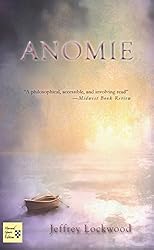
Book "Anomie" by Jeffrey Lockwood
About the Book: Anomie is a uniquely told story of Michael, a Native American, middle-aged university professor and writer. After a series of tragic events, he seeks closure through myriad experiences, in order to bring balance to his world.


About the Author: Jeffrey Lockwood hails from Michigan's Upper Peninsula, and is a member of the Chippewa tribe there. He is the author of In These Low Mountains (March Street Press), a chapbook of poems and short stories, and has several other poems and short stories published in print. Jeffrey has lived internationally for many years, as a soldier, Fulbright Scholar, Peace Corps volunteer, and teacher. Presently, he writes in Hohhot, Inner Mongolia (Huhehaote, Nei Mongol). Anomie is his first novel.
My Review: The story is about an american professor who feels lost in his life after the death of his love. He feels that he does not really belong anywhere. He isolates himself from the world he knows and end up moving to China, trying to have a new beginning in his teaching career and love life. Some symptoms of schizophrenia shows up and at the end he finally discovers where he belongs and embraces it. Some flashback stories are made known, from his youth.
This is a very well written book that works with the psychic of the main character (Michael) in a very realistic way. You feel like you are living his story, his agony, his search for a purpose in life. Very well constructed environment, this book will keep you entertained for hours. Excellent effort and surprisingly just the first novel of this author. Hopefully there will be more!
Thursday, May 7, 2015
Book "The Adventure of the Sussex Vampire" by Sir Arthur Conan Doyle
About the Book: "The Adventure of the Sussex Vampire", written by British author Arthur Conan Doyle, is one of 12 Sherlock Holmes stories collected between 1921-1927 as The Case Book of Sherlock Holmes. It was first published in the January 1924 issues of The Strand Magazine in London and Hearst's International Magazine in New York.
About the Author: Arthur Ignatius Conan Doyle was born on 22 May 1859 at 11 Picardy Place, Edinburgh, Scotland. From 1876 to 1881, he studied medicine at the University of Edinburgh, including a period working in the town of Aston (now a district of Birmingham) and in Sheffield, as well as in Shropshire at Ruyton-XI-Towns. While studying, Doyle began writing short stories. His earliest extant fiction, "The Haunted Grange of Goresthorpe", was unsuccessfully submitted to Blackwood's Magazine. His first published piece "The Mystery of Sasassa Valley", a story set in South Africa, was printed in Chambers's Edinburgh Journal on 6 September 1879. On 20 September 1879, he published his first non-fiction article, "Gelsemium as a Poison" in the British Medical Journal. In 1882 he joined former classmate George Turnavine Budd as his partner at a medical practice in Plymouth, but their relationship proved difficult, and Doyle soon left to set up an independent practice. Arriving in Portsmouth in June of that year with less than £10 (£900 today) to his name, he set up a medical practice at 1 Bush Villas in Elm Grove, Southsea. The practice was initially not very successful. While waiting for patients, Doyle again began writing stories and composed his first novels, The Mystery of Cloomber, not published until 1888, and the unfinished Narrative of John Smith, which would go unpublished until 2011. He amassed a portfolio of short stories including "The Captain of the Pole-Star" and "J. Habakuk Jephson's Statement", both inspired by Doyle's time at sea, the latter of which popularized the mystery of the Mary Celeste and added fictional details such as the perfect condition of the ship (which had actually taken on water by the time it was discovered) and its boats remaining on board (the one boat was in fact missing) that have come to dominate popular accounts of the incident. Doyle struggled to find a publisher for his work. His first significant piece, A Study in Scarlet, was taken by Ward Lock Co. on 20 November 1886, giving Doyle £25 for all rights to the story. The piece appeared later that year in the Beeton's Christmas Annual and received good reviews in The Scotsman and the Glasgow Herald. The story featured the first appearance of Watson and Sherlock Holmes, partially modeled after his former university teacher Joseph Bell. Doyle wrote to him, "It is most certainly to you that I owe Sherlock Holmes ... Round the center of deduction and inference and observation which I have heard you inculcate I have tried to build up a man." Robert Louis Stevenson was able, even in faraway Samoa, to recognize the strong similarity between Joseph Bell and Sherlock Holmes: "My compliments on your very ingenious and very interesting adventures of Sherlock Holmes. ... Can this be my old friend Joe Bell?" Other authors sometimes suggest additional influences—for instance, the famous Edgar Allan Poe character C. Auguste Dupin. A sequel to A Study in Scarlet was commissioned and The Sign of the Four appeared in Lippincott's Magazine in February 1890, under agreement with the Ward Lock company. Doyle felt grievously exploited by Ward Lock as an author new to the publishing world and he left them. Short stories featuring Sherlock Holmes were published in the Strand Magazine. Doyle first began to write for the 'Strand' from his home at 2 Upper Wimpole Street, now marked by a memorial plaque. In this period, however, Holmes was not his sole subject and in 1893, he collaborated with J.M. Barrie on the libretto of Jane Annie. Doyle was found clutching his chest in the hall of Windlesham Manor, his house in Crowborough, East Sussex, on 7 July 1930. He died of a heart attack at the age of 71. His last words were directed toward his wife: "You are wonderful." At the time of his death, there was some controversy concerning his burial place, as he was avowedly not a Christian, considering himself a Spiritualist. He was first buried on 11 July 1930 in Windlesham rose garden. He was later re-interred together with his wife in Minstead churchyard in the New Forest, Hampshire. Carved wooden tablets to his memory and to the memory of his wife are held privately and are inaccessible to the public. That inscription reads, "Blade straight / Steel true / Arthur Conan Doyle / Born May 22nd 1859 / Passed On 7th July 1930." The epitaph on his gravestone in the churchyard reads, in part: "Steel true/Blade straight/Arthur Conan Doyle/Knight/Patriot, Physician, and man of letters". Undershaw, the home near Hindhead, Haslemere, south of London, that Doyle had built and lived in between October 1897 and September 1907, was a hotel and restaurant from 1924 until 2004. It was then bought by a developer and stood empty while conservationists and Doyle fans fought to preserve it. In 2012 the High Court ruled that the redevelopment permission be quashed because proper procedure had not been followed. A statue honors Doyle at Crowborough Cross in Crowborough, where he lived for 23 years. There is also a statue of Sherlock Holmes in Picardy Place, Edinburgh, close to the house where Doyle was born.

My Review: In this story, Holmes receives two odd letters that make reference to vampires. Mr. Robert Ferguson, who comes to 221B Baker Street the next morning, has become convinced that his Peruvian wife has been sucking their baby son's blood. The woman is Mr. Ferguson's second wife, and by his first wife he has an adolescent son of 15, who suffered an unfortunate accident as a child and now does not have the full use of his legs, although he can walk. His name is Jack, and he has suffered beatings at his stepmother's hands, although Mr. Ferguson cannot imagine why. Ever since being found out by her husband, she has locked herself in her room and refused to come out. Only her Peruvian maid, Dolores, is ever allowed in. She takes Mrs. Ferguson her meals.
Even before Holmes and Watson set off for Mr. Ferguson's house in Sussex, Holmes has deduced what is going on, and it has nothing to do with vampires. Holmes's trip is made simply to observe and confirm what he has already deduced.
Mrs. Ferguson's maid announces that her mistress is ill, and Dr. Watson offers to help. He finds an agitated woman in the room upstairs. She speaks of all being destroyed, and of sacrificing herself rather than breaking her husband's heart. She also demands her child, who has been with the nurse, Mrs. Mason, ever since Mr. Ferguson has known about the bloodsucking incidents.
Holmes examines the South American weapons displayed in the house, and meets the children. While Mr. Ferguson is doting on his younger son, Watson notices that Holmes is gazing at the window. He cannot imagine why his friend is doing this.
Mrs. Ferguson is relieved that Holmes tells the truth about what has been happening, as this is exactly what she has wanted: for the truth to come from someone else's lips. It seems that the culprit is Jack, Mr. Ferguson's elder son, who is extremely jealous of his young half-brother. Holmes has deduced this, and confirmed it by looking at Jack's reflection in the window while his father's attention was on the baby. Jack has been shooting poisoned darts — thoughtfully provided by the weapon collection at Cheeseman's — at his brother, and his stepmother's behavior of sucking the baby's neck is thereby explained: she was sucking the poison out. The wounds were caused by the darts, not by her biting.
Another entertaining story by Sir Conan Doyle. I recommend this book to any reader that appreciates a well written mystery, mainly featuring Sherlock Holmes.
Wednesday, May 6, 2015
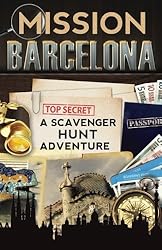
Book "Mission Barcelona - A Scavenger Hunt Adventure" by Catherine Aragon
About the Book: The Scavenger Hunt Adventure series (www.ScavengerHuntAdventures.com) takes your young travelers through the famous sights of cities, engaging them with exciting scavenger hunt activities as you discover city landmarks together.
About the Author: Catherine's favorite quote comes from S. Rao: "There's no destination. The journey is all that there is, and it can be very, very joyful." She believes these words ring true for travel and the joy of the journey - unless that journey happens to be a long plane ride with an energetic toddler (Atlanta to Singapore, 24+ hours, middle seats)!
My Review: This truly is a remarkable book that will keep your kids engaged and enjoying travelling with you. And before you notice, you will also be hunting for the treasures of Barcelona.
I visited Barcelona when I was a kid and went back there other times as an adult. I just wish I had this book when I first visited Barcelona at the age of 11. It would be a completely different travel.
The author presents this traveler's guide for kids in an unusual way, as a mission the kids are assigned to, where for each task they succesfuly accomplish, they earn points. Rules are established (most important, "be kind and respectful to team members"). A quick history of the city, its symbols (dragons, bats), emblems etc is presented. And the fun begins!
Twelve missions are listed (there is a last one called "Anytime Mission", for a total of thirteen). And each one of these missions cover a particular touristic landmark of the city of Barcelona, including La Rambla, Port Vell, La Catedral (St. Eulalia), Plaça Nova, Plaça de Sant Felip Neri, Santa Maria del Mar, Sagrada Familia, La Pedrera, Casa Batlló, Parc de la Ciutadella, Parc Güell, and Castell the Montjuïc. And at each landmark there are lots of details that the kids are asked to search for, or identify some particularity of the place.
This is a very well written guide for the kids that will keep them entertained during the whole trip, allowing you to enjoy the place you are visiting. And the family interaction that his activity stimulates is simply priceless. I recommend this book to all parents that intent to travel to Barcelona with kids. Give them this book as a gift and enjoy your trip!
Thursday, April 30, 2015
Balance of April, 2015
During the month of April 2015, I reviewed the following:
Books:
- "The Adventure of the Mazarin Stone" by Sir Arthur Conan Doyle. Read my review.
- "The Ghosts of Petroglyph Canyon" by Christopher Cloud. Read my review.
- "The Adventure of the Three Gables" by Sir Arthur Conan Doyle. Read my review.
Books:
- "The Adventure of the Mazarin Stone" by Sir Arthur Conan Doyle. Read my review.
- "The Ghosts of Petroglyph Canyon" by Christopher Cloud. Read my review.
- "The Adventure of the Three Gables" by Sir Arthur Conan Doyle. Read my review.
Friday, April 17, 2015
Book: The Adventure of the Three Gables" by Sir Arthur Conan Doyle
About the Book: "The Adventure of the Three Gables" 1926 is one of 12 Sherlock Holmes short stories (56 total) by Arthur Conan Doyle in The Case-Book of Sherlock Holmes first published Strand Magazine October 1921 - April 1927.
About the Author: Arthur Ignatius Conan Doyle was born on 22 May 1859 at 11 Picardy Place, Edinburgh, Scotland. From 1876 to 1881, he studied medicine at the University of Edinburgh, including a period working in the town of Aston (now a district of Birmingham) and in Sheffield, as well as in Shropshire at Ruyton-XI-Towns. While studying, Doyle began writing short stories. His earliest extant fiction, "The Haunted Grange of Goresthorpe", was unsuccessfully submitted to Blackwood's Magazine. His first published piece "The Mystery of Sasassa Valley", a story set in South Africa, was printed in Chambers's Edinburgh Journal on 6 September 1879. On 20 September 1879, he published his first non-fiction article, "Gelsemium as a Poison" in the British Medical Journal. In 1882 he joined former classmate George Turnavine Budd as his partner at a medical practice in Plymouth, but their relationship proved difficult, and Doyle soon left to set up an independent practice. Arriving in Portsmouth in June of that year with less than £10 (£900 today) to his name, he set up a medical practice at 1 Bush Villas in Elm Grove, Southsea. The practice was initially not very successful. While waiting for patients, Doyle again began writing stories and composed his first novels, The Mystery of Cloomber, not published until 1888, and the unfinished Narrative of John Smith, which would go unpublished until 2011. He amassed a portfolio of short stories including "The Captain of the Pole-Star" and "J. Habakuk Jephson's Statement", both inspired by Doyle's time at sea, the latter of which popularized the mystery of the Mary Celeste and added fictional details such as the perfect condition of the ship (which had actually taken on water by the time it was discovered) and its boats remaining on board (the one boat was in fact missing) that have come to dominate popular accounts of the incident. Doyle struggled to find a publisher for his work. His first significant piece, A Study in Scarlet, was taken by Ward Lock Co. on 20 November 1886, giving Doyle £25 for all rights to the story. The piece appeared later that year in the Beeton's Christmas Annual and received good reviews in The Scotsman and the Glasgow Herald. The story featured the first appearance of Watson and Sherlock Holmes, partially modeled after his former university teacher Joseph Bell. Doyle wrote to him, "It is most certainly to you that I owe Sherlock Holmes ... Round the center of deduction and inference and observation which I have heard you inculcate I have tried to build up a man." Robert Louis Stevenson was able, even in faraway Samoa, to recognize the strong similarity between Joseph Bell and Sherlock Holmes: "My compliments on your very ingenious and very interesting adventures of Sherlock Holmes. ... Can this be my old friend Joe Bell?" Other authors sometimes suggest additional influences—for instance, the famous Edgar Allan Poe character C. Auguste Dupin. A sequel to A Study in Scarlet was commissioned and The Sign of the Four appeared in Lippincott's Magazine in February 1890, under agreement with the Ward Lock company. Doyle felt grievously exploited by Ward Lock as an author new to the publishing world and he left them. Short stories featuring Sherlock Holmes were published in the Strand Magazine. Doyle first began to write for the 'Strand' from his home at 2 Upper Wimpole Street, now marked by a memorial plaque. In this period, however, Holmes was not his sole subject and in 1893, he collaborated with J.M. Barrie on the libretto of Jane Annie. Doyle was found clutching his chest in the hall of Windlesham Manor, his house in Crowborough, East Sussex, on 7 July 1930. He died of a heart attack at the age of 71. His last words were directed toward his wife: "You are wonderful." At the time of his death, there was some controversy concerning his burial place, as he was avowedly not a Christian, considering himself a Spiritualist. He was first buried on 11 July 1930 in Windlesham rose garden. He was later re-interred together with his wife in Minstead churchyard in the New Forest, Hampshire. Carved wooden tablets to his memory and to the memory of his wife are held privately and are inaccessible to the public. That inscription reads, "Blade straight / Steel true / Arthur Conan Doyle / Born May 22nd 1859 / Passed On 7th July 1930." The epitaph on his gravestone in the churchyard reads, in part: "Steel true/Blade straight/Arthur Conan Doyle/Knight/Patriot, Physician, and man of letters". Undershaw, the home near Hindhead, Haslemere, south of London, that Doyle had built and lived in between October 1897 and September 1907, was a hotel and restaurant from 1924 until 2004. It was then bought by a developer and stood empty while conservationists and Doyle fans fought to preserve it. In 2012 the High Court ruled that the redevelopment permission be quashed because proper procedure had not been followed. A statue honors Doyle at Crowborough Cross in Crowborough, where he lived for 23 years. There is also a statue of Sherlock Holmes in Picardy Place, Edinburgh, close to the house where Doyle was born.

My Review: The story begins with a visit to 221B Baker Street from Steve Dixie, a black man and a cowardly ruffian who warns Sherlock Holmes to keep away from Harrow. Although Dixie has come to intimidate Holmes, Holmes secures Dixie's future cooperation by threatening to tell what he knows about the suspicious Perkins death involving Dixie. Dixie's boss is Barney Stockdale, and he must be connected with the Harrow Weald case, of which Holmes has just learnt from a message from Mary Maberley, a lady who lives at Three Gables, a house at Harrow Weald.
Mrs. Maberley is an elderly woman whose son has recently died in Rome. He was an attaché there. Some peculiar things have happened at Three Gables. Mrs. Maberley has lived there nearly two years and in all that time has attracted very little attention from her neighbours. Suddenly, however, a man came to her recently and offered to buy her house and all the furniture in it. She was not really willing to do it, especially after her lawyer, Mr. Sutro, told her that the legal agreement drawn up by this prospective buyer would forbid her to remove any possessions from the house when she moved out.
As she is telling Holmes this story, he becomes aware that someone is eavesdropping on the conversation. He opens a door and drags in Susan, a wheezing maid. Holmes manages to establish that Susan communicated to Barney Stockdale the fact that her mistress was hiring Sherlock Holmes, and that precipitated Steve Dixie's visit. Holmes also finds out that a rich woman hired Barney Stockdale and his thugs to do her dirty work. Susan is also a member of the gang but will not give up all their secrets. She leaves in a huff.
Obviously, this woman wants something that has come into the house quite recently. Holmes, seeing some trunks with Italian placenames on them, realizes that her late son Douglas's belongings must hold the key. He instructs Mrs. Maberley to try to get Mr. Sutro to spend a couple of nights at Three Gables, to keep the house guarded.
Holmes finds Dixie outside, keeping the house under surveillance. Dixie is now inclined to help Holmes if he can, to avoid any indiscreet talk about the Perkins lad who met his end so tragically. He swears, however, that he does not know who has hired Barney Stockdale.
Holmes and Watson go back to Three Gables to investigate a burglary that has happened there. The burglars chloroformed Mrs. Maberley and stole a manuscript from her son's belongings. She retained part of one sheet of paper from it when, coming round, she lunged after one of the thieves.
The police inspector at the scene treats the matter as an ordinary burglary, but Holmes knows better. He examines the bit of manuscript retained by Mrs. Maberley, and it appears to be the end of a lurid novel. Holmes is struck by the peculiar wording; the story abruptly changes from third-person narration to first-person narration. It is in Douglas's handwriting; so it would seem that he was putting himself in a story that he was writing.
Holmes and Watson go to see Isadora Klein, a wealthy woman who is used to getting what she wants. The happenings at Three Gables and the information from Langdale Pike have all added up to something. It turns out that Douglas Maberley was involved with Isadora Klein at one time. She broke the relationship off, and he almost wrought his revenge by writing a thinly veiled account of their affair, to be published as a novel. Everyone in London would know who the characters truly were, were the novel ever published. Isadora established that no copy had ever been sent to Douglas's publisher but realized that he must have a copy. She hired Barney Stockdale and his confederates to secure the manuscript. She tried legal means at first, and when that did not work, she resorted to crime. She has burnt the manuscript.
Holmes forces Isadora Klein to write a cheque for £5000 to furnish Mrs. Maberley with a first-class trip round the world in return for his silence about Isadora's nefarious dealings.
another entertaining story, I recommend it to all readers who appreciates a well written mystery short story.
Friday, April 3, 2015
Book "The Ghosts of Petroglyph Canyon" by Christopher Cloud
About the Book: School is out for the summer and Pablo Perez, his sister, Pia, and their cousin, Kiki Flores, visit the Bar-7 ranch in New Mexico. The young Missourians have come to help their Uncle Antonio with the annual cattle roundup.
Uncle Antonio introduces his nephew and nieces to hundreds of primitive petroglyphs that have been chiseled into the walls of a nearby canyon—Petroglyph Canyon. The primitive rock drawings are part of Uncle Antonio’s sprawling cattle ranch. Sadly, looters are routinely excavating the ancient drawings with high-tech rock saws. Uncle Antonio believes the looters are selling the glyphs.
Pablo, Pia, and Kiki are determined to put a stop to the looting, and that’s when the adventure begins.
Pablo, Pia, and Kiki are determined to put a stop to the looting, and that’s when the adventure begins.

About the Author: Award-winning author Christopher Cloud writes middle-grade and young adult novels. He began writing fiction full time at the age of 66 after a long career in journalism and public relations. Chris graduated from the University of Missouri in 1967 with a degree in journalism. He has worked as a reporter, editor, and columnist at newspapers in Texas, California, and Missouri. He was employed by a major oil company as a public relations executive, and later operated his own public relations agency. He created the board game Sixth Sense in 2003. Chris lives in Joplin, Missouri, and enjoys golf and hiking.
 My Review: I became a fan of this author after reading his wonderful novel "Adelita's Secret". Although this particular book is supposed to be a children's book, I thought about giving it a shoot, and I am not disappointed at all for giving it an opportunity. The book is well written, and the plot is very intelligent. The author makes our young characters to be the hero/heroines of this story, and that definitely will captivate the attention of our young readers, increasing their will to read more and more. This is the perfect book to give as a gift to any young reader, but even adults will enjoy this very well written book. All the characters are well developed and I particularly loved Charlie Pecos and Pia. The plot develops in a nice pace and there are some twists in the story that you will love. This book will keep the reader entertained for some hours. It took me about six hours to read the whole book.
Kudos to Mr. Christopher, that is proving to be a very versatile writer, producing excellent pieces on different themes. Very impressive!

Kudos to Mr. Christopher, that is proving to be a very versatile writer, producing excellent pieces on different themes. Very impressive!
Thursday, April 2, 2015
Book "The Adventure of the Mazarin Stone" by Sir Arthur Conan Doyle
About the Book: "The Adventure of the Mazarin Stone" (1921) is one of 12 Sherlock Holmes short stories (56 total) by Arthur Conan Doyle in The Case-Book of Sherlock Holmes first published Strand Magazine October 1921 - April 1927.
About the Author: Arthur Ignatius Conan Doyle was born on 22 May 1859 at 11 Picardy Place, Edinburgh, Scotland. From 1876 to 1881, he studied medicine at the University of Edinburgh, including a period working in the town of Aston (now a district of Birmingham) and in Sheffield, as well as in Shropshire at Ruyton-XI-Towns. While studying, Doyle began writing short stories. His earliest extant fiction, "The Haunted Grange of Goresthorpe", was unsuccessfully submitted to Blackwood's Magazine. His first published piece "The Mystery of Sasassa Valley", a story set in South Africa, was printed in Chambers's Edinburgh Journal on 6 September 1879. On 20 September 1879, he published his first non-fiction article, "Gelsemium as a Poison" in the British Medical Journal. In 1882 he joined former classmate George Turnavine Budd as his partner at a medical practice in Plymouth, but their relationship proved difficult, and Doyle soon left to set up an independent practice. Arriving in Portsmouth in June of that year with less than £10 (£900 today) to his name, he set up a medical practice at 1 Bush Villas in Elm Grove, Southsea. The practice was initially not very successful. While waiting for patients, Doyle again began writing stories and composed his first novels, The Mystery of Cloomber, not published until 1888, and the unfinished Narrative of John Smith, which would go unpublished until 2011. He amassed a portfolio of short stories including "The Captain of the Pole-Star" and "J. Habakuk Jephson's Statement", both inspired by Doyle's time at sea, the latter of which popularized the mystery of the Mary Celeste and added fictional details such as the perfect condition of the ship (which had actually taken on water by the time it was discovered) and its boats remaining on board (the one boat was in fact missing) that have come to dominate popular accounts of the incident. Doyle struggled to find a publisher for his work. His first significant piece, A Study in Scarlet, was taken by Ward Lock Co. on 20 November 1886, giving Doyle £25 for all rights to the story. The piece appeared later that year in the Beeton's Christmas Annual and received good reviews in The Scotsman and the Glasgow Herald. The story featured the first appearance of Watson and Sherlock Holmes, partially modeled after his former university teacher Joseph Bell. Doyle wrote to him, "It is most certainly to you that I owe Sherlock Holmes ... Round the center of deduction and inference and observation which I have heard you inculcate I have tried to build up a man." Robert Louis Stevenson was able, even in faraway Samoa, to recognize the strong similarity between Joseph Bell and Sherlock Holmes: "My compliments on your very ingenious and very interesting adventures of Sherlock Holmes. ... Can this be my old friend Joe Bell?" Other authors sometimes suggest additional influences—for instance, the famous Edgar Allan Poe character C. Auguste Dupin. A sequel to A Study in Scarlet was commissioned and The Sign of the Four appeared in Lippincott's Magazine in February 1890, under agreement with the Ward Lock company. Doyle felt grievously exploited by Ward Lock as an author new to the publishing world and he left them. Short stories featuring Sherlock Holmes were published in the Strand Magazine. Doyle first began to write for the 'Strand' from his home at 2 Upper Wimpole Street, now marked by a memorial plaque. In this period, however, Holmes was not his sole subject and in 1893, he collaborated with J.M. Barrie on the libretto of Jane Annie. Doyle was found clutching his chest in the hall of Windlesham Manor, his house in Crowborough, East Sussex, on 7 July 1930. He died of a heart attack at the age of 71. His last words were directed toward his wife: "You are wonderful." At the time of his death, there was some controversy concerning his burial place, as he was avowedly not a Christian, considering himself a Spiritualist. He was first buried on 11 July 1930 in Windlesham rose garden. He was later re-interred together with his wife in Minstead churchyard in the New Forest, Hampshire. Carved wooden tablets to his memory and to the memory of his wife are held privately and are inaccessible to the public. That inscription reads, "Blade straight / Steel true / Arthur Conan Doyle / Born May 22nd 1859 / Passed On 7th July 1930." The epitaph on his gravestone in the churchyard reads, in part: "Steel true/Blade straight/Arthur Conan Doyle/Knight/Patriot, Physician, and man of letters". Undershaw, the home near Hindhead, Haslemere, south of London, that Doyle had built and lived in between October 1897 and September 1907, was a hotel and restaurant from 1924 until 2004. It was then bought by a developer and stood empty while conservationists and Doyle fans fought to preserve it. In 2012 the High Court ruled that the redevelopment permission be quashed because proper procedure had not been followed. A statue honors Doyle at Crowborough Cross in Crowborough, where he lived for 23 years. There is also a statue of Sherlock Holmes in Picardy Place, Edinburgh, close to the house where Doyle was born.

He invites them to discuss the deal while he plays violin in the next room. When the Count decides to double-cross Holmes and takes the stone from his secret pocket to show Sam in window light, the detective springs from the chair in place of his replica and grabs the £100K jewel. His bedroom has a gramophone and secret passage to behind the curtain.
After the police take away the villains, Lord Cantlemere sweeps in. Unlike the Prime Minister and Home Secretary, he did not want Holmes. When tricked into insisting on arrest for whoever is found possessing the diamond, he finds the jewel in his pocket, and apologizes. Finally, Holmes can eat.
This adventure is notable for being the one of only two Arthur Conan Doyle Holmes stories, aside from a couple of humorous vignettes, to be written in third person. The other is "His Last Bow". "The Mazarin Stone" was written this way because it was adapted from a stage play, "The Crown Diamond", in which Watson hardly appeared. Its adaptation from the theatre also explains why the action in this story is confined to one room.
In the original play, the villain was Holmes's enemy Colonel Sebastian Moran of "The Adventure of the Empty House" infamy, not Count Negretto Sylvius.
I recommend this book to all readers who appreciate a well written mystery story.
Tuesday, March 31, 2015
Balance of March 2015
Subscribe to:
Posts (Atom)