
During the month of April 2015, I reviewed the following:
Books:
- "The Adventure of the Mazarin Stone" by Sir Arthur Conan Doyle. Read my review.
- "The Ghosts of Petroglyph Canyon" by Christopher Cloud. Read my review.
- "The Adventure of the Three Gables" by Sir Arthur Conan Doyle. Read my review.
Thursday, April 30, 2015


Friday, April 17, 2015
Book: The Adventure of the Three Gables" by Sir Arthur Conan Doyle
About the Book: "The Adventure of the Three Gables" 1926 is one of 12 Sherlock Holmes short stories (56 total) by Arthur Conan Doyle in The Case-Book of Sherlock Holmes first published Strand Magazine October 1921 - April 1927.
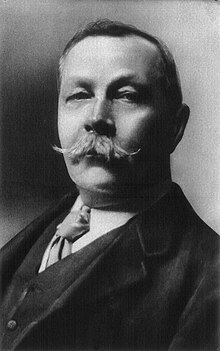
About the Author: Arthur Ignatius Conan Doyle was born on 22 May 1859 at 11 Picardy Place, Edinburgh, Scotland. From 1876 to 1881, he studied medicine at the University of Edinburgh, including a period working in the town of Aston (now a district of Birmingham) and in Sheffield, as well as in Shropshire at Ruyton-XI-Towns. While studying, Doyle began writing short stories. His earliest extant fiction, "The Haunted Grange of Goresthorpe", was unsuccessfully submitted to Blackwood's Magazine. His first published piece "The Mystery of Sasassa Valley", a story set in South Africa, was printed in Chambers's Edinburgh Journal on 6 September 1879. On 20 September 1879, he published his first non-fiction article, "Gelsemium as a Poison" in the British Medical Journal. In 1882 he joined former classmate George Turnavine Budd as his partner at a medical practice in Plymouth, but their relationship proved difficult, and Doyle soon left to set up an independent practice. Arriving in Portsmouth in June of that year with less than £10 (£900 today) to his name, he set up a medical practice at 1 Bush Villas in Elm Grove, Southsea. The practice was initially not very successful. While waiting for patients, Doyle again began writing stories and composed his first novels, The Mystery of Cloomber, not published until 1888, and the unfinished Narrative of John Smith, which would go unpublished until 2011. He amassed a portfolio of short stories including "The Captain of the Pole-Star" and "J. Habakuk Jephson's Statement", both inspired by Doyle's time at sea, the latter of which popularized the mystery of the Mary Celeste and added fictional details such as the perfect condition of the ship (which had actually taken on water by the time it was discovered) and its boats remaining on board (the one boat was in fact missing) that have come to dominate popular accounts of the incident. Doyle struggled to find a publisher for his work. His first significant piece, A Study in Scarlet, was taken by Ward Lock Co. on 20 November 1886, giving Doyle £25 for all rights to the story. The piece appeared later that year in the Beeton's Christmas Annual and received good reviews in The Scotsman and the Glasgow Herald. The story featured the first appearance of Watson and Sherlock Holmes, partially modeled after his former university teacher Joseph Bell. Doyle wrote to him, "It is most certainly to you that I owe Sherlock Holmes ... Round the center of deduction and inference and observation which I have heard you inculcate I have tried to build up a man." Robert Louis Stevenson was able, even in faraway Samoa, to recognize the strong similarity between Joseph Bell and Sherlock Holmes: "My compliments on your very ingenious and very interesting adventures of Sherlock Holmes. ... Can this be my old friend Joe Bell?" Other authors sometimes suggest additional influences—for instance, the famous Edgar Allan Poe character C. Auguste Dupin. A sequel to A Study in Scarlet was commissioned and The Sign of the Four appeared in Lippincott's Magazine in February 1890, under agreement with the Ward Lock company. Doyle felt grievously exploited by Ward Lock as an author new to the publishing world and he left them. Short stories featuring Sherlock Holmes were published in the Strand Magazine. Doyle first began to write for the 'Strand' from his home at 2 Upper Wimpole Street, now marked by a memorial plaque. In this period, however, Holmes was not his sole subject and in 1893, he collaborated with J.M. Barrie on the libretto of Jane Annie. Doyle was found clutching his chest in the hall of Windlesham Manor, his house in Crowborough, East Sussex, on 7 July 1930. He died of a heart attack at the age of 71. His last words were directed toward his wife: "You are wonderful." At the time of his death, there was some controversy concerning his burial place, as he was avowedly not a Christian, considering himself a Spiritualist. He was first buried on 11 July 1930 in Windlesham rose garden. He was later re-interred together with his wife in Minstead churchyard in the New Forest, Hampshire. Carved wooden tablets to his memory and to the memory of his wife are held privately and are inaccessible to the public. That inscription reads, "Blade straight / Steel true / Arthur Conan Doyle / Born May 22nd 1859 / Passed On 7th July 1930." The epitaph on his gravestone in the churchyard reads, in part: "Steel true/Blade straight/Arthur Conan Doyle/Knight/Patriot, Physician, and man of letters". Undershaw, the home near Hindhead, Haslemere, south of London, that Doyle had built and lived in between October 1897 and September 1907, was a hotel and restaurant from 1924 until 2004. It was then bought by a developer and stood empty while conservationists and Doyle fans fought to preserve it. In 2012 the High Court ruled that the redevelopment permission be quashed because proper procedure had not been followed. A statue honors Doyle at Crowborough Cross in Crowborough, where he lived for 23 years. There is also a statue of Sherlock Holmes in Picardy Place, Edinburgh, close to the house where Doyle was born.

My Review: The story begins with a visit to 221B Baker Street from Steve Dixie, a black man and a cowardly ruffian who warns Sherlock Holmes to keep away from Harrow. Although Dixie has come to intimidate Holmes, Holmes secures Dixie's future cooperation by threatening to tell what he knows about the suspicious Perkins death involving Dixie. Dixie's boss is Barney Stockdale, and he must be connected with the Harrow Weald case, of which Holmes has just learnt from a message from Mary Maberley, a lady who lives at Three Gables, a house at Harrow Weald.
Mrs. Maberley is an elderly woman whose son has recently died in Rome. He was an attaché there. Some peculiar things have happened at Three Gables. Mrs. Maberley has lived there nearly two years and in all that time has attracted very little attention from her neighbours. Suddenly, however, a man came to her recently and offered to buy her house and all the furniture in it. She was not really willing to do it, especially after her lawyer, Mr. Sutro, told her that the legal agreement drawn up by this prospective buyer would forbid her to remove any possessions from the house when she moved out.
As she is telling Holmes this story, he becomes aware that someone is eavesdropping on the conversation. He opens a door and drags in Susan, a wheezing maid. Holmes manages to establish that Susan communicated to Barney Stockdale the fact that her mistress was hiring Sherlock Holmes, and that precipitated Steve Dixie's visit. Holmes also finds out that a rich woman hired Barney Stockdale and his thugs to do her dirty work. Susan is also a member of the gang but will not give up all their secrets. She leaves in a huff.
Obviously, this woman wants something that has come into the house quite recently. Holmes, seeing some trunks with Italian placenames on them, realizes that her late son Douglas's belongings must hold the key. He instructs Mrs. Maberley to try to get Mr. Sutro to spend a couple of nights at Three Gables, to keep the house guarded.
Holmes finds Dixie outside, keeping the house under surveillance. Dixie is now inclined to help Holmes if he can, to avoid any indiscreet talk about the Perkins lad who met his end so tragically. He swears, however, that he does not know who has hired Barney Stockdale.
Holmes and Watson go back to Three Gables to investigate a burglary that has happened there. The burglars chloroformed Mrs. Maberley and stole a manuscript from her son's belongings. She retained part of one sheet of paper from it when, coming round, she lunged after one of the thieves.
The police inspector at the scene treats the matter as an ordinary burglary, but Holmes knows better. He examines the bit of manuscript retained by Mrs. Maberley, and it appears to be the end of a lurid novel. Holmes is struck by the peculiar wording; the story abruptly changes from third-person narration to first-person narration. It is in Douglas's handwriting; so it would seem that he was putting himself in a story that he was writing.
Holmes and Watson go to see Isadora Klein, a wealthy woman who is used to getting what she wants. The happenings at Three Gables and the information from Langdale Pike have all added up to something. It turns out that Douglas Maberley was involved with Isadora Klein at one time. She broke the relationship off, and he almost wrought his revenge by writing a thinly veiled account of their affair, to be published as a novel. Everyone in London would know who the characters truly were, were the novel ever published. Isadora established that no copy had ever been sent to Douglas's publisher but realized that he must have a copy. She hired Barney Stockdale and his confederates to secure the manuscript. She tried legal means at first, and when that did not work, she resorted to crime. She has burnt the manuscript.
Holmes forces Isadora Klein to write a cheque for £5000 to furnish Mrs. Maberley with a first-class trip round the world in return for his silence about Isadora's nefarious dealings.
another entertaining story, I recommend it to all readers who appreciates a well written mystery short story.
Friday, April 3, 2015
Book "The Ghosts of Petroglyph Canyon" by Christopher Cloud
About the Book: School is out for the summer and Pablo Perez, his sister, Pia, and their cousin, Kiki Flores, visit the Bar-7 ranch in New Mexico. The young Missourians have come to help their Uncle Antonio with the annual cattle roundup.
Uncle Antonio introduces his nephew and nieces to hundreds of primitive petroglyphs that have been chiseled into the walls of a nearby canyon—Petroglyph Canyon. The primitive rock drawings are part of Uncle Antonio’s sprawling cattle ranch. Sadly, looters are routinely excavating the ancient drawings with high-tech rock saws. Uncle Antonio believes the looters are selling the glyphs.
Pablo, Pia, and Kiki are determined to put a stop to the looting, and that’s when the adventure begins.
Pablo, Pia, and Kiki are determined to put a stop to the looting, and that’s when the adventure begins.

About the Author: Award-winning author Christopher Cloud writes middle-grade and young adult novels. He began writing fiction full time at the age of 66 after a long career in journalism and public relations. Chris graduated from the University of Missouri in 1967 with a degree in journalism. He has worked as a reporter, editor, and columnist at newspapers in Texas, California, and Missouri. He was employed by a major oil company as a public relations executive, and later operated his own public relations agency. He created the board game Sixth Sense in 2003. Chris lives in Joplin, Missouri, and enjoys golf and hiking.
 My Review: I became a fan of this author after reading his wonderful novel "Adelita's Secret". Although this particular book is supposed to be a children's book, I thought about giving it a shoot, and I am not disappointed at all for giving it an opportunity. The book is well written, and the plot is very intelligent. The author makes our young characters to be the hero/heroines of this story, and that definitely will captivate the attention of our young readers, increasing their will to read more and more. This is the perfect book to give as a gift to any young reader, but even adults will enjoy this very well written book. All the characters are well developed and I particularly loved Charlie Pecos and Pia. The plot develops in a nice pace and there are some twists in the story that you will love. This book will keep the reader entertained for some hours. It took me about six hours to read the whole book.
Kudos to Mr. Christopher, that is proving to be a very versatile writer, producing excellent pieces on different themes. Very impressive!

Kudos to Mr. Christopher, that is proving to be a very versatile writer, producing excellent pieces on different themes. Very impressive!
Thursday, April 2, 2015
Book "The Adventure of the Mazarin Stone" by Sir Arthur Conan Doyle
About the Book: "The Adventure of the Mazarin Stone" (1921) is one of 12 Sherlock Holmes short stories (56 total) by Arthur Conan Doyle in The Case-Book of Sherlock Holmes first published Strand Magazine October 1921 - April 1927.
About the Author: Arthur Ignatius Conan Doyle was born on 22 May 1859 at 11 Picardy Place, Edinburgh, Scotland. From 1876 to 1881, he studied medicine at the University of Edinburgh, including a period working in the town of Aston (now a district of Birmingham) and in Sheffield, as well as in Shropshire at Ruyton-XI-Towns. While studying, Doyle began writing short stories. His earliest extant fiction, "The Haunted Grange of Goresthorpe", was unsuccessfully submitted to Blackwood's Magazine. His first published piece "The Mystery of Sasassa Valley", a story set in South Africa, was printed in Chambers's Edinburgh Journal on 6 September 1879. On 20 September 1879, he published his first non-fiction article, "Gelsemium as a Poison" in the British Medical Journal. In 1882 he joined former classmate George Turnavine Budd as his partner at a medical practice in Plymouth, but their relationship proved difficult, and Doyle soon left to set up an independent practice. Arriving in Portsmouth in June of that year with less than £10 (£900 today) to his name, he set up a medical practice at 1 Bush Villas in Elm Grove, Southsea. The practice was initially not very successful. While waiting for patients, Doyle again began writing stories and composed his first novels, The Mystery of Cloomber, not published until 1888, and the unfinished Narrative of John Smith, which would go unpublished until 2011. He amassed a portfolio of short stories including "The Captain of the Pole-Star" and "J. Habakuk Jephson's Statement", both inspired by Doyle's time at sea, the latter of which popularized the mystery of the Mary Celeste and added fictional details such as the perfect condition of the ship (which had actually taken on water by the time it was discovered) and its boats remaining on board (the one boat was in fact missing) that have come to dominate popular accounts of the incident. Doyle struggled to find a publisher for his work. His first significant piece, A Study in Scarlet, was taken by Ward Lock Co. on 20 November 1886, giving Doyle £25 for all rights to the story. The piece appeared later that year in the Beeton's Christmas Annual and received good reviews in The Scotsman and the Glasgow Herald. The story featured the first appearance of Watson and Sherlock Holmes, partially modeled after his former university teacher Joseph Bell. Doyle wrote to him, "It is most certainly to you that I owe Sherlock Holmes ... Round the center of deduction and inference and observation which I have heard you inculcate I have tried to build up a man." Robert Louis Stevenson was able, even in faraway Samoa, to recognize the strong similarity between Joseph Bell and Sherlock Holmes: "My compliments on your very ingenious and very interesting adventures of Sherlock Holmes. ... Can this be my old friend Joe Bell?" Other authors sometimes suggest additional influences—for instance, the famous Edgar Allan Poe character C. Auguste Dupin. A sequel to A Study in Scarlet was commissioned and The Sign of the Four appeared in Lippincott's Magazine in February 1890, under agreement with the Ward Lock company. Doyle felt grievously exploited by Ward Lock as an author new to the publishing world and he left them. Short stories featuring Sherlock Holmes were published in the Strand Magazine. Doyle first began to write for the 'Strand' from his home at 2 Upper Wimpole Street, now marked by a memorial plaque. In this period, however, Holmes was not his sole subject and in 1893, he collaborated with J.M. Barrie on the libretto of Jane Annie. Doyle was found clutching his chest in the hall of Windlesham Manor, his house in Crowborough, East Sussex, on 7 July 1930. He died of a heart attack at the age of 71. His last words were directed toward his wife: "You are wonderful." At the time of his death, there was some controversy concerning his burial place, as he was avowedly not a Christian, considering himself a Spiritualist. He was first buried on 11 July 1930 in Windlesham rose garden. He was later re-interred together with his wife in Minstead churchyard in the New Forest, Hampshire. Carved wooden tablets to his memory and to the memory of his wife are held privately and are inaccessible to the public. That inscription reads, "Blade straight / Steel true / Arthur Conan Doyle / Born May 22nd 1859 / Passed On 7th July 1930." The epitaph on his gravestone in the churchyard reads, in part: "Steel true/Blade straight/Arthur Conan Doyle/Knight/Patriot, Physician, and man of letters". Undershaw, the home near Hindhead, Haslemere, south of London, that Doyle had built and lived in between October 1897 and September 1907, was a hotel and restaurant from 1924 until 2004. It was then bought by a developer and stood empty while conservationists and Doyle fans fought to preserve it. In 2012 the High Court ruled that the redevelopment permission be quashed because proper procedure had not been followed. A statue honors Doyle at Crowborough Cross in Crowborough, where he lived for 23 years. There is also a statue of Sherlock Holmes in Picardy Place, Edinburgh, close to the house where Doyle was born.

He invites them to discuss the deal while he plays violin in the next room. When the Count decides to double-cross Holmes and takes the stone from his secret pocket to show Sam in window light, the detective springs from the chair in place of his replica and grabs the £100K jewel. His bedroom has a gramophone and secret passage to behind the curtain.
After the police take away the villains, Lord Cantlemere sweeps in. Unlike the Prime Minister and Home Secretary, he did not want Holmes. When tricked into insisting on arrest for whoever is found possessing the diamond, he finds the jewel in his pocket, and apologizes. Finally, Holmes can eat.
This adventure is notable for being the one of only two Arthur Conan Doyle Holmes stories, aside from a couple of humorous vignettes, to be written in third person. The other is "His Last Bow". "The Mazarin Stone" was written this way because it was adapted from a stage play, "The Crown Diamond", in which Watson hardly appeared. Its adaptation from the theatre also explains why the action in this story is confined to one room.
In the original play, the villain was Holmes's enemy Colonel Sebastian Moran of "The Adventure of the Empty House" infamy, not Count Negretto Sylvius.
I recommend this book to all readers who appreciate a well written mystery story.
Tuesday, March 31, 2015
Balance of March 2015
Friday, March 27, 2015
Book "The Adventure of the Blanched Soldier" by Sir Arthur Conan Doyle
About the Book: "The Adventure of the Blanched Soldier" (1926) is one of 12 Sherlock Holmes short stories (56 total) by Arthur Conan Doyle in The Case-Book of Sherlock Holmes first published Strand Magazine October 1921 - April 1927. This story is one of only two narrated by Holmes rather than Doctor Watson - the other one being "The Adventure of the Lion's Mane".
About the Author: Arthur Ignatius Conan Doyle was born on 22 May 1859 at 11 Picardy Place, Edinburgh, Scotland. From 1876 to 1881, he studied medicine at the University of Edinburgh, including a period working in the town of Aston (now a district of Birmingham) and in Sheffield, as well as in Shropshire at Ruyton-XI-Towns. While studying, Doyle began writing short stories. His earliest extant fiction, "The Haunted Grange of Goresthorpe", was unsuccessfully submitted to Blackwood's Magazine. His first published piece "The Mystery of Sasassa Valley", a story set in South Africa, was printed in Chambers's Edinburgh Journal on 6 September 1879. On 20 September 1879, he published his first non-fiction article, "Gelsemium as a Poison" in the British Medical Journal. In 1882 he joined former classmate George Turnavine Budd as his partner at a medical practice in Plymouth, but their relationship proved difficult, and Doyle soon left to set up an independent practice. Arriving in Portsmouth in June of that year with less than £10 (£900 today) to his name, he set up a medical practice at 1 Bush Villas in Elm Grove, Southsea. The practice was initially not very successful. While waiting for patients, Doyle again began writing stories and composed his first novels, The Mystery of Cloomber, not published until 1888, and the unfinished Narrative of John Smith, which would go unpublished until 2011. He amassed a portfolio of short stories including "The Captain of the Pole-Star" and "J. Habakuk Jephson's Statement", both inspired by Doyle's time at sea, the latter of which popularized the mystery of the Mary Celeste and added fictional details such as the perfect condition of the ship (which had actually taken on water by the time it was discovered) and its boats remaining on board (the one boat was in fact missing) that have come to dominate popular accounts of the incident. Doyle struggled to find a publisher for his work. His first significant piece, A Study in Scarlet, was taken by Ward Lock Co. on 20 November 1886, giving Doyle £25 for all rights to the story. The piece appeared later that year in the Beeton's Christmas Annual and received good reviews in The Scotsman and the Glasgow Herald. The story featured the first appearance of Watson and Sherlock Holmes, partially modeled after his former university teacher Joseph Bell. Doyle wrote to him, "It is most certainly to you that I owe Sherlock Holmes ... Round the center of deduction and inference and observation which I have heard you inculcate I have tried to build up a man." Robert Louis Stevenson was able, even in faraway Samoa, to recognize the strong similarity between Joseph Bell and Sherlock Holmes: "My compliments on your very ingenious and very interesting adventures of Sherlock Holmes. ... Can this be my old friend Joe Bell?" Other authors sometimes suggest additional influences—for instance, the famous Edgar Allan Poe character C. Auguste Dupin. A sequel to A Study in Scarlet was commissioned and The Sign of the Four appeared in Lippincott's Magazine in February 1890, under agreement with the Ward Lock company. Doyle felt grievously exploited by Ward Lock as an author new to the publishing world and he left them. Short stories featuring Sherlock Holmes were published in the Strand Magazine. Doyle first began to write for the 'Strand' from his home at 2 Upper Wimpole Street, now marked by a memorial plaque. In this period, however, Holmes was not his sole subject and in 1893, he collaborated with J.M. Barrie on the libretto of Jane Annie. Doyle was found clutching his chest in the hall of Windlesham Manor, his house in Crowborough, East Sussex, on 7 July 1930. He died of a heart attack at the age of 71. His last words were directed toward his wife: "You are wonderful." At the time of his death, there was some controversy concerning his burial place, as he was avowedly not a Christian, considering himself a Spiritualist. He was first buried on 11 July 1930 in Windlesham rose garden. He was later re-interred together with his wife in Minstead churchyard in the New Forest, Hampshire. Carved wooden tablets to his memory and to the memory of his wife are held privately and are inaccessible to the public. That inscription reads, "Blade straight / Steel true / Arthur Conan Doyle / Born May 22nd 1859 / Passed On 7th July 1930." The epitaph on his gravestone in the churchyard reads, in part: "Steel true/Blade straight/Arthur Conan Doyle/Knight/Patriot, Physician, and man of letters". Undershaw, the home near Hindhead, Haslemere, south of London, that Doyle had built and lived in between October 1897 and September 1907, was a hotel and restaurant from 1924 until 2004. It was then bought by a developer and stood empty while conservationists and Doyle fans fought to preserve it. In 2012 the High Court ruled that the redevelopment permission be quashed because proper procedure had not been followed. A statue honors Doyle at Crowborough Cross in Crowborough, where he lived for 23 years. There is also a statue of Sherlock Holmes in Picardy Place, Edinburgh, close to the house where Doyle was born.

My Review: In this story, in January 1903, at Baker Street, James M. Dodd sees Holmes about a missing friend, Godfrey Emsworth. Dodd and Emsworth served together in the Imperial Yeomanry in South Africa during the Second Boer War, which has only just ended. Emsworth was wounded. Dodd has not seen him since the report of his injury, and "not a word for six months and more". Since Emsworth has always been such a good friend, Dodd believes something is amiss.
Dodd tried writing to Colonel Emsworth, Godfrey's father. He had to write twice before he got an answer, and then was told in a terse letter that Godfrey was not at home; he had gone on a voyage around the world. Dodd was not satisfied with this explanation — he was sure that Godfrey would not simply go off around the world without telling his old army friend.
Next, Dodd went to the Emsworth family home, Tuxbury Old Park, near Bedford. There were four people there — the Colonel and his wife; and an old butler and his wife. The Colonel was something less than a gracious host. He repeated the story about his son's world voyage, implied that Dodd was lying about even knowing Godfrey, and seemed irritated at Dodd's suggestion that he provide information that would allow him to send Godfrey a letter. This the Colonel would not do.
Dodd was still determined to ascertain Godfrey's fate. That evening, in the ground-floor bedroom, Dodd talked to the butler, Ralph, when he came to deliver some coal. When Ralph mentioned Godfrey in the past tense, Dodd began to suspect that his friend was dead. Ralph indicated that no, he wasn't, but that it might be better that way.
If the butler's words had deepened the mystery, Godfrey's appearance at the bedroom window made it utterly bottomless. There he was, with his nose pressed against the glass, but looking ghastly pale. He ran off when he saw that Dodd was looking straight at him. Dodd opened the window and climbed out, thinking to go after him and put an end to this mystery. In the pathways of the park, he could not see where Godfrey had gone, but heard a door slam somewhere ahead of him, not back at the house.
Dodd contrived to stay another day at Tuxbury Old Park, and went looking about the property. He saw a well-dressed man leaving an outbuilding, whose suspicion was aroused somewhat, as Dodd was aware that he was watching him. The outbuilding seemed empty enough, but he was sure that it was where Godfrey had gone the previous evening.
After nightfall, he crept out of the bedroom window again and stole down to the outbuilding. Finding a crack in the shutters, he looked in, saw the man he had seen earlier in the day, and another figure who he was sure was Godfrey, although he could not see him clearly.
At this point came the tap on his shoulder. It was Colonel Emsworth, beside himself with rage, and he made it plain to Dodd that he was to leave on the first available train.
Dodd comes straight to Holmes to relate the story, and Holmes, as is often the case, finds the matter quite elementary. There are, after all, only a few reasons why a family would shut one of its members in an outbuilding. Holmes needs only to ask about the publication that the man with Godfrey was reading, and although Dodd cannot be absolutely sure of it, Holmes seems satisfied with the answer. Only one piece of evidence is missing.
Holmes has his missing clue that same day when he and Dodd visit Tuxbury Old Park, much to the Colonel's fury. The clue comes in the form of a tarry smell from the leather gloves that Ralph has just removed. The Colonel threatens to summon the police if Dodd and Holmes do not leave, but Holmes points out that involving the police would bring about the very catastrophe that the Colonel wishes to avoid.
Holmes makes it known that he has deduced that the mystery can be summed up in one word: leprosy. Upon visiting the outbuilding, Holmes and Dodd hear Godfrey's story right from his own lips. The night he was wounded in South Africa, he found his way to a house and slept in a bed there. When he woke up in the morning, he found himself surrounded by lepers. The doctor there told him that he was in a leper hospital, and would likely contract the disease after sleeping in a leper's bed. The doctor helped heal his wounds, and once Godfrey got back to England, the dreaded symptoms began to appear. His family's fear of their son's seclusion in an institution, and possibly the stigma attached to leprosy, have forced them to keep his presence secret.
The story ends happily, however. Holmes has brought with him Sir James Saunders, a famous dermatologist from London. Sir James determines that Godfrey in fact has pseudo-leprosy, or ichthyosis, something quite treatable.
Another entertaining story, I recommend this one to all readers that enjoy a well written mystery case, mainly featuring Mr. Sherlock Holmes and his friend Dr. Watson.
Friday, March 13, 2015
Book "Dracengard: Book 2" by Christopher Vale
About the Book: It has been over a thousand years since the last Realm War, when the forces of light banished the demonic shedom back to the Realm of Darkness. Now a new evil threatens the Middle Realm as a self-proclaimed wizard and a mysterious black knight lead an army of humanoid lizards against the kingdoms of man.
Sides are chosen as news of the Wizard's conquests spread throughout the Middle Realm. While Terrwyn struggles to overcome lies and betrayal, another young princess leads an elite military order towards Dracengard, and our heroes' faith in the ancient legends is renewed when they come face-to-face with warriors from the Realm of Light.

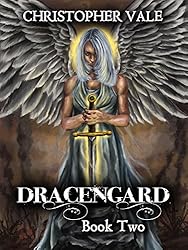
The plot is interesting: In the first book we saw a wizard trying to reunite some magic stones that would give him power beyond anything imaginable. And there was also a dark knight helping him with an army of monsters. In this second book we see the development of this war for power and the characters in the book will have to chose sides. Help for our heroes will come from unexpected places and new alliances are made.
This is the second book of a series, so I recommend that you read the first book prior of reading this one. You will not regret it. And I can hardly wait to read the third book in this series!
I recommend this book to the permanent library of all readers that enjoy a well written book, young adults or not. You will enjoy it the same.
I recommend this book to the permanent library of all readers that enjoy a well written book, young adults or not. You will enjoy it the same.
If you read this review, feel free to leave a comment.
Saturday, February 28, 2015
Friday, February 27, 2015
Book "The Adventure of The Illustrious Client" by Sir Arthur Conan Doyle
About the Book: "The Adventure of the Illustrious Client" (1924), one of the 56 Sherlock Holmes short stories written by British author Sir Arthur Conan Doyle, is one of 12 stories in the cycle collected as The Case Book of Sherlock Holmes.
About the Author: Arthur Ignatius Conan Doyle was born on 22 May 1859 at 11 Picardy Place, Edinburgh, Scotland. From 1876 to 1881, he studied medicine at the University of Edinburgh, including a period working in the town of Aston (now a district of Birmingham) and in Sheffield, as well as in Shropshire at Ruyton-XI-Towns. While studying, Doyle began writing short stories. His earliest extant fiction, "The Haunted Grange of Goresthorpe", was unsuccessfully submitted to Blackwood's Magazine. His first published piece "The Mystery of Sasassa Valley", a story set in South Africa, was printed in Chambers's Edinburgh Journal on 6 September 1879. On 20 September 1879, he published his first non-fiction article, "Gelsemium as a Poison" in the British Medical Journal. In 1882 he joined former classmate George Turnavine Budd as his partner at a medical practice in Plymouth, but their relationship proved difficult, and Doyle soon left to set up an independent practice. Arriving in Portsmouth in June of that year with less than £10 (£900 today) to his name, he set up a medical practice at 1 Bush Villas in Elm Grove, Southsea. The practice was initially not very successful. While waiting for patients, Doyle again began writing stories and composed his first novels, The Mystery of Cloomber, not published until 1888, and the unfinished Narrative of John Smith, which would go unpublished until 2011. He amassed a portfolio of short stories including "The Captain of the Pole-Star" and "J. Habakuk Jephson's Statement", both inspired by Doyle's time at sea, the latter of which popularized the mystery of the Mary Celeste and added fictional details such as the perfect condition of the ship (which had actually taken on water by the time it was discovered) and its boats remaining on board (the one boat was in fact missing) that have come to dominate popular accounts of the incident. Doyle struggled to find a publisher for his work. His first significant piece, A Study in Scarlet, was taken by Ward Lock Co. on 20 November 1886, giving Doyle £25 for all rights to the story. The piece appeared later that year in the Beeton's Christmas Annual and received good reviews in The Scotsman and the Glasgow Herald. The story featured the first appearance of Watson and Sherlock Holmes, partially modeled after his former university teacher Joseph Bell. Doyle wrote to him, "It is most certainly to you that I owe Sherlock Holmes ... Round the center of deduction and inference and observation which I have heard you inculcate I have tried to build up a man." Robert Louis Stevenson was able, even in faraway Samoa, to recognize the strong similarity between Joseph Bell and Sherlock Holmes: "My compliments on your very ingenious and very interesting adventures of Sherlock Holmes. ... Can this be my old friend Joe Bell?" Other authors sometimes suggest additional influences—for instance, the famous Edgar Allan Poe character C. Auguste Dupin. A sequel to A Study in Scarlet was commissioned and The Sign of the Four appeared in Lippincott's Magazine in February 1890, under agreement with the Ward Lock company. Doyle felt grievously exploited by Ward Lock as an author new to the publishing world and he left them. Short stories featuring Sherlock Holmes were published in the Strand Magazine. Doyle first began to write for the 'Strand' from his home at 2 Upper Wimpole Street, now marked by a memorial plaque. In this period, however, Holmes was not his sole subject and in 1893, he collaborated with J.M. Barrie on the libretto of Jane Annie. Doyle was found clutching his chest in the hall of Windlesham Manor, his house in Crowborough, East Sussex, on 7 July 1930. He died of a heart attack at the age of 71. His last words were directed toward his wife: "You are wonderful." At the time of his death, there was some controversy concerning his burial place, as he was avowedly not a Christian, considering himself a Spiritualist. He was first buried on 11 July 1930 in Windlesham rose garden. He was later re-interred together with his wife in Minstead churchyard in the New Forest, Hampshire. Carved wooden tablets to his memory and to the memory of his wife are held privately and are inaccessible to the public. That inscription reads, "Blade straight / Steel true / Arthur Conan Doyle / Born May 22nd 1859 / Passed On 7th July 1930." The epitaph on his gravestone in the churchyard reads, in part: "Steel true/Blade straight/Arthur Conan Doyle/Knight/Patriot, Physician, and man of letters". Undershaw, the home near Hindhead, Haslemere, south of London, that Doyle had built and lived in between October 1897 and September 1907, was a hotel and restaurant from 1924 until 2004. It was then bought by a developer and stood empty while conservationists and Doyle fans fought to preserve it. In 2012 the High Court ruled that the redevelopment permission be quashed because proper procedure had not been followed. A statue honors Doyle at Crowborough Cross in Crowborough, where he lived for 23 years. There is also a statue of Sherlock Holmes in Picardy Place, Edinburgh, close to the house where Doyle was born.

My Review: In this story, Sir James Damery comes to see Holmes and Watson about his illustrious client's problem (the client's identity is never revealed to the reader, although Watson finds out at the end of the story). General de Merville's young daughter Violet has fallen in love with the roguish and sadistic Austrian Baron Adelbert Gruner, whom Damery and Holmes are convinced is a shameless philanderer and a murderer. The victim was his last wife, of whose murder he was acquitted owing to a legal technicality and a witness's untimely death. She met her end in the Splügen Pass. Holmes also finds out that the Baron has expensive tastes and is a collector and a recognized authority on Chinese pottery.
Holmes's first step is to see Gruner, who is amused to see Holmes trying to "play a hand with no cards in it". The Baron will not be moved and claims that his charm is more potent than even a post-hypnotic suggestion in conditioning Violet's mind to reject anything bad that might be said about him. Gruner tells the story of Le Brun, a French agent who was crippled for life after being beaten by thugs after making similar inquiries into the Baron's personal business.
Holmes gets some help with his mission in the form of Shinwell Johnson, a former criminal who now acts as an informer for Holmes in London's underworld. Johnson rakes up Miss Kitty Winter, the Baron's last mistress. She is bent on revenge and will do anything to help Holmes. Kitty tells Holmes that the Baron "collects women" and chronicles his conquests in a book. Holmes realizes that this book, written in Gruner's own hand, is the key to curing Violet of her devotion to the scoundrel. Kitty tells Holmes that this book is kept in the Baron's study. First, Holmes goes to see Violet, bringing Kitty with him, but Violet is proof against Holmes's words. Kitty then makes it clear that Violet might end up dead if she is foolish enough to marry Gruner. The meeting ends with Holmes narrowly averting a public scene involving the enraged Kitty.
Next, Holmes is attacked by two men, and the newspapers imply that he is near death. Watson goes to 221B Baker Street only to discover that Holmes's injuries have been exaggerated to give the impression that he will be out of action for quite a while. Several days later, Holmes is sufficiently recovered to be out of bed. The Baron is planning a trip to the United States just before the wedding and will be leaving in three days. Holmes knows that Gruner will take his incriminating book with him, never daring to leave it behind in his study.
Holmes orders Watson to learn everything that he can about Chinese pottery in the next 24 hours. The next day, Holmes presents Watson with a fake business card styling him as "Dr. Hill Barton" and an actual piece of Ming pottery, a saucer. He is to go to Baron Gruner's house, pose as a connoisseur of Chinese pottery, and try to sell the saucer. Watson does as Holmes tells him but cannot fool the Baron for very long. Gruner realizes who has sent him.
As Watson faces his murderous captor, a noise from another room alerts the Baron and he rushes into his study just in time to see Holmes jump out of the window. The Baron rushes to the window and gets vitriol thrown in his face by Kitty Winter, who has been hiding outside. During Holmes visit he manages to steal the book.
The Baron is now hideously disfigured, but Holmes says this will not put Violet off him. However, when Violet sees the book of conquests, written in her fiancé's handwriting, she realizes what a rogue he is. An announcement in The Morning Post says that the marriage between Baron Adelbert Gruner and Miss Violet de Merville is off. It also says vitriol-throwing charges are being pressed against Kitty Winter. Extenuating circumstances reduce her sentence to the lowest possible for such an offence.
Another good plot, I recommend this book to all readers that appreciate a well written mystery book.
Thursday, February 26, 2015
Book "365 Days of Wonder" by R.J.Palacio
About the Book: In the #1 New York Times bestselling novel Wonder, readers were introduced to memorable English teacher Mr. Browne and his love of precepts. This companion book features conversations between Mr. Browne and Auggie, Julian, Summer, Jack Will, and others, giving readers a special peek at their lives after Wonder ends. Mr. Browne's essays and correspondence are rounded out by a precept for each day of the year—drawn from popular songs to children’s books to inscriptions on Egyptian tombstones to fortune cookies. His selections celebrate the goodness of human beings, the strength of people’s hearts, and the power of people’s wills.
There’s something for everyone here, with words of wisdom from such noteworthy people as Anne Frank, Martin Luther King Jr., Confucius, Goethe, Sappho—and over 100 readers of Wonder who sent R. J. Palacio their own precepts.

About the Author: She lives in NYC with her husband, two sons, and two dogs. For many years, she was an art director and book jacket designer, designing covers for countless well-known and not so well-known writers in every genre of fiction and nonfiction. She always wanted to write, though. She kept waiting for the perfect time in her life to start writing, but after more than twenty years of designing book jackets for other people, she realized that the perfect time would never really present itself. It's never the perfect time to start writing a book. So she decided to just go for it. Wonder is her first novel. And no, she didn't design the cover, but she sure do love it
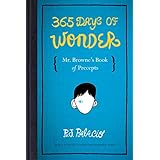
This is a very well written book, excellent idea e very inspirational. I recommend this book to the permanent library of any reader who wants to spend some quality time with a nice reading material. They will not be disappointed.
Subscribe to:
Posts (Atom)