Friday, August 1, 2014

Book "The Adventure of the Speckled Band" by Sir Arthur Conan Doyle

About the Book: "The Adventure of the Speckled Band" is one of the 56 short Sherlock Holmes stories written by Scottish author Sir Arthur Conan Doyle. It is the eighth of the twelve stories collected in The Adventures of Sherlock Holmes. It is one of four Sherlock Holmes stories that can be classified as a locked room mystery. The story was first published in Strand Magazine in February 1892, with illustrations by Sidney Paget. It was published under the different title "The Spotted Band" in New York World in August 1905. Doyle later revealed that he thought this was his best Holmes story.
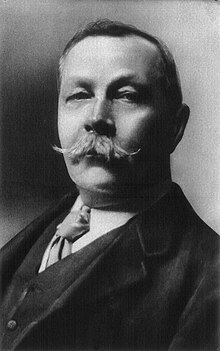
About the Author: Arthur Ignatius Conan Doyle was born on 22 May 1859 at 11 Picardy Place, Edinburgh, Scotland. From 1876 to 1881, he studied medicine at the University of Edinburgh, including a period working in the town of Aston (now a district of Birmingham) and in Sheffield, as well as in Shropshire at Ruyton-XI-Towns. While studying, Doyle began writing short stories. His earliest extant fiction, "The Haunted Grange of Goresthorpe", was unsuccessfully submitted to Blackwood's Magazine. His first published piece "The Mystery of Sasassa Valley", a story set in South Africa, was printed in Chambers's Edinburgh Journal on 6 September 1879. On 20 September 1879, he published his first non-fiction article, "Gelsemium as a Poison" in the British Medical Journal. In 1882 he joined former classmate George Turnavine Budd as his partner at a medical practice in Plymouth, but their relationship proved difficult, and Doyle soon left to set up an independent practice. Arriving in Portsmouth in June of that year with less than £10 (£900 today) to his name, he set up a medical practice at 1 Bush Villas in Elm Grove, Southsea. The practice was initially not very successful. While waiting for patients, Doyle again began writing stories and composed his first novels, The Mystery of Cloomber, not published until 1888, and the unfinished Narrative of John Smith, which would go unpublished until 2011. He amassed a portfolio of short stories including "The Captain of the Pole-Star" and "J. Habakuk Jephson's Statement", both inspired by Doyle's time at sea, the latter of which popularized the mystery of the Mary Celeste and added fictional details such as the perfect condition of the ship (which had actually taken on water by the time it was discovered) and its boats remaining on board (the one boat was in fact missing) that have come to dominate popular accounts of the incident. Doyle struggled to find a publisher for his work. His first significant piece, A Study in Scarlet, was taken by Ward Lock Co. on 20 November 1886, giving Doyle £25 for all rights to the story. The piece appeared later that year in the Beeton's Christmas Annual and received good reviews in The Scotsman and the Glasgow Herald. The story featured the first appearance of Watson and Sherlock Holmes, partially modeled after his former university teacher Joseph Bell. Doyle wrote to him, "It is most certainly to you that I owe Sherlock Holmes ... Round the center of deduction and inference and observation which I have heard you inculcate I have tried to build up a man." Robert Louis Stevenson was able, even in faraway Samoa, to recognize the strong similarity between Joseph Bell and Sherlock Holmes: "My compliments on your very ingenious and very interesting adventures of Sherlock Holmes. ... Can this be my old friend Joe Bell?" Other authors sometimes suggest additional influences—for instance, the famous Edgar Allan Poe character C. Auguste Dupin. A sequel to A Study in Scarlet was commissioned and The Sign of the Four appeared in Lippincott's Magazine in February 1890, under agreement with the Ward Lock company. Doyle felt grievously exploited by Ward Lock as an author new to the publishing world and he left them. Short stories featuring Sherlock Holmes were published in the Strand Magazine. Doyle first began to write for the 'Strand' from his home at 2 Upper Wimpole Street, now marked by a memorial plaque. In this period, however, Holmes was not his sole subject and in 1893, he collaborated with J.M. Barrie on the libretto of Jane Annie. Doyle was found clutching his chest in the hall of Windlesham Manor, his house in Crowborough, East Sussex, on 7 July 1930. He died of a heart attack at the age of 71. His last words were directed toward his wife: "You are wonderful." At the time of his death, there was some controversy concerning his burial place, as he was avowedly not a Christian, considering himself a Spiritualist. He was first buried on 11 July 1930 in Windlesham rose garden. He was later reinterred together with his wife in Minstead churchyard in the New Forest, Hampshire. Carved wooden tablets to his memory and to the memory of his wife are held privately and are inaccessible to the public. That inscription reads, "Blade straight / Steel true / Arthur Conan Doyle / Born May 22nd 1859 / Passed On 7th July 1930." The epitaph on his gravestone in the churchyard reads, in part: "Steel true/Blade straight/Arthur Conan Doyle/Knight/Patriot, Physician, and man of letters". Undershaw, the home near Hindhead, Haslemere, south of London, that Doyle had built and lived in between October 1897 and September 1907, was a hotel and restaurant from 1924 until 2004. It was then bought by a developer and stood empty while conservationists and Doyle fans fought to preserve it. In 2012 the High Court ruled that the redevelopment permission be quashed because proper procedure had not been followed. A statue honours Doyle at Crowborough Cross in Crowborough, where he lived for 23 years. There is also a statue of Sherlock Holmes in Picardy Place, Edinburgh, close to the house where Doyle was born.

My Review: Another magnificent story with a very elaborated plot: Holmes' client is Helen Stoner, a 32 year old spinster who lives with her stepfather: Dr. Grimesby Roylott of Stoke Moran. Dr Roylott is the last survivor of what was a wealthy but dissolute and violent tempered aristocratic Anglo-Saxon family of Surrey. After returning from India where he had a large medical practice and had served a jail sentence for killing his native Butler in a fit of rage, Roylott—a widower—settles with his two stepdaughters in the broken-down ancestral manor-all that is left of estates that had extended into Berkshire and Hampshire. The doctor becomes notorious for terrorizing the local village because of his quarrelsome personality and violent temper. Dr. Roylott has required Miss Stoner, who is engaged to be married, to move into a particular bedroom of his heavily mortgaged ancestral home in Stoke Moran. This room was the one in which two years before, Helen's twin sister Julia had died under mysterious and dramatic circumstances—uttering the last words "The band! The speckled band!"—just prior to her wedding. Helen is reluctant to sleep in the room because a number of things about the bedroom are mysterious and disturbing. Late at night, Helen hears low whistling sounds followed by a metallic clang. There is a strange bell cord over the bed but it does not appear to work any bell. The rope goes to a ventilator—an opening high in the wall of the room, close to the ceiling—which provides air circulation between Helen's room and an adjacent room of Dr Roylott in the crumbling mansion. In addition, Helen's bed is clamped to the floor; this piece of furniture can never be moved from its position. Stoner surmises that Julia might have been murdered by the gypsies who wear speckled handkerchiefs around their necks, in order to bring in a bit of cash. Dr. Roylott has rented spare rooms in Stoke Moran near them. A cheetah and a baboon also have the run of the property, for Dr. Roylott keeps exotic pets from India.
After Helen leaves, Dr. Roylott comes to visit Holmes, having traced his stepdaughter. He demands to know what Helen has said to Holmes, but Holmes refuses to say. Dr. Roylott bends an iron fireplace poker into a curve in an attempt to intimidate Holmes, but Holmes is unaffected as he attempts to make small talk during the encounter. After Roylott leaves, Holmes straightens the poker out again. Holmes research of the late wife's will finds that she had arranged for Roylott to receive an annuity which had been £ 1,100 GBP but now totals £ 750 GBP, with the provision that the daughters can each claim 1/3 of the annuity (£ 250 GBP) upon marriage. If both or even one daughter were to marry and claim the annuity due her, this would seriously pauperize Roylott financially-thus the doctor has motive for neither daughter to marry.
Having arranged for Helen to spend the night in another bedroom, Holmes and Watson sneak into her bedroom without Dr. Roylott's knowledge. Holmes says that he has already deduced the solution to the mystery, and the test of his theory turns out to be successful. They hear the whistle, and Holmes also sees what the bell cord is really for, although Watson does not. Julia's last words about a "speckled band" were in fact describing "a swamp adder, the deadliest snake in India". The adjacent room was occupied by Dr. Roylott and a safe containing the venomous snake, and the ventilator and bell cord were bridges for the snake to land on the bed. After the swamp adder bit Julia, he called off the snake with the whistling, which made the snake climb up through the bell cord, disappearing from the scene.
Now the swamp adder is sent again through the ventilator by Dr. Roylott to kill Julia's sister Helen. Holmes attacks the snake with a walking stick, sending it through the hole in the wall back toward its home in the physician's room. A shriek is heard, and the annoyed reptile is soon found to have injected its venom into the murderous physician. When Holmes and Watson enter the death scene, the swamp adder has wound its body around the head of its victim in triumph. Holmes replaces the reptile into the safe. A coroner's jury finds that Dr. Roylott came to his death due to indiscreet handling of a dangerous pet. Holmes grimly notes that he is indirectly responsible for Dr. Roylott's death, but that he is unlikely to feel much guilt over the chain of events that led to his departure from this world.
I recommend this book to any reader that is a lover of a good mystery and a Sherlock Holmes story.

If you read this review, feel free to leave a comment!


Thursday, July 31, 2014

Balance of July 2014

During the month of July, I reviewed the following:

Books:
- "Siege of Providence" by Michael Kaiser. Read my review.
- "Death by Didgeridoo" by Barbara Venkataraman. Read my review.
- "The Metal Black" by Gary Ballard. Read my review.
- "I'm Not Talking About You, of Course..." by Barbara Venkataraman. Read my review.
- "Way Out" by Arthur Thomas Morton. Read my review.
- "The Valley of Fear" by Sir Arthur Conan Doyle. Read my review.
- "Hook - Why Websites Fail to Make Money" by Andrew McDermott and Rachel McDermott. Read my review.
- "A Scandal in Bohemia" by Sir Arthur Conan Doyle. Read my review.
- "Gameland - Episode 2 - Failsafe" by Saul W.Tanpepper. Read my review.
- "The Red-Headed League" by Sir Arthur Conan Doyle. Read my review.
- "A March of Kings" by Morgan Rice. Read my review.
- "A Case of Identity" by Sir Arthur Conan Doyle. Read my review.
- "Dark Visions" by Jonas Saul. Read my review.
- "The Boscombe Valley Mystery" by Sir Arthur Conan Doyle. Read my review.
- "Gameland - Episode 3 - Deadman's Switch" by Saul W.Tanpepper. Read my review.
- "The Five Orange Pips" by Sir Arthur Conan Doyle. Read my review.
- "A Feast of Dragons" by Morgan Rice. Read my review.
- "The Man With The Twisted Lip" by Sir Arthur Conan Doyle. Read my review.


Wednesday, July 30, 2014

Book "The Man with The Twisted Lip" by Sir Arthur Conan Doyle

About the Book: "The Man with the Twisted Lip", one of the 56 short Sherlock Holmes stories written by British author Sir Arthur Conan Doyle, is the sixth of the twelve stories in The Adventures of Sherlock Holmes. The story was first published in the Strand Magazine in December 1891. Doyle ranked "The Man with the Twisted Lip" sixteenth in a list of his nineteen favourite Sherlock Holmes stories.

About the Author: Arthur Ignatius Conan Doyle was born on 22 May 1859 at 11 Picardy Place, Edinburgh, Scotland. From 1876 to 1881, he studied medicine at the University of Edinburgh, including a period working in the town of Aston (now a district of Birmingham) and in Sheffield, as well as in Shropshire at Ruyton-XI-Towns. While studying, Doyle began writing short stories. His earliest extant fiction, "The Haunted Grange of Goresthorpe", was unsuccessfully submitted to Blackwood's Magazine. His first published piece "The Mystery of Sasassa Valley", a story set in South Africa, was printed in Chambers's Edinburgh Journal on 6 September 1879. On 20 September 1879, he published his first non-fiction article, "Gelsemium as a Poison" in the British Medical Journal. In 1882 he joined former classmate George Turnavine Budd as his partner at a medical practice in Plymouth, but their relationship proved difficult, and Doyle soon left to set up an independent practice. Arriving in Portsmouth in June of that year with less than £10 (£900 today) to his name, he set up a medical practice at 1 Bush Villas in Elm Grove, Southsea. The practice was initially not very successful. While waiting for patients, Doyle again began writing stories and composed his first novels, The Mystery of Cloomber, not published until 1888, and the unfinished Narrative of John Smith, which would go unpublished until 2011. He amassed a portfolio of short stories including "The Captain of the Pole-Star" and "J. Habakuk Jephson's Statement", both inspired by Doyle's time at sea, the latter of which popularized the mystery of the Mary Celeste and added fictional details such as the perfect condition of the ship (which had actually taken on water by the time it was discovered) and its boats remaining on board (the one boat was in fact missing) that have come to dominate popular accounts of the incident. Doyle struggled to find a publisher for his work. His first significant piece, A Study in Scarlet, was taken by Ward Lock Co. on 20 November 1886, giving Doyle £25 for all rights to the story. The piece appeared later that year in the Beeton's Christmas Annual and received good reviews in The Scotsman and the Glasgow Herald. The story featured the first appearance of Watson and Sherlock Holmes, partially modeled after his former university teacher Joseph Bell. Doyle wrote to him, "It is most certainly to you that I owe Sherlock Holmes ... Round the center of deduction and inference and observation which I have heard you inculcate I have tried to build up a man." Robert Louis Stevenson was able, even in faraway Samoa, to recognize the strong similarity between Joseph Bell and Sherlock Holmes: "My compliments on your very ingenious and very interesting adventures of Sherlock Holmes. ... Can this be my old friend Joe Bell?" Other authors sometimes suggest additional influences—for instance, the famous Edgar Allan Poe character C. Auguste Dupin. A sequel to A Study in Scarlet was commissioned and The Sign of the Four appeared in Lippincott's Magazine in February 1890, under agreement with the Ward Lock company. Doyle felt grievously exploited by Ward Lock as an author new to the publishing world and he left them. Short stories featuring Sherlock Holmes were published in the Strand Magazine. Doyle first began to write for the 'Strand' from his home at 2 Upper Wimpole Street, now marked by a memorial plaque. In this period, however, Holmes was not his sole subject and in 1893, he collaborated with J.M. Barrie on the libretto of Jane Annie. Doyle was found clutching his chest in the hall of Windlesham Manor, his house in Crowborough, East Sussex, on 7 July 1930. He died of a heart attack at the age of 71. His last words were directed toward his wife: "You are wonderful." At the time of his death, there was some controversy concerning his burial place, as he was avowedly not a Christian, considering himself a Spiritualist. He was first buried on 11 July 1930 in Windlesham rose garden. He was later reinterred together with his wife in Minstead churchyard in the New Forest, Hampshire. Carved wooden tablets to his memory and to the memory of his wife are held privately and are inaccessible to the public. That inscription reads, "Blade straight / Steel true / Arthur Conan Doyle / Born May 22nd 1859 / Passed On 7th July 1930." The epitaph on his gravestone in the churchyard reads, in part: "Steel true/Blade straight/Arthur Conan Doyle/Knight/Patriot, Physician, and man of letters". Undershaw, the home near Hindhead, Haslemere, south of London, that Doyle had built and lived in between October 1897 and September 1907, was a hotel and restaurant from 1924 until 2004. It was then bought by a developer and stood empty while conservationists and Doyle fans fought to preserve it. In 2012 the High Court ruled that the redevelopment permission be quashed because proper procedure had not been followed. A statue honours Doyle at Crowborough Cross in Crowborough, where he lived for 23 years. There is also a statue of Sherlock Holmes in Picardy Place, Edinburgh, close to the house where Doyle was born.

My Review: Well written, another excellent plot on the Sherlock Holmes short story series: Dr Watson is called upon late at night by a female friend of his wife. Her husband has been absent for several days and, as he is an opium addict, she is sure he has been indulging in a lengthy drug binge in a dangerous East End opium den. Frantic with worry, she seeks Dr. Watson's help in fetching him home. Watson does this, but he also finds his friend Sherlock Holmes in the den, disguised as an old man, trying to extract information about a new case from the addicts in the den.
Mr. Neville St. Clair, a respectable and punctual country businessman, has disappeared. Making the matter even more mysterious is that Mrs. St. Clair is quite sure that she saw her husband at a second-floor window of the opium den, in Upper Swandam Lane, a rather rough part of town near the docks. He withdrew into the window immediately, and Mrs. St. Clair is quite sure that there was something very wrong.
Naturally, she tries to enter the building, but her way was blocked by the opium den's owner, a Lascar. She quickly fetches the police, but they cannot find Mr. St. Clair. The room, in whose window she saw her husband, is that of a dirty, disfigured beggar, well known to the police, by the name of Hugh Boone. The police are about to put this report down as a mistake of some kind when Mrs. St. Clair spots and identifies a box of wooden bricks that her husband said he would buy for their son. A further search turns up some of her husband's clothes. Later, his coat, with the pockets full of several pounds' worth of pennies and halfpennies, is found in the Thames just below the building.
The beggar is arrested and locked up at the police station, and Holmes initially is quite convinced that Mr. St. Clair has been the unfortunate victim of murder. However, several days after Mr. St. Clair's disappearance, his wife receives a letter in his own writing. The arrival of this letter forces Holmes to reconsider his conclusions, leading him eventually to an extraordinary solution. Taking a bath sponge to the police station in a Gladstone bag, Holmes washes Boone's still-dirty face, causing his face to be revealed — the face of Neville St. Clair! Upon Mr. St. Clair's immediate confession, this solves the mystery, and also creates a few problems.
It seems that Mr. St. Clair has been leading a double life, one of respectability, and the other as a beggar. In his youth, he had been an actor before becoming a newspaper reporter. In order to research an article, he had disguised himself as a beggar for a short time, during which he earned a very large amount of money. Later in his life, he returned to the street to beg for several days in order to pay a large debt. Given a choice between his newspaper salary and his high beggar earnings, he eventually became a professional beggar. His takings were large enough that he was able to establish himself as a country gentleman, marry well, and begin a respectable family. His wife never knew what he did for a living, and Holmes agrees to preserve Mr. St. Clair's secret as long as no more is heard of Hugh Boone.
I recommend this book to the permanent library of all readers who appreciate a good mystery story or enjoy Sherlock Holmes tales.

If you read this review, feel free to leave a message.

Tuesday, July 29, 2014

Book "A Feast of Dragons" by Morgan Rice

About the Book: A FATE OF DRAGONS takes us deeper into Thor’s epic journey to becoming a warrior, as he journeys across the Sea of Fire to the dragon’s Isle of Mist. An unforgiving place, home to the most elite warriors of the world, Thor’s powers and abilities deepen as he trains. His friendships deepen, too, as they face adversities together, beyond what they could imagine. But as they find themselves up against unimaginable monsters , The Hundred quickly goes from training session to a matter of life or death. Not all will survive.
Along the way, Thor’s dreams, along with his mysterious encounters with Argon, will continue to plague him, to press him to try to learn more about who he is, who his mother is, and what the source of his powers are. What is his destiny?
Back in the Ring, matters are getting much worse. As Kendrick is imprisoned, Gwendolyn finds it landing on her to try to save him, to save the Ring by bringing down her brother Gareth. She hunts for clues for her father’s murderer along with her brother Godfrey, and along the way, the two of them will become much closer, united in their cause. But Gwendolyn finds herself in mortal danger as she presses too deep, and she may be in over her head.
Gareth attempts to wield the Dynasty Sword and learns what it means to be King, becoming drunk with the abuse of power. He rules ruthlessly, becoming paranoid. As the noose tightens on the king’s assassin, the McClouds attack deeper into the Ring, and King’s Court finds itself in an increasingly precarious position.
Gwendolyn pines for Thor’s return, for them to be together, for their love to blossom. But with powerful forces in their way, it is questionable if that chance will ever come.
Will Thor survive The Hundred? Will King’s Court collapse? Will MacGil’s murderer be found? Will Gwendolyn end up with Thor? And will Thor finally learn the secret of his destiny?
With its sophisticated world-building and characterization, A FATE OF DRAGONS is an epic tale of friends and lovers, of rivals and suitors, of knights and dragons, of intrigues and political machinations, of coming of age, of broken hearts, of deception, ambition and betrayal. It is a tale of honor and courage, of fate and destiny, of sorcery. It is a fantasy that brings us into a world we will never forget, and which will appeal to all ages and genders. It is nearly 70,000 words.

About the Author: Morgan is author of the #1 Bestselling and USA Today Bestselling series THE SORCERER'S RING, an epic fantasy series comprising fourteen books (and counting). The newest title, AN OATH OF BROTHERS (#14) is now available! 
Morgan Rice is also author of the #1 Bestselling series THE VAMPIRE JOURNALS, comprising eleven books (and counting). The newest title, FATED (#11) is now available!
Morgan is also author of the #1 Bestselling ARENA ONE and ARENA TWO, the first two books in THE SURVIVAL TRILOGY, a post-apocalyptic action thriller set in the future.
Morgan's books are available in audio and print editions, and translations of the books are available in German, French, Italian, Spanish, Portuguese, Japanese, Chinese, Swedish, Dutch, Turkish, Hungarian, Czech and Slovak (with more languages forthcoming).
Morgan loves to hear from you, so please feel free to visit www.morganricebooks.com to join the email list, receive a free book, receive free giveaways, download the free app, get the latest exclusive news, connect on Facebook and Twitter, and stay in touch!

My Review: While I know I am repeating myself, this is another masterpiece from this author. In this third episode, our hero Thor goes for his training in a distant island, together with other members of his group. But that is not a regular trip. His training will last one hundred days, in an island full of dangerous places, with cyclops, dragons, and warriors from all over the places. And the trip to the island is an adventure on its own. But while he is at the island, things in the Ring deteriorate quickly and an invasion from the McCloud clan is imminent. Gwendolyn is joining forces with her brother Godfrey to find the real murderer of her father. They do not believe in the accusations their brother Gareth is planting against their other brother Kendrick. And Erec is trying to find a spouse far away from the kingdom, unaware of everything that is going on.
This episode brings a lot of action, but I strongly recommend you read the series from the beginning, so you fully understand the dynamic among the characters.
I recommend this book to the permanent library of all readers who love a well written story with a fascinating plot, that will keep you entertained for hours. 

 If you read this review, feel free to leave a comment.

Monday, July 28, 2014

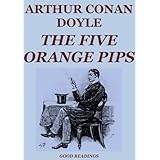
Book : "The Five Orange Pips" by Sir Arthur Conan Doyle

About the Book: "The Five Orange Pips", one of the 56 short Sherlock Holmes stories written by British author Sir Arthur Conan Doyle, is the fifth of the twelve stories in The Adventures of Sherlock Holmes.
The story was first published in The Strand magazine in November 1891. Conan Doyle later ranked the story seventh in a list of his twelve favorite Sherlock Holmes stories. This is also one of only two Sherlock Holmes short stories where Holmes' client dies after seeking his help. The other is The Dancing Men.

About the Author: Arthur Ignatius Conan Doyle was born on 22 May 1859 at 11 Picardy Place, Edinburgh, Scotland. From 1876 to 1881, he studied medicine at the University of Edinburgh, including a period working in the town of Aston (now a district of Birmingham) and in Sheffield, as well as in Shropshire at Ruyton-XI-Towns. While studying, Doyle began writing short stories. His earliest extant fiction, "The Haunted Grange of Goresthorpe", was unsuccessfully submitted to Blackwood's Magazine. His first published piece "The Mystery of Sasassa Valley", a story set in South Africa, was printed in Chambers's Edinburgh Journal on 6 September 1879. On 20 September 1879, he published his first non-fiction article, "Gelsemium as a Poison" in the British Medical Journal. In 1882 he joined former classmate George Turnavine Budd as his partner at a medical practice in Plymouth, but their relationship proved difficult, and Doyle soon left to set up an independent practice. Arriving in Portsmouth in June of that year with less than £10 (£900 today) to his name, he set up a medical practice at 1 Bush Villas in Elm Grove, Southsea. The practice was initially not very successful. While waiting for patients, Doyle again began writing stories and composed his first novels, The Mystery of Cloomber, not published until 1888, and the unfinished Narrative of John Smith, which would go unpublished until 2011. He amassed a portfolio of short stories including "The Captain of the Pole-Star" and "J. Habakuk Jephson's Statement", both inspired by Doyle's time at sea, the latter of which popularized the mystery of the Mary Celeste and added fictional details such as the perfect condition of the ship (which had actually taken on water by the time it was discovered) and its boats remaining on board (the one boat was in fact missing) that have come to dominate popular accounts of the incident. Doyle struggled to find a publisher for his work. His first significant piece, A Study in Scarlet, was taken by Ward Lock Co. on 20 November 1886, giving Doyle £25 for all rights to the story. The piece appeared later that year in the Beeton's Christmas Annual and received good reviews in The Scotsman and the Glasgow Herald. The story featured the first appearance of Watson and Sherlock Holmes, partially modeled after his former university teacher Joseph Bell. Doyle wrote to him, "It is most certainly to you that I owe Sherlock Holmes ... Round the center of deduction and inference and observation which I have heard you inculcate I have tried to build up a man." Robert Louis Stevenson was able, even in faraway Samoa, to recognize the strong similarity between Joseph Bell and Sherlock Holmes: "My compliments on your very ingenious and very interesting adventures of Sherlock Holmes. ... Can this be my old friend Joe Bell?" Other authors sometimes suggest additional influences—for instance, the famous Edgar Allan Poe character C. Auguste Dupin. A sequel to A Study in Scarlet was commissioned and The Sign of the Four appeared in Lippincott's Magazine in February 1890, under agreement with the Ward Lock company. Doyle felt grievously exploited by Ward Lock as an author new to the publishing world and he left them. Short stories featuring Sherlock Holmes were published in the Strand Magazine. Doyle first began to write for the 'Strand' from his home at 2 Upper Wimpole Street, now marked by a memorial plaque. In this period, however, Holmes was not his sole subject and in 1893, he collaborated with J.M. Barrie on the libretto of Jane Annie. Doyle was found clutching his chest in the hall of Windlesham Manor, his house in Crowborough, East Sussex, on 7 July 1930. He died of a heart attack at the age of 71. His last words were directed toward his wife: "You are wonderful." At the time of his death, there was some controversy concerning his burial place, as he was avowedly not a Christian, considering himself a Spiritualist. He was first buried on 11 July 1930 in Windlesham rose garden. He was later reinterred together with his wife in Minstead churchyard in the New Forest, Hampshire. Carved wooden tablets to his memory and to the memory of his wife are held privately and are inaccessible to the public. That inscription reads, "Blade straight / Steel true / Arthur Conan Doyle / Born May 22nd 1859 / Passed On 7th July 1930." The epitaph on his gravestone in the churchyard reads, in part: "Steel true/Blade straight/Arthur Conan Doyle/Knight/Patriot, Physician, and man of letters". Undershaw, the home near Hindhead, Haslemere, south of London, that Doyle had built and lived in between October 1897 and September 1907, was a hotel and restaurant from 1924 until 2004. It was then bought by a developer and stood empty while conservationists and Doyle fans fought to preserve it. In 2012 the High Court ruled that the redevelopment permission be quashed because proper procedure had not been followed. A statue honours Doyle at Crowborough Cross in Crowborough, where he lived for 23 years. There is also a statue of Sherlock Holmes in Picardy Place, Edinburgh, close to the house where Doyle was born.

Add caption
My Review: This is a very well written story with a very interesting and captivating plot: A young Sussex gentleman named John Openshaw has a strange story: in 1869 his uncle Elias Openshaw had suddenly come back to England to settle on an estate at Horsham, West Sussex after living for years in the United States as a planter in Florida and serving as a Colonel in the Confederate Army.
Not being married, Elias had allowed his nephew to stay at his estate. Strange incidents have occurred; one is that although John could go anywhere in the house he could never enter a locked room containing his uncle's trunks. Another peculiarity was that in March 1883 a letter postmarked Pondicherry, in India, arrived for the Colonel inscribed only "K.K.K." with five orange pips enclosed.
More strange things happened: Papers from the locked room were burnt and a will was drawn up leaving the estate to John Openshaw. The Colonel's behavior became bizarre. He would either lock himself in his room and drink or he would go shouting forth in a drunken sally with a pistol in his hand. On 2 May 1883 he was found dead in a garden pool.
On 4 January 1885 Elias's brother Joseph receives a letter postmarked Dundee with the initials "K.K.K" and instructions to leave "the papers" on the sundial. Despite his son's urging, Joseph Openshaw refuses to call the police. Three days later, Joseph Openshaw is found dead in a chalk-pit. The only clue John Openshaw can furnish Holmes is a page from his uncle's diary marked March 1869 in which orange pips have been sent to three men, of whom two flee and the third has been "visited".
Holmes advises Openshaw to leave the diary page with a note telling of the destruction of the Colonel's papers on the garden sundial. After Openshaw leaves, Holmes deduces from the time that has passed between the letter mailings and the deaths of Elias and his brother that the writer is on a sailing ship.
Holmes also recognizes the "K.K.K" as Ku Klux Klan, an anti-Reconstruction group in the South until its sudden collapse in March 1869 – and theorizes that this collapse was the result of the Colonel's maliciously taking their papers away to England.
The next day there is a newspaper account that the body of Openshaw has been found in the River Thames and the death is believed to be an accident. Holmes checks sailing records of ships who were at both Pondicherry in January/February 1883 and at Dundee in January 1885 and recognizes a Georgia sloop named The Lone Star. Lone Star may refer to the Lone Star State, Texas, although the boat is registered to Georgia. Furthermore Holmes confirms that The Lone Star had docked in London a week before. Holmes sends five orange pips to the captain of The Lone Star, and then sends a telegram to the Savannah police claiming that the captain and two mates are wanted for murder. The Lone Star never arrives in Savannah due to a severe gale. The only trace of the boat is a mast marked "L.S." sighted in the North Atlantic.
I recommend this book to any reader who appreciates mysteries and Sherlock Holmes in particular. You will not be disappointed.

Friday, July 25, 2014

Book "Gameland - Episode 3 - Deadman's Switch" by Saul W.Tanpepper

About the Book: 6 Hackers, 1 Game... and 10,000 Undead.
Everyone loves Survivalist, a live-action, virtual reality show based on Arc Entertainment's The Game, where cybernetically controlled zombies do battle in a video arcade in the middle of a Long Island wasteland. It's to die for.
If you're rich enough, you can buy your way in. If you're desperate enough, you can volunteer to become one of the Undead Players. Jessie Daniels and her gang of computer hackers plan to break their way in.
Welcome to GAMELAND. Access Restricted.

About the Author: Saul writes in several speculative fiction genres, including horror, cyberpunk, biopunk, and straight science fiction. A former Army medic and trauma specialist, he earned a PhD in molecular biology and genetics; his works are heavily informed by these past experiences.
Saul spent his formative years in a century-old house overlooking the Erie Canal in Upstate New York. He shared an attic room with all manner of creatures, not all, he is convinced, flesh and blood.
After several years spent overseas and working his way to executive positions in biotech, he returned to his true passion of storytelling.
He now writes full time from his home in the San Francisco Bay Area. He continues to be haunted by a variety of creatures, including a wife, kids, three dogs, three cats, twenty chickens, a wayward rooster, and one very grumpy possum. They are all flesh and blood.
Except for the possum, which he's sure is the reincarnated spirit of Jack Torrance.
Visit him at tanpepperwrites.com
Subscribe to be notified of new releases and exclusive deals at tinyletter.com/SWTanpepper

Add caption
My Review: This is a very well written book with a very intense story-line.  It is the sequel of "Failsafe", episode two of this series. This is supposed to be the third of an eight series book, so it does not stand by itself as a story. It starts where episode two ended and finishes with a hook to the next episode. The plot is interesting and will keep you reading on the edge of your chair for most of the book. The characters are well developed and the scenario is so richly described that you feel you are inside the story. In episode one we saw a group of game hackers deciding to break into Long Island's Gameland, a place where nobody lives, because of an outbreak that happened twelve years before. All population that survived the outbreak were evacuated. Now the only entities that inhabit that wasteland are the zombies. Their adventure starts with a poorly planed trip idea and tension escalates during preparation for the trip and execution of the trip. They soon figure out that it is easier to enter than to leave the Island... In episode two, after trying to leave the Island, Jake is trapped and left behind, so Jessie wants to return to rescue him. Kelly anticipates her move and goes alone for the rescue. Then the whole group unite again, trying to bring them home. It fails badly and the whole original group plus a new member (added by accident) are back in the Island and facing some more mysteries. In this third book, Steven is an employee from Arc, doing some experiments on our group with new drugs to create an improved version of zombie. But before they were injected, they manage to escape from La Guardia Airport and go in the direction of Gameland. When arriving there (after lots of incidents and twists in the story), they find out some answers to questions they had from Steven and they were not happy about what they discover.
This book was written by Saul W.Tanpepper in June 2012. I recommend this book to the permanent library of all thriller lovers, young adults or not. But be aware that you should read the previous episodes before reading this one, so you can understand what is going on and the interaction among the characters.

If you read my review, feel free to leave a comment!

Thursday, July 24, 2014

Book "The Boscombe Valley Mystery" by Sir Arthur Conan Doyle

About the Book: "The Boscombe Valley Mystery", one of the 56 short Sherlock Holmes stories written by British author, Sir Arthur Conan Doyle, is the fourth of the twelve stories in The Adventures of Sherlock Holmes. It was first published in the Strand Magazine in 1891.

About the Author: Arthur Ignatius Conan Doyle was born on 22 May 1859 at 11 Picardy Place, Edinburgh, Scotland. From 1876 to 1881, he studied medicine at the University of Edinburgh, including a period working in the town of Aston (now a district of Birmingham) and in Sheffield, as well as in Shropshire at Ruyton-XI-Towns. While studying, Doyle began writing short stories. His earliest extant fiction, "The Haunted Grange of Goresthorpe", was unsuccessfully submitted to Blackwood's Magazine. His first published piece "The Mystery of Sasassa Valley", a story set in South Africa, was printed in Chambers's Edinburgh Journal on 6 September 1879. On 20 September 1879, he published his first non-fiction article, "Gelsemium as a Poison" in the British Medical Journal. In 1882 he joined former classmate George Turnavine Budd as his partner at a medical practice in Plymouth, but their relationship proved difficult, and Doyle soon left to set up an independent practice. Arriving in Portsmouth in June of that year with less than £10 (£900 today) to his name, he set up a medical practice at 1 Bush Villas in Elm Grove, Southsea. The practice was initially not very successful. While waiting for patients, Doyle again began writing stories and composed his first novels, The Mystery of Cloomber, not published until 1888, and the unfinished Narrative of John Smith, which would go unpublished until 2011. He amassed a portfolio of short stories including "The Captain of the Pole-Star" and "J. Habakuk Jephson's Statement", both inspired by Doyle's time at sea, the latter of which popularized the mystery of the Mary Celeste and added fictional details such as the perfect condition of the ship (which had actually taken on water by the time it was discovered) and its boats remaining on board (the one boat was in fact missing) that have come to dominate popular accounts of the incident. Doyle struggled to find a publisher for his work. His first significant piece, A Study in Scarlet, was taken by Ward Lock Co. on 20 November 1886, giving Doyle £25 for all rights to the story. The piece appeared later that year in the Beeton's Christmas Annual and received good reviews in The Scotsman and the Glasgow Herald. The story featured the first appearance of Watson and Sherlock Holmes, partially modeled after his former university teacher Joseph Bell. Doyle wrote to him, "It is most certainly to you that I owe Sherlock Holmes ... Round the center of deduction and inference and observation which I have heard you inculcate I have tried to build up a man." Robert Louis Stevenson was able, even in faraway Samoa, to recognize the strong similarity between Joseph Bell and Sherlock Holmes: "My compliments on your very ingenious and very interesting adventures of Sherlock Holmes. ... Can this be my old friend Joe Bell?" Other authors sometimes suggest additional influences—for instance, the famous Edgar Allan Poe character C. Auguste Dupin. A sequel to A Study in Scarlet was commissioned and The Sign of the Four appeared in Lippincott's Magazine in February 1890, under agreement with the Ward Lock company. Doyle felt grievously exploited by Ward Lock as an author new to the publishing world and he left them. Short stories featuring Sherlock Holmes were published in the Strand Magazine. Doyle first began to write for the 'Strand' from his home at 2 Upper Wimpole Street, now marked by a memorial plaque. In this period, however, Holmes was not his sole subject and in 1893, he collaborated with J.M. Barrie on the libretto of Jane Annie. Doyle was found clutching his chest in the hall of Windlesham Manor, his house in Crowborough, East Sussex, on 7 July 1930. He died of a heart attack at the age of 71. His last words were directed toward his wife: "You are wonderful." At the time of his death, there was some controversy concerning his burial place, as he was avowedly not a Christian, considering himself a Spiritualist. He was first buried on 11 July 1930 in Windlesham rose garden. He was later reinterred together with his wife in Minstead churchyard in the New Forest, Hampshire. Carved wooden tablets to his memory and to the memory of his wife are held privately and are inaccessible to the public. That inscription reads, "Blade straight / Steel true / Arthur Conan Doyle / Born May 22nd 1859 / Passed On 7th July 1930." The epitaph on his gravestone in the churchyard reads, in part: "Steel true/Blade straight/Arthur Conan Doyle/Knight/Patriot, Physician, and man of letters". Undershaw, the home near Hindhead, Haslemere, south of London, that Doyle had built and lived in between October 1897 and September 1907, was a hotel and restaurant from 1924 until 2004. It was then bought by a developer and stood empty while conservationists and Doyle fans fought to preserve it. In 2012 the High Court ruled that the redevelopment permission be quashed because proper procedure had not been followed. A statue honours Doyle at Crowborough Cross in Crowborough, where he lived for 23 years. There is also a statue of Sherlock Holmes in Picardy Place, Edinburgh, close to the house where Doyle was born.

My Review: Although a short story, the plot is sufficiently complex and entertaining:
Lestrade, a Scotland Yard detective,  summons Holmes to a community in Herefordshire, where a local landowner has been murdered outdoors. The deceased's estranged son is strongly implicated. Holmes quickly determines that a mysterious third man may be responsible for the crime, unraveling a thread involving a secret criminal past, thwarted love, and blackmail.
Sherlock Holmes and Dr. Watson take a train to Boscombe Valley, in Herefordshire. En route, Holmes reads the news and briefs Watson on their new case.
Mr. John Turner, a widower and a major landowner who has a daughter named Alice, lives there with a fellow expatriate from Australia, Mr. Charles McCarthy, a widower who has a son named James. Charles has been found dead near Boscombe Pool. It was reported that he was there to meet someone. Two witnesses testify that they saw Charles walking into the woods followed by James, who was bearing a gun. Patience Moran, daughter of a lodge keeper, says she saw Charles and James arguing and, when James raised his hand as if to hit his father, she ran to her mother. While telling her mother what she saw, James rushed to their house seeking help. The Morans followed James back to the Pool, where they found his father dead. James was arrested and charged with murder. Alice Turner believes James is innocent and has contacted Lestrade, a Scotland Yard detective who in turn has asked Holmes’ help.
James confirms the testimonies of the witnesses, but explains that he went to the woods to hunt, not to follow his father. He later heard his father calling "Cooee", and he found his father standing by the pool, surprised to see him. They argued heatedly, and James decided to return to Hatherley Farm. Shortly thereafter, he heard his father cry out, and returned to find his father lying on the ground. James insists that he tried to help him, but his father died in his arms. James refuses to reveal the cause of their argument, despite the coroner's warning that it could be damaging to his case. James also remembers his father’s last words were something about "a rat", but James is uncertain of the meaning. He also saw a cloak nearby that was gone when he returned later.
Alice meets Holmes, Watson and Lestrade in the hotel; she hopes Holmes has found a way to prove James' innocence. She also believes that she was the subject of the argument between James and his father, for Alice had asked James to marry her but James refused. Alice's father was also against the union. Holmes asks Alice if he could meet her father, but she says his health worsened after the death of Charles, whom he had known since they were in Victoria. Holmes decides to see James.
Holmes mistakenly surmises that James knows who killed his father and is only protecting someone. Alice is right about the cause of the argument between James and Charles. What she does not know is that James loves her and wants to marry her, but could not because he had already married a barmaid before Alice returned from boarding school. This burdens him, but he cannot tell his father about his marriage because he would be thrown out of the house and left unable to support himself. To James’ consolation, when his wife hears of his troubles, she confesses she was already married before they met, and therefore their marriage is invalid.
Holmes, Watson and Lestrade go to Hatherly Farm and examine Charles' and James' boots. They then head to Boscombe Pool, following the track from the courtyard. After examining the ground, Holmes finds evidence of the presence of another man besides Charles and James, whom he believes to be the murderer. The stranger is a tall, limping, left-handed man who smokes cigars (Watson having helped Holmes deduce the killer's left-handed nature because the victim was struck neatly on the left side of the head from behind where a right-handed man would have struck him on the other side). Lestrade is not convinced.
At the hotel, Holmes explains to Watson that "Cooee" is an Australian cry and "a rat", overheard by James, were the last syllables of "Ballarat", a place in Australia. So the person Charles was meeting is someone he knew from Australia. John comes to their room (entering with Holmes' predicted limp) and, realising that Holmes has deduced the crime, confesses.
In his confession, John explains that he was a member of the Ballarat Gang, a group of bushrangers in Australia. They robbed a gold convoy in which Charles was the wagon driver, and John spared his life despite knowing that Charles could identify him. The loot made the gang rich, and they moved to England. Resolved to change, John parted ways with his friends. He bought land, married, and then Alice was born. John met Charles again by chance, and Charles threatened to blackmail him. In response John gave Charles Hatherly Farm and money. Eventually this was not enough, and Charles demanded the marriage of James and Alice. Although he likes James, John could not allow Charles eventual control over his family's finances through Alice, and resisted the union. After much pressure, John agreed to meet Charles secretly at the Pool. Seeing Charles and James there arguing, John waited till James left. Then he killed Charles to preserve his freedom and spare his daughter. James heard his father's death cry and returned, but John was able to hide in the woods. He had to return later to retrieve a cloak that he dropped in his haste.
John signs his statement, and Holmes vows to keep it secret unless needed to free James.
Holmes' objections are sufficient to acquit James. John passes away seven months after the meeting with Holmes and Watson. James and Alice marry, without knowing the mysterious past of their fathers.
Very entertaining and well written story, I recommend this book to any reader who appreciates mystery and Sherlock Holmes adventures. You will not be disappointed.

If you read my review, feel free to leave a comment!
Wednesday, July 23, 2014

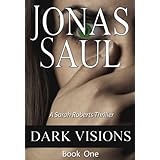
Book "Dark Visions" by Jonas Saul

About the Book: Dark Visions (Sarah Roberts Book One)
Eighteen-year-old Sarah Roberts experiences blackouts from which she wakes to notes written by her own hand. Prophecies. Dark Visions. Future events with dire consequences only she can avert.
Sarah is an Automatic Writer who suffers from a rare obsessive-compulsive disorder called trichotillomania.
She receives a message that details a kidnapping and what she can do to stop it. She has averted kidnappings before. The notes are quite specific. She's convinced it won't be that hard. But things go wrong when the kidnappers spot her. People are killed. Witnesses place Sarah at the scene. The police find her notebook riddled with prophecies of accidents and crimes, and they want answers.
Sarah is in a fight for her life with no one to trust and a kidnapping ring who only want to find out how she knows so much about them. The police are hunting her for very different reasons and her parents think she's at a sleepover.

About the Author: Meet Jonas Saul, an international bestselling thriller author.
"I have read a lot of Koontz, Patterson, Connelly, Coben ... they were starting to blend together ... in my opinion, Jonas Saul is my favorite author out there." -Reviewer
Jonas Saul is from Toronto, Canada. He lives in Leavenworth, Washington. He is always writing the next novel.
The Sarah Roberts Series are his best selling novels with the highest reviews. The Mafia Trilogy is fast becoming the next series to rival Sarah Roberts.
Jonas Saul's published novels include:
The Sarah Roberts Series:
1. Dark Visions
2. The Warning
3. The Crypt
4. The Hostage (*Featuring Drake Bellamy from The Threat)
5. The Victim (*Featuring Aaron Stevens from The Specter)
6. The Enigma
7. The Vigilante (*Featuring Aaron Stevens from The Specter)
8. The Rogue (*Featuring Darwin and Rosina Kostas from The Mafia Trilogy in a cameo appearance)
9. Killing Sarah
10. The Antagonist
11. The Redeemed
12. The Haunted (Coming Soon)
13. The Unlucky (Coming Soon)

The Mafia Trilogy (Starring Darwin and Rosina Kostas)
1. The Kill
2. The Blade
3. The Scythe

Standalone Novels
1. The Threat (Starring Drake Bellamy)
2. The Specter (Starring Aaron Stevens)
3. A Murder in Time (Starring Marcus Johnson)

3-Pack Compilations
Sarah Roberts Series Vol. 1-3
Sarah Roberts Series Vol. 4-6
Sarah Roberts Series Vol. 7-9
Sarah Roberts Series Vol. 10-12 (Coming Soon)
The Mafia Trilogy
The Jonas Saul Thriller Trilogy (The Threat, The Specter, A Murder in Time)
Jonas Saul was born in the small city of Oshawa, Ontario, just outside Toronto. He grew up reading Stephen King, Dean Koontz, and John Saul. Jonas wrote his first short story when he was ten-years old and went on to win Writer's Digest Short Story awards for his writing.
"I have been an avid reader for many years. Read everything from King to Koontz to Sandford to Patterson and Connelly. Now I have stumbled upon Jonas Saul. Do yourself a favor this year ... start reading this author and the wonderful novels he has to share ... Jonas Saul will be at the top of your MUST READ AUTHORS list." -Richard Huxley, author of The Cleansing.
Sign up at Jonas Saul's website for newsletters and updates;
Website: www.jonassaul.com
Twitter: @jonassaul
Email: jonassaul@icloud.com

My Review: This is a well written book with an intense plot that will keep you seating on the edge of your chair for most of the book. The characters are well defined and the environment richly described, making you feel the story as if you were there, cheering for Sarah. 
Sarah is a young lady who writes mysterious messages during black-outs, warning about bad things to happen in the future, and she works alone to prevent those things to happen, without the knowledge even of her parents. But after preventing one kidnapping from happening, she was spotted by the kidnappers on a second try six months later. When the kidnappers saw her at the place where they should get their victim, they aborted their original plan and took her instead. The drama develops in a fast pace and the twists in the story will keep you hooked until you turn the last page.
I recommend this book to the permanent library of all readers who appreciate a nice thriller/suspense story with psychic touches.

If you read this review, feel free to leave a comment!
Tuesday, July 22, 2014

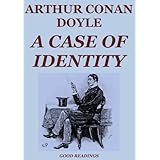
Book "A Case of Identity" by Sir Arthur Conan Doyle

About the Book: "A Case of Identity" is one of the 56 short Sherlock Holmes stories written by Sir Arthur Conan Doyle and is the third story in The Adventures of Sherlock Holmes.

About the Author: Arthur Ignatius Conan Doyle was born on 22 May 1859 at 11 Picardy Place, Edinburgh, Scotland. From 1876 to 1881, he studied medicine at the University of Edinburgh, including a period working in the town of Aston (now a district of Birmingham) and in Sheffield, as well as in Shropshire at Ruyton-XI-Towns. While studying, Doyle began writing short stories. His earliest extant fiction, "The Haunted Grange of Goresthorpe", was unsuccessfully submitted to Blackwood's Magazine. His first published piece "The Mystery of Sasassa Valley", a story set in South Africa, was printed in Chambers's Edinburgh Journal on 6 September 1879. On 20 September 1879, he published his first non-fiction article, "Gelsemium as a Poison" in the British Medical Journal. In 1882 he joined former classmate George Turnavine Budd as his partner at a medical practice in Plymouth, but their relationship proved difficult, and Doyle soon left to set up an independent practice. Arriving in Portsmouth in June of that year with less than £10 (£900 today) to his name, he set up a medical practice at 1 Bush Villas in Elm Grove, Southsea. The practice was initially not very successful. While waiting for patients, Doyle again began writing stories and composed his first novels, The Mystery of Cloomber, not published until 1888, and the unfinished Narrative of John Smith, which would go unpublished until 2011. He amassed a portfolio of short stories including "The Captain of the Pole-Star" and "J. Habakuk Jephson's Statement", both inspired by Doyle's time at sea, the latter of which popularized the mystery of the Mary Celeste and added fictional details such as the perfect condition of the ship (which had actually taken on water by the time it was discovered) and its boats remaining on board (the one boat was in fact missing) that have come to dominate popular accounts of the incident. Doyle struggled to find a publisher for his work. His first significant piece, A Study in Scarlet, was taken by Ward Lock Co. on 20 November 1886, giving Doyle £25 for all rights to the story. The piece appeared later that year in the Beeton's Christmas Annual and received good reviews in The Scotsman and the Glasgow Herald. The story featured the first appearance of Watson and Sherlock Holmes, partially modeled after his former university teacher Joseph Bell. Doyle wrote to him, "It is most certainly to you that I owe Sherlock Holmes ... Round the center of deduction and inference and observation which I have heard you inculcate I have tried to build up a man." Robert Louis Stevenson was able, even in faraway Samoa, to recognize the strong similarity between Joseph Bell and Sherlock Holmes: "My compliments on your very ingenious and very interesting adventures of Sherlock Holmes. ... Can this be my old friend Joe Bell?" Other authors sometimes suggest additional influences—for instance, the famous Edgar Allan Poe character C. Auguste Dupin. A sequel to A Study in Scarlet was commissioned and The Sign of the Four appeared in Lippincott's Magazine in February 1890, under agreement with the Ward Lock company. Doyle felt grievously exploited by Ward Lock as an author new to the publishing world and he left them. Short stories featuring Sherlock Holmes were published in the Strand Magazine. Doyle first began to write for the 'Strand' from his home at 2 Upper Wimpole Street, now marked by a memorial plaque. In this period, however, Holmes was not his sole subject and in 1893, he collaborated with J.M. Barrie on the libretto of Jane Annie. Doyle was found clutching his chest in the hall of Windlesham Manor, his house in Crowborough, East Sussex, on 7 July 1930. He died of a heart attack at the age of 71. His last words were directed toward his wife: "You are wonderful." At the time of his death, there was some controversy concerning his burial place, as he was avowedly not a Christian, considering himself a Spiritualist. He was first buried on 11 July 1930 in Windlesham rose garden. He was later reinterred together with his wife in Minstead churchyard in the New Forest, Hampshire. Carved wooden tablets to his memory and to the memory of his wife are held privately and are inaccessible to the public. That inscription reads, "Blade straight / Steel true / Arthur Conan Doyle / Born May 22nd 1859 / Passed On 7th July 1930." The epitaph on his gravestone in the churchyard reads, in part: "Steel true/Blade straight/Arthur Conan Doyle/Knight/Patriot, Physician, and man of letters". Undershaw, the home near Hindhead, Haslemere, south of London, that Doyle had built and lived in between October 1897 and September 1907, was a hotel and restaurant from 1924 until 2004. It was then bought by a developer and stood empty while conservationists and Doyle fans fought to preserve it. In 2012 the High Court ruled that the redevelopment permission be quashed because proper procedure had not been followed. A statue honours Doyle at Crowborough Cross in Crowborough, where he lived for 23 years. There is also a statue of Sherlock Holmes in Picardy Place, Edinburgh, close to the house where Doyle was born.

My Review: This is not among my favorites in the short stories from Sherlock Holmes series, but it is not completely bad. The story revolves around the case of Miss Mary Sutherland, a woman with a substantial income from the interest on a fund set up for her, which she will get full control upon her marriage. She is engaged to a quiet Londoner who has recently disappeared. Sherlock Holmes's detective powers are barely challenged as this turns out to be quite an elementary case for him, much as it puzzles Watson.
The fiancé, Mr. Hosmer Angel, is a curious character, rather quiet, and rather secretive about his life. Miss Sutherland only knows that he works in an office in Leadenhall Street, but nothing more specific than that. All his letters to her are typewritten, even the signature, and he insists that she write back to him through the local Post Office.
The climax of the sad liaison comes when Mr. Angel abandons Miss Sutherland at the altar on their wedding day.
Holmes, noting all these things, Hosmer Angel's description, and the fact that he only seems to meet with Miss Sutherland while her disapproving youngish stepfather, James Windibank, is out of the country on business, reaches a conclusion quite quickly. A typewritten letter confirms his belief beyond doubt. Only one person could have gained by this: Mr. James Windibank. Holmes deduces "Angel" had "disappeared" by simply going out the other side of a four-wheeler cab.
After solving the mystery, Holmes chooses not to tell his client the solution, since "If I tell her she will not believe me. You may remember the old Persian saying, 'There is danger for him who taketh the tiger cub, and danger also for whoso snatches a delusion from a woman.' There is as much sense in Hafiz as in Horace, and as much knowledge of the world." In this, however, he can be accused of not fulfilling his professional duty for which he was paid – namely, to investigate the matter to which she set him, provide her with the results and let her decide what to do with them. Holmes does advise his client to forget "Mr. Angel"; Miss Sutherland refuses to take Holmes' advice and vows to remain faithful to "Angel" until he reappears – for at least ten years.
Holmes predicts Windibank will continue a career in crime and end up on the gallows.
As this is a short story, you should be done reading it in less than a couple of hours.

If you read this review, feel free to leave a message.

Monday, July 21, 2014

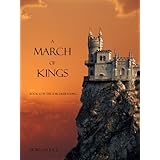
Book "A March of Kings" by Morgan Rice

About the Book: A MARCH OF KINGS takes us one step further on Thor’s epic journey into manhood, as he begins to realize more about who he is, what his powers are, and as he embarks to become a warrior.
After he escapes from the dungeon, Thor is horrified to learn of another assassination attempt on King MacGil. When MacGil dies, the kingdom is set into turmoil. As everyone vies for the throne, King’s Court is more rife than ever with its family dramas, power struggles, ambitions, jealousy, violence and betrayal. An heir must be chosen from among the children, and the ancient Dynasty Sword, the source of all their power, will have a chance to be wielded by someone new. But all this might be upended: the murder weapon is recovered, and the noose tightens on finding the assassin. Simultaneously, the MacGils face a new threat by the McClouds, who are set to attack again from within the Ring.
Thor fights to win back Gwendolyn’s love, but there may not be time: he is told to pack up, to prepare with his brothers in arms for The Hundred, a hundred grueling days of hell that all Legion members must survive. The Legion will have to cross the Canyon, beyond the protection of the Ring, into the Wilds, and set sail across the Tartuvian Sea for the Isle of Mist, said to be patrolled by a dragon, for their initiation into manhood.
Will they make it back? Will the Ring survive in their absence? And will Thor finally learn the secret of his destiny?
With its sophisticated world-building and characterization, A MARCH OF KINGS is an epic tale of friends and lovers, of rivals and suitors, of knights and dragons, of intrigues and political machinations, of coming of age, of broken hearts, of deception, ambition and betrayal. It is a tale of honor and courage, of fate and destiny, of sorcery. It is a fantasy that brings us into a world we will never forget, and which will appeal to all ages and genders. It is 60,000 words.

About the Author: Morgan is author of the #1 Bestselling and USA Today Bestselling series THE SORCERER'S RING, an epic fantasy series comprising fourteen books (and counting). The newest title, AN OATH OF BROTHERS (#14) is now available! Book #1 in the series, A QUEST OF HEROES, is available as a FREE download!
Morgan Rice is also author of the #1 Bestselling series THE VAMPIRE JOURNALS, comprising eleven books (and counting). The newest title, FATED (#11) is now available! Book #1 in the series, TURNED, is available as a FREE download!
Morgan is also author of the #1 Bestselling ARENA ONE and ARENA TWO, the first two books in THE SURVIVAL TRILOGY, a post-apocalyptic action thriller set in the future. Book #1 in the series, ARENA ONE, is available as a FREE download!
Morgan's books are available in audio and print editions, and translations of the books are available in German, French, Italian, Spanish, Portuguese, Japanese, Chinese, Swedish, Dutch, Turkish, Hungarian, Czech and Slovak (with more languages forthcoming).
Morgan loves to hear from you, so please feel free to visit www.morganricebooks.com to join the email list, receive a free book, receive free giveaways, download the free app, get the latest exclusive news, connect on Facebook and Twitter, and stay in touch!

My Review: When you thought that the story could not get better, the author delivers an amazing sequence that will keep you entertained and wishing for more! In this second episode, our hero Thor escape from the dungeons where he was held captive under the charge of attempting to assassinate the king. But the king suffered another assassination attempt when Thor was captive and this time he is dying on his bed and Thor is proclaimed innocent by the king himself. But his adventures have just began for a second time. He needs to conquer again the heart of Gwendolyn while he continues with his training to become a member of the Silver, the elite guard of the palace. His time is short, as all the soldiers and trainees are about to leave to The Hundred, a period of hundred days of training that is done in a far away island under some challenging environment. While Thor continues his preparation to leave, the new king is crowned and some other threatens appears to disturb what was once a calm period for the kingdom.
I recommend this book to the permanent library of all readers who love a well written story with a fascinating plot, that will keep you entertained for hours.

If you read this review, feel free to leave a comment.